We know air pollution is linked to heart disease, strokes, lung problems, and death. But scientists have long wondered how tiny pollution particles travel from the lungs to the rest of the body.
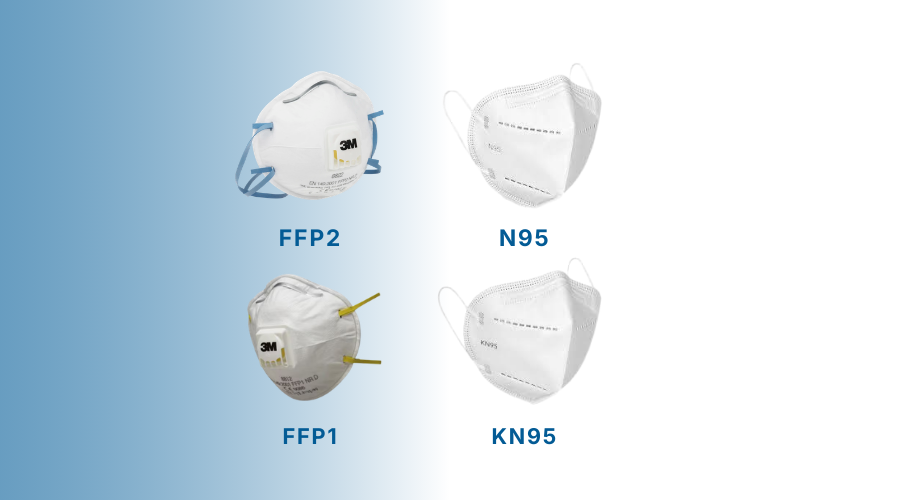
A new study offers an interesting clue. Researchers found evidence that pollution particles from traffic can enter the bloodstream and attach to red blood cells. They also found that people wearing FFP2 masks (which are essentially Europe’s version of N95s in the US) had far fewer of these particles on their blood cells after being exposed to traffic pollution.

Pollution Particles on Red Blood Cells
To figure out how this worked, researchers recruited 12 healthy adults in London. The researchers asked them to spend several hours indoors as a baseline and then stand next to a busy road for one hour. Next to the road, the air had nearly eight times as much black carbon as indoor air. Black carbon is soot, which comes from burning things like diesel and coal. Researchers often use black carbon as a marker of traffic pollution.
The researchers collected blood samples before and after they stood next to the road. Then they examined 3,000 red blood cells from each volunteer.
After spending an hour near traffic, participants had two to three times more pollution particles attached to their red blood cells. They still had particles stuck to their blood cells an hour after they left the roadside, when the study ended.
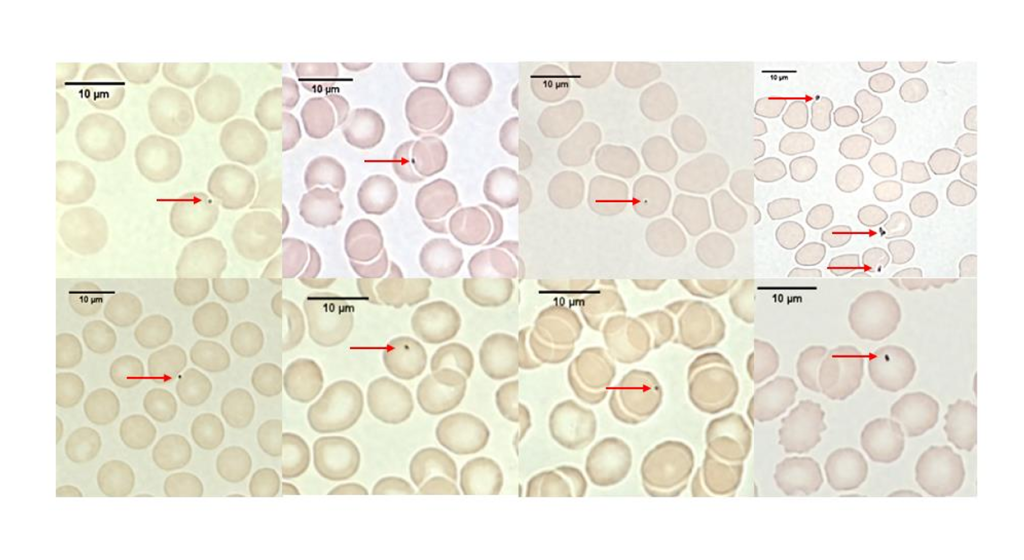
Light microscopy images of pollution particles stuck to red blood cells.
That may not sound like much, but we have 20–30 trillion red blood cells in our bodies, which means tens of millions of red blood cells could be carrying pollution particles through our bloodstream.
Think of red blood cells as tiny delivery vehicles. Pollution particles hitchhike on red blood cells, and they may be able to travel throughout the body after being inhaled.
What Happened When People Wore Masks?
To test the idea, eight volunteers repeated the experiment while wearing an FFP2 mask.
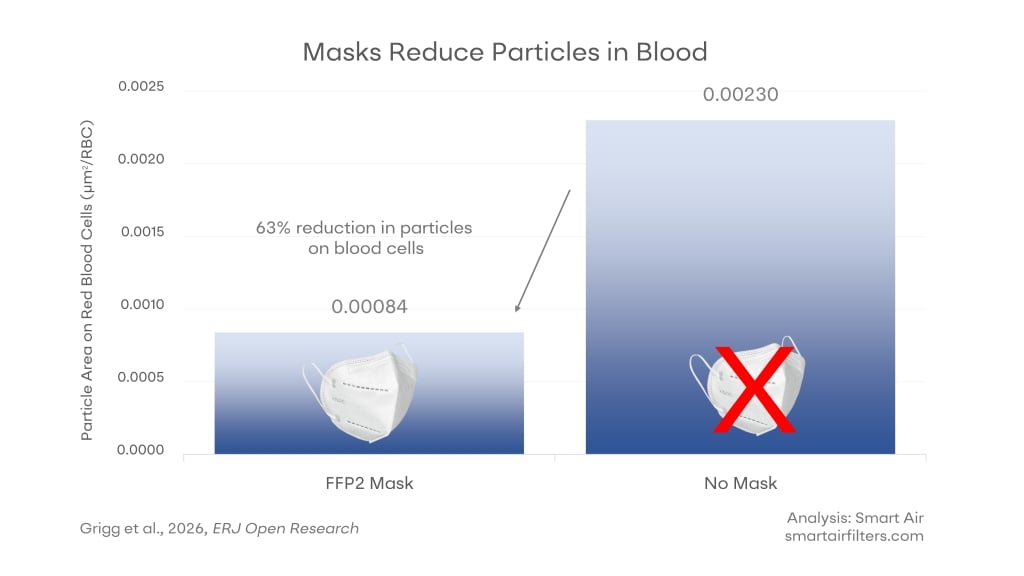
The masks helped. The amount of pollution particle material attached to red blood cells was about 63% lower when participants wore the mask.
In other words, people wearing masks had roughly one-third as much particle material detected on their blood cells after spending time near traffic.
What’s in These Particles?
To confirm their findings, the researchers also exposed human blood cells and mice to diesel exhaust particles in the lab. In both cases, the particles readily attached to red blood cells.
The team analyzed some of the particles found on volunteers’ blood cells and detected metals, including iron, copper, silicon, chromium, and zinc. These metals come from things like car brakes (which have lots of iron), exhaust (which has copper and zinc), and tires (which have silicon).
Free Guide to Breathing Safe
Want to learn more about breathing clean air? Join thousands more and stay up to date on protecting your health.