Offices and the workplace can be breeding grounds for viruses such as COVID-19. In poorly ventilated spaces, not only do we experience dizziness and headaches, but it also increases the risk of allergies and virus transmission. This article will provide data demonstrating that enhancing office ventilation and airflow can help reduce the spread of viruses such as the coronavirus in the workplace.
What Health Problem Will You Experience in Poorly Ventilated Spaces?
In a poorly ventilated space, you may experience symptoms such as shortness of breath, fatigue, dizziness, headaches, irritation of the eyes, nose, or throat, respiratory issues, increased allergies, and foul odors.

How Office Ventilation Affects Disease and Virus Transmission
There’s little evidence directly linking good ventilation with lower virus transmission. However, there’s a huge amount of data linking bad ventilation with higher virus transmission rates. The WHO has compiled a list of over 65 studies which show this phenomenon.
In this list is a study undertaken in a NY elementary school in 1970s. In the study, scientists modelled an outbreak of measles in a the school. The measles were introduced by a second-grader, and subsequently spread to over 60 other pupils within the course of a month.

They collected data including room ventilation rates, time spent in each room, and amount of virus in the air was collected. They used this to model the probability that each student would capture measles based on various factors. The scientists called this the Wells-Riley Equation. While not perfect, this equation can be used to show how ventilation affects the probability of catching a virus.
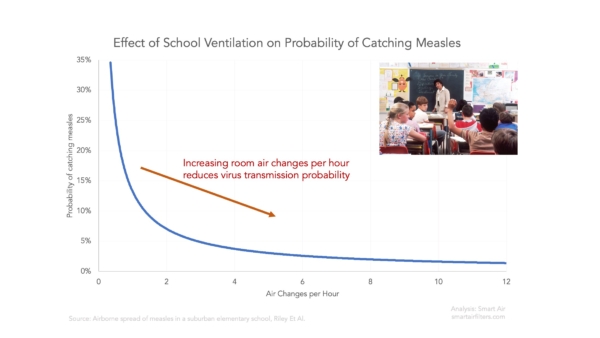
The Wells-Riley model shows clearly how increasing room ventilation reduces the chance of virus transmission. This, in a nutshell, is what’s important.
In the US, ASHARE recommends a minimum of 0.35 air changes per hour (ACH) for a typical home. This model shows how increasing a room’s ventilation from 0.35 ACH to 1 ACH can more than halve the probability of virus transmission. That’s huge.
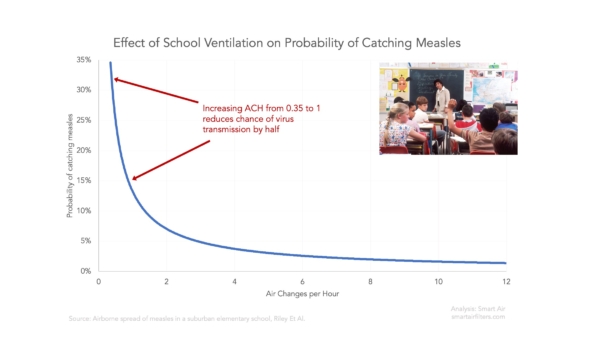
Isn’t a 30% Chance of Virus Transmission a bit too High?
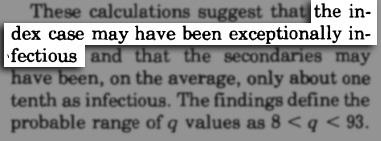
Some beady-eyed readers may think that a 30% probability of capturing the virus for low ventilation levels sounds very high. The scientists who created the Wells-Riley equation noticed this too. They explained how their first model was based on the initial sick person, who may have been very infectious:
They used subsequent cases to adjust the model, leading to much lower probabilities of virus transmission:
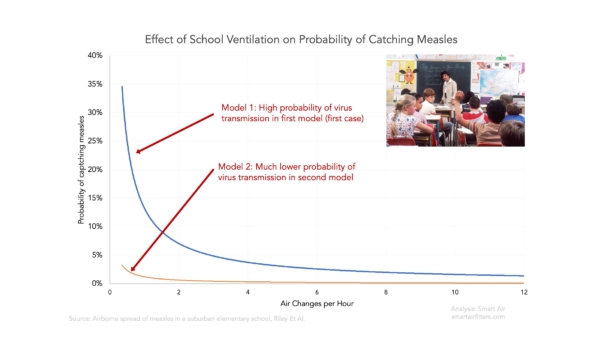
Despite chance of virus transmission dropping in the 2nd model, the chance in virus transmission with ventilation is the same. Re-scaling the 2nd model above shows this clearly:

It’s clear that increasing the ventilation from 0.35ACH to 1ACH can almost halve the probability of virus transmission.
Caveat 1: This model is based on only a single outbreak of measles in the 70s. Although widely used, the Wells-Riley equation can only be used as an approximation.
Caveat 2: COVID-19 has been shown to be both droplet-transmitted and airborne-transmitted. The data above covers just airborne-transmission, and doesn’t show how improving ventilation can lower the transmission of droplet-transmitted viruses.
Free Guide to Breathing Safe
Want to learn more about breathing clean air? Join thousands more and stay up to date on protecting your health.