
After I published directions for how to make your own purifier, people asked me: “Which HEPAs should I use? Is this one trustworthy?”
That’s the type of question that makes a nerd like me happy because it means we need to get more data. So I ordered HEPAs from every manufacturer I could find, and I tested them all. After all the testing was done, I found I could ship the HEPAs that worked best for 80 RMB, which was cheaper than the 110 RMB HEPAs I was buying–quality and price!
Can HEPAs be even Cheaper?
Later I found HEPAs for 20 RMB wholesale. I was excited. If HEPAs are that cheap, we can make the DIY even cheaper!
But the test data was terrible. These HEPAs weren’t anywhere close to getting 99% of particles, so I passed on them. If didn’t want to use it in my home, why would I want to ship them to other people?
A 99.97% HEPA for 30 RMB?
Thus I wasn’t surprised a couple weeks ago when I saw a store on Taobao selling HEPAs for 30 RMB and claiming that my HEPAs are 暴利 (aggressively overpriced). They claim that their HEPAs get 99.97% of particles, and if that’s true, maybe these were the holy grail of HEPAs I was looking for all along!
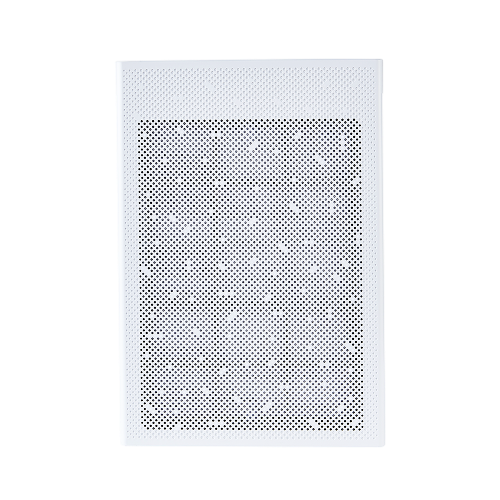
So I ordered two online and put them to the test. The first shock was seeing that it doesn’t have a frame:

That makes it harder retain its shape, but it might still be effective without a frame, so I put it through the tests.
Air Outlet Test
First, I tested it by putting it on the Cannon and testing the air coming out of the HEPA with a Met One Aerocet 531S. (The Met One is useful because it has a pump to regulate airflow. In air outlet tests, the particle counter is sitting in a stream of air, so using a pump maintains constant readings.)

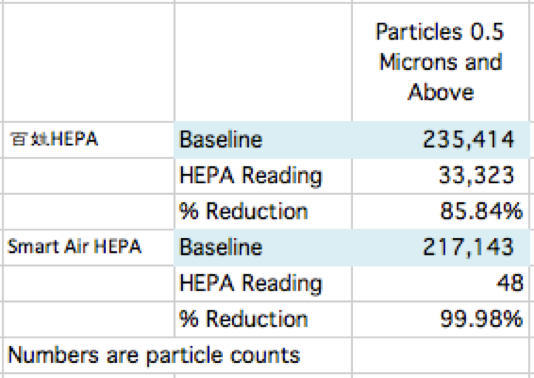
The results weren’t pretty. Smart Air HEPAs got over 99.9% of particles, but the 30 RMB HEPA was below 90%–far below their claim of 99.97%.
Air Speed
But particle effectiveness isn’t everything. A HEPA in the 80% range might work better if it has better air flow. In that case, maybe the HEPA could process the air more times and clean the room air as well as a real HEPA.
To test that possibility, I put each HEPA on the Cannon and used a tool to measure air speed (fancy name “anemometer”). I placed the anemometer on the HEPA at four locations (left, right, top, bottom) and took the average air speed.

Again, the results weren’t pretty. So not only was the 30 RMB HEPA getting far fewer particles, it was letting much less air through.
Conclusion
Quality HEPAs for 30 RMB are still a dream. They’re not useless, but using this 30 RMB HEPA would expose people to significantly more particles.
I still hold out hope that manufacturers will be able to innovate cheaper HEPAs without sacrificing quality, but I haven’t seen those HEPAs yet.
Is the Taobao Store Owner Being Dishonest?
The 30 RMB HEPA store makes claims that their HEPAs get 99.97% of particles, and the data clearly contradicts that, so it’s tempting to think that they’re lying.
But are they? I don’t know what’s in their mind, but my guess is that they simply didn’t go through the hassle of buying a particle counter and testing the HEPAs. I suspect that half of what seems like dishonesty on Taobao is actually just sloppiness.
As usual, I’m posting the raw data below.
Air Outlet Test
For the air outlet test, I used the Met One Aerocet 531S. Similar to my test of another sub-par imitation DIY, I took readings of the air at the inlet as a baseline, then sampled air coming out of the HEPA for one minute. I tested the HEPAs on the Cannon on its high setting.
The Met One measures particles .5 microns and above. Ideally the test should use a particle counter that measures down to .3 microns because that is the hardest particle size for HEPAs to capture. However, I am still in the process of getting a particle counter that measures to .3 microns (they’re not cheap!). But given the fact that .5 microns is a slightly lower bar, it’s hard to imagine that the 30 RMB HEPA would score better on even smaller particles.
I used the particle count mode rather than the microgram-estimation mode. Micrograms are far too coarse to detect differences between HEPAs. Microgram modes will often read zero even when placed in front of a poor-quality HEPA.
Does that mean microgram particle counters are wrong? Not quite. A reading of zero micrograms does NOT mean the machine has detected zero particles. If you switch it to particle count mode, you’ll see that the machine is still detecting plenty of particles. It reads zero micrograms because the algorithm it’s using to convert to micrograms is below the threshold for micrograms.
Here is the raw data for the air outlet test:
Air Speed Test
In the air speed test, I placed the HEPAs on the Cannon on its high setting. I put the anemometer directly on the HEPA and let it remain until the reading was stable (about 15-30 seconds). I oriented the Cannon as horizontally as possible (air speed readings are slightly lower if the Cannon is pointed directly up).
I tested the lower left, lower right, upper left, and upper right. Then I averaged the values. There are slight variations in air speed between the different areas of the HEPA.

Free Guide to Breathing Safe
Want to learn more about breathing clean air? Join thousands more and stay up to date on protecting your health.






Thank you for all of the testing that you conduct and share – it is very helpful in making data-based decisions rather than relying on marketing claims. If the Taobao “HEPA” has an 85% reduction in >0.5 μm particulates, would it be reasonable to assume it is closer to an E10-E11 filter, based on the filter classes here: https://en.wikipedia.org/wiki/Air_filter#Filter_classes
Good Day Mr Thomas. am a nigerian leaving in the southern part of Nigeria (Rivers State) precisely. the state is the hub of crude oil production in the country both legal and illegal and as such, the air most times is filled with soot and it makes the air very dangerous for people. i just join quora today and came across your life hack and i have since gone through most of your write up on the HEPA DIY and am convinced its very much needed here in my state. i want to make this my project for this state… Read more »