
Scientists have actually randomized people to wear N95 or regular surgical masks, then tracked how many people got infected with viruses similar to COVID-19 such as the flu. This data can tell us whether N95 or surgical masks are more effective at preventing infection of respiratory viruses including COVID-19. The results surprised me.

COVID-19 & Mask Livestream
Wondering whether masks work to protect you against COVID-19? Check out our livestream recap covering all the info here!
People’s Intuitions About N95 Masks and COVID-19
The results are surprising because I’ve seen several people claim that we need N95 masks to stop the coronavirus. They say surgical masks just won’t cut it when it comes to COVID.

Similarly, a doctor interviewed on CNN said that masks don’t work.

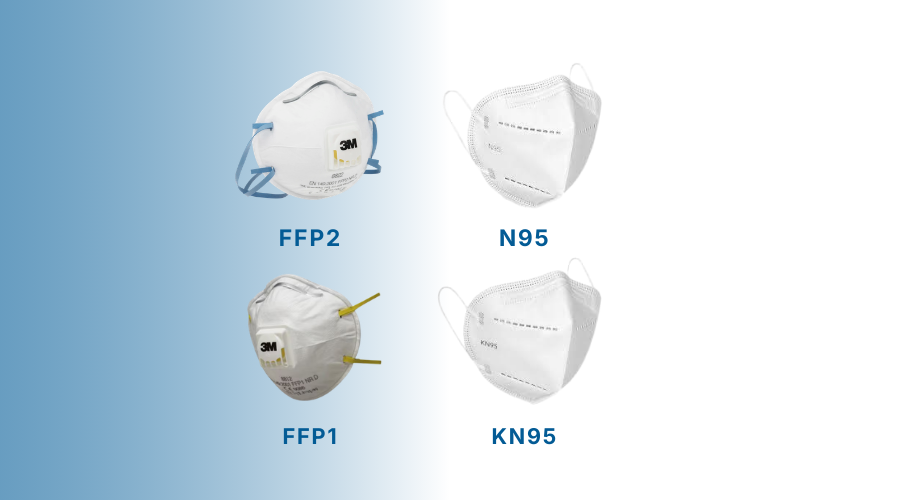
And to be honest, that’s my intuition too. N95 masks fit a lot tighter than surgical masks, and they capture a higher percentage of particles. They’re what I wear in Delhi and Beijing to protect against air pollution.

The Surgical Mask vs. N95 Mask Test
Scientists tested this question by randomly assigning over 2,000 nurses to wear N95 or surgical masks. Then they tracked how many of them caught the flu.

I polled people on Twitter to see what people guessed. A majority (68%) guessed N95, so I’m not alone in my intuition.

But when the data came back, it turned out that rates of infection were the same!

Differences weren’t significant, although surgical mask users actually had slightly lower infection rates.

OK, Maybe That Study Was a Fluke
Data can be flukey. That’s just one study. But it’s not the only one.

Researchers in Canada randomly assigned 446 nurses to wear N95 or surgical masks during a few months of cold and flu seasons (September to December). Then they tracked how many got the flu or a cold.

Again, no significant difference! Both masks performed just as well at preventing the transmission of the viruses. About 9% percent of nurses wearing surgical masks got sick versus 10% wearing N95 masks.

Entirely Reasonable Skepticism
At this point, there must be at least a few savvy readers thinking, “aha!”

I know what’s going on! These studies didn’t have a control group, so we don’t know whether the masks worked. If they both don’t work, then of course there’s no significant difference!
That’s a great question. It’s just hard to test because, what are we going to do? Assign nurses to NOT wear masks? That seems irresponsible.
What we need is some situation where people face infection but don’t normally wear masks. It turns out, scientists found just such a place:

Home!
The No-Mask Test on Viruses
Researchers in Australia studied parents taking care of their children, who were sick with the flu.

Because people often don’t wear masks at home (even around sick people), researchers could defensibly randomly assign people to wear masks or not. They randomly assigned parents to wear no mask, a surgical mask, or an N95 mask like the one I’m wearing here.

Then they tracked how many parents got the flu.
About 16% of parents not wearing a mask got sick, compared to 8% in the surgical and N95 mask groups (called “P2” masks in Australia). Thus, masks seemed to work! But again, surgical masks were just as effective as N95 masks. And the effect size was fairly large—half the infection rate.

Perhaps not surprisingly, the masks only worked for people who actually wore them. There was no benefit among people who often forgot or just gave up on wearing the mask.
Maybe this study was a fluke too? A different group of researchers tried the same test in German homes and found similar results.

How Could Surgical Masks Work as Well as N95 Masks at Capturing Viruses & COVID-19?
OK, at this point, there must still be some skeptical readers out there. There’s no way that surgical masks can capture particles that small! I saw a doctor on Quora say that “most masks” can’t capture particles the size of viruses and COVID-19.

But when we ignore our intuition and look at actual test data, reality is far more interesting. Test data shows surgical masks are surprisingly effective, even for tiny particles. For example, in one study, researchers tested particles down to .007 microns (even smaller than viruses and COVID-19) and found that a simple surgical mask blocked 80%.

Yet still, N95 and N99 masks outscore them. For example, in that study, N95 masks captured 96% (see also 1).

So it’s downright surprising that surgical masks are just as effective! Maybe virus particles are actually easy to capture because they fly on water droplets. Or maybe mask usage prevents people from touching their mouth and nose. For now, I can only speculate.
There’s scientific evidence finding that (1) masks prevent flu infection and (2) surgical masks prevent infection of viruses like COVID-19, as well as more sophisticated N95 masks.
Breathe safe!
P.S. Do we even know whether masks capture tiny virus particles? Aren’t they too small for masks?
This is a solid intuition I’ve seen several times, including here on Quora, repeated by a doctor.

The only problem it doesn’t fit the data. I summarize that data here: Can wearing masks stop the spread of the coronavirus?
Free Guide to Breathing Safe
Want to learn more about breathing clean air? Join thousands more and stay up to date on protecting your health.






I wore a well fitting surgical mask for the first two years of the pandemic, but upgraded to a 3M n95 after Omicron made an appearance. Since then, I’ve been wearing the n95 for six hours a day while teaching. After doing this for over a year, I’m feeling as though I can’t keep wearing the n95. It’s causing a significant number of complications including tension in my jaw which has led to dental problems, and I’ve also developed eye problems because the tension from the mask has altered by blinking. I have a SmartAir Blast and a Blast Mini… Read more »
Wearing any mask keeps you from touching your mouth and nose. Before Covid, hand washing was considered to be the best way to protect your self from respiratory viruses. If you remember, that was what we were told at the beginning of the pandemic. Likely still true, with masking an important second line of defense, perhaps preventing the giving of the virus more than preventing the receiving of it?
Infection rate: 18% maskless vs 9% surgical & N95 mask. So uninfected rate: 82% maskless vs 91% masked. Mask benefits, despite high >90% filtration ratings, compared to being completely maskless, isn’t very high, is it? Not even a 10% difference (one would have expected ‘about’ 90x less infections)! Would it boils down just to participants’ behaviour then? The maskless being more normal/carefree; while the masked participants are constantly being reminded, right under their noses, to be more alert/careful of cross-infections? And the similarities between surgical & N95 masks being users’ error/negligence (N95 being more difficult to breathe & getting a… Read more »
Thanks for sharing this. One of the major differences between a surgical mask and a N95 filtering face piece respirator is that surgical masks are not intended to provide respiratory protection to the wearer since they do not effectively filter smaller airborne particles. Surgical masks have not met all the standards that a N95 or higher-level respirator has.
I do a lot of construction work and always wear N95s to prevent sparkle dust from entering my respiratory system. After a day of sanding, my mask would be covered in sparkle dust. If I take the mask off and blow my nose, i can not detect any sparkle dust, so the n95 is extremely effective. I do not think I would get the same results using a surgical mask,