
Living on the 20th floor of a high rise building isolates people from the world. Cars, trucks, shaokao vendors—they’re all farther away. So does that mean PM2.5 is lower on the higher floors of buildings?
The Test
Tristan from the Smart Air team tested this by taking laser particle counters from floor 1 to floor 22 of an apartment building in Chaoyangmen, Beijing. Tristan tested on two polluted summer days (207 micrograms on Day 1 and 84 micrograms on Day 2, versus the WHO 24-hour limit of 25).
Tristan brought the Air Visual Node and the Dylos DC1700 laser particle counters and took measurements at every hallway window from floor 1 to 22 and all the even-numbered floors in between.The Dylos and Node correlate highly with the US Embassy PM2.5 readings (rs > .90).

Paddy from the Smart Air team is demonstrating testing with Air Visual Node & Dylos DC1700 laser particle counters

Results: The Small Stuff
First we looked at the smaller particles, particles 0.5 microns and above. We did the most extreme comparison: was particulate lower on the 22nd floor than the 1st floor?
On Day 1, the Dylos found small particulate was actually a bit higher on the top floor.

Nerd note: there is no typo here, take the PM0.5 particle count and divide it by 100 and that gives you the PM2.5 concentration
On Day 2, the Node found PM2.5 was about the same on the top floor.
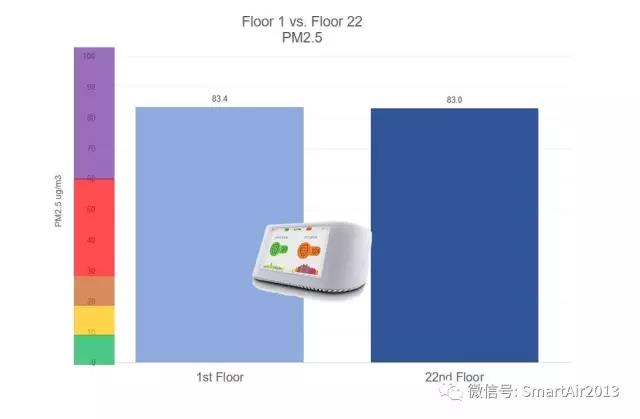
Results were similar when we averaged floors 1-10 versus floors 12-22. Upper floors were slightly higher in one test, slightly lower on the other test.
Bottom line: There is no clear benefit of living on a high floor in small particles.
Results: Larger Particles
So there weren’t clear differences in the small particles, but what about larger particles (above 2.5 microns)? Perhaps this sort of dust is lower on the higher floors because it settles faster than small particles.
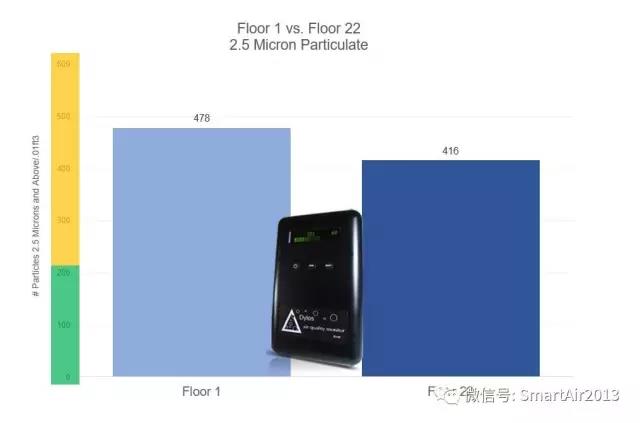
Again, there was no clear benefit. The 22nd floor had fewer particles on Day 1 with the Dylos:
But then the 22nd floor had more large particles on Day 2 with the Node:
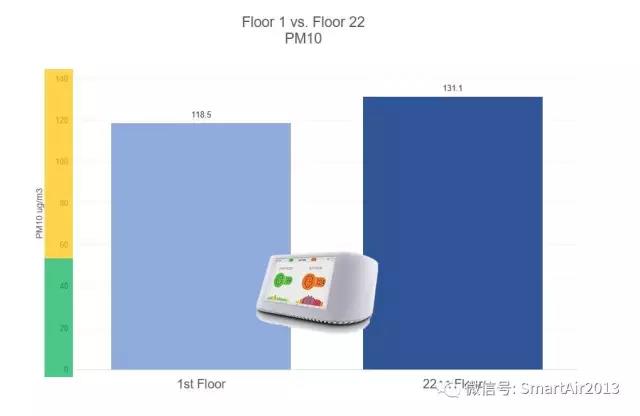
But averaging floors 1-10 versus 12-22, higher floors had a slight advantage for these large particles for both days. Higher floors had 3% fewer large particles on day 1 and 10% fewer on day 2.
Bottom line: Higher floors may have slightly fewer large particles.
So How High Up Do You Need to Be?
So living on the 22nd floor doesn’t help with the small PM2.5 particles. Then how high would you have to live to escape PM2.5?

Without a helicopter to do these tests, here’s my best guess:
Air mixes to different heights in the summer and winter, in day and night. In the daytime, the lowest average mixing height is 1,000 meters, which is a lot higher than high rise buildings.
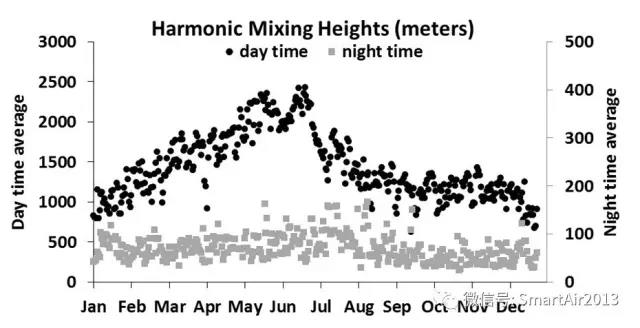
At about 3.1 meters per floor, people on the 20th floor are about 62 meters high. So that’s not going to get us anywhere near the 1,000 meter mixing height.
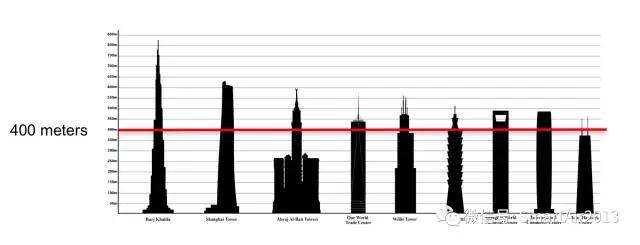
But at night, air is more settled. At night, the average is around 400 meters. Can we get that high?
Even if we stretch all the way up to the 30th floor, that’s still just 93 meters high. To get to 400 meters, we’d need to live on the 129th floor. We’d have to live at the top of one of the top-10 tallest buildings in the world to get that high. And even then, that’d only help some of the time.
Conclusion
For now, most of us earth-dwellers can’t hope to outclimb pollution.
Free Guide to Breathing Safe
Want to learn more about breathing clean air? Join thousands more and stay up to date on protecting your health.








Thomas, why are there so many versions of the conclusion of this topic? There is the article on this website from 2017 (https://smartairfilters.com/en/blog/less-pm25-pollution-higher-lower-floor/) and there is also this Quora answer (https://www.quora.com/Do-air-pollution-measurements-taken-at-higher-elevation-change-significantly), all having different ends.
That graph is poorly made, because it has different scale on the right side, so you probably got confused, but obviously many points there are below 50 meters, even many at only 30 meters in the latter months. So you should really redo this height test at night so we can see the difference. The 22-floor building should be enough. Thanks.