
Using actual air purifiers test data on is the best way to cut through the misleading marketing claims purifier companies make to try to get us to pay more money for clean air. For that reason, I’m always on the look out for good test data. Data is power.

One source I like is the Shanghai Consumer Protection Bureau’s tests, so I was sad to see that their results disappeared from the internet. Fortunately, I was able to pull a copy of the results from the the Internet Wayback Machine and bring their data back to life.
Testing Method
The Consumer Protection Bureau bought 22 purifiers, 17 made in China and 5 imports. Prices ranged from 1,488 to a budget-busting 9,300 RMB (US$215 to $1,350).
To test the air purifiers, they burned a cigarette in a small 30m3 room until the concentration reached an apocalyptic 5,000 micrograms/m3. For reference, what I would consider safe is 10 micrograms (the WHO annual limit). Then they turned the purifier on high and saw what percentage reduction in particulate pollution (PM2.5) the purifier achieved in 20 minutes.
Air Purifier Test Results
All 22 air purifiers significantly reduced particulate, with 17 machines reducing particulate 90% or higher.

A neat way to slice up the data is to look at the cost effectiveness, the price per percentage reduction. This measures how much we’re paying for each 1% reduction in particulate.

On the cost-effective end (left side), we’re paying about 20 RMB ($3) for each percent reduction. On the expensive end (right side), the Amway machine costs 94 RMB (almost $14) per percent reduction!
Best Value Among Top Performers
But a reasonable person might say, “I don’t just want the best value, I want the best value among the machines that are putting out the most clean air.” For example, a purifier that achieved only 50% reductions in particulate could be a great value, but it’s not putting out enough clean air.
One way to get at that question is to compare the machines that achieved 97% reductions or greater.
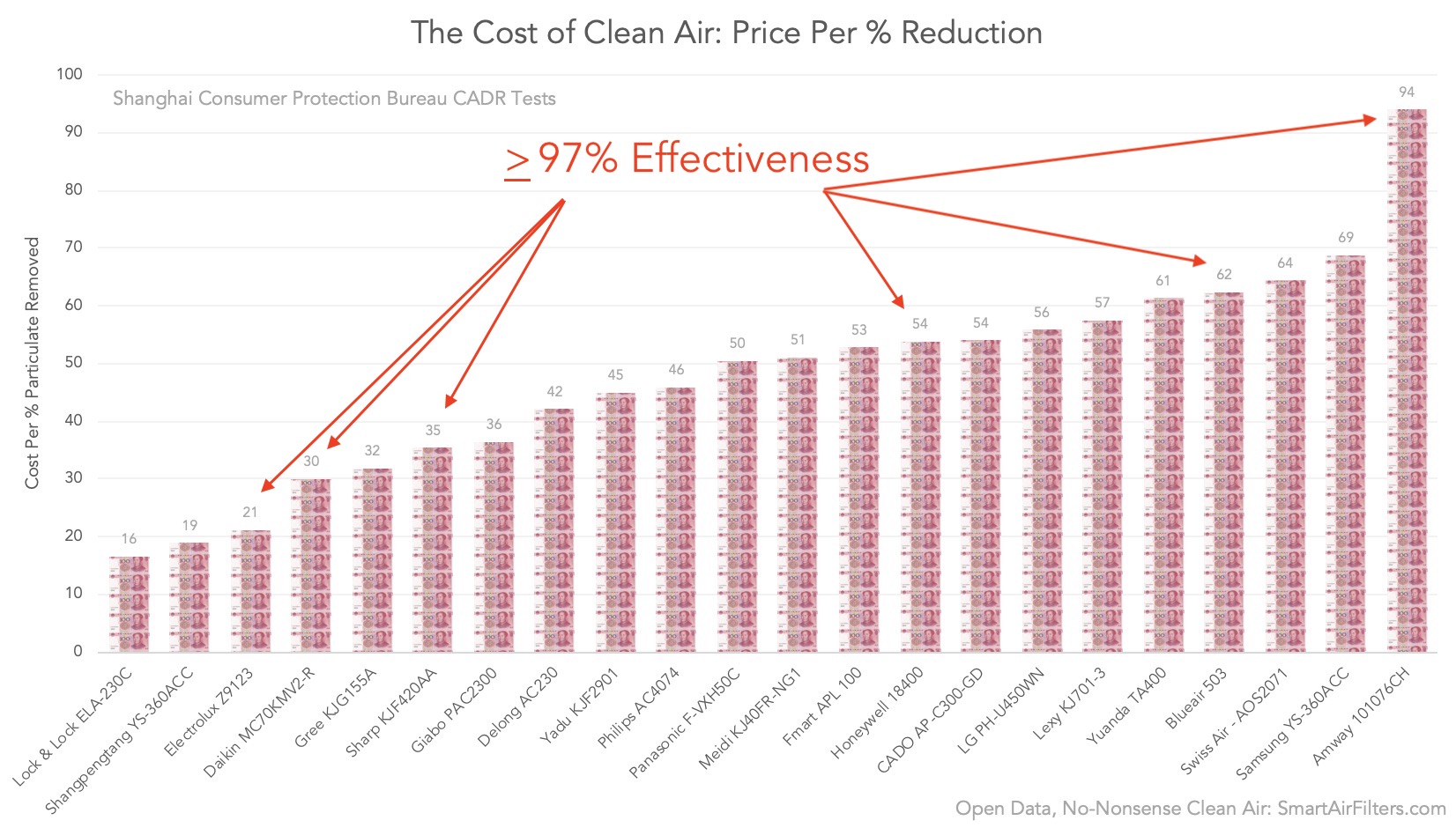
The top performers were equally spread from cheap to expensive, with three cheap purifiers and three expensive purifiers. The Electrolux achieved top performance at just 21 RMB per percent reduction; the Blue Air reached top performance at roughly three times the price.
A quick look at the data will spare our wallets and our lungs.
Air Purifier Tests: Open Data
Here is the original test data (in Chinese):
上海市消保委 Shanghai Consumer Protection Bureau Tests
Looking for more good air purifier test data?
I summarize the four best test resources I’ve found here:
What is the best purifier on the market today?
Free Guide to Breathing Safe
Want to learn more about breathing clean air? Join thousands more and stay up to date on protecting your health.






Wouldn’t a more relevant test for most users be PM reduction per dB of noise? I have never seen this metric used for some reason.