
A Smart Air analysis of 2019 air pollution data found that Shanghai’s PM2.5 improvement has stalled out, actually increasing by 3% over 2018.
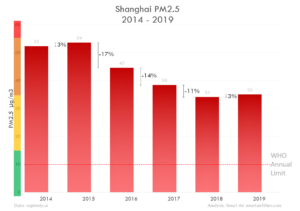
A tally of “good” air dropped by 9.3% in 2019. In 2018, 32% of days in Shanghai qualified as “good”. In 2019, that dropped to 23%.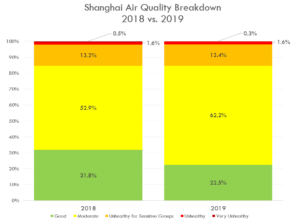
Daily air quality is categorized based on their AQI values based on the EPA standard.
The slowdown came despite Shanghai’s 2018-2020 Coal Consumption Control Action Plan and the 2019 target of limiting coal consumption to about 44 million tons. This change was larger than the 5% drop from 2015 amount aimed for in the action plan.
Is the Air Quality Good Enough Already?
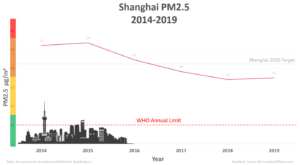
The good news for lungs in Shanghai is that PM2.5 has already achieved the goal 42 micrograms (µg/m3). The bad news is that Shanghai’s PM2.5 still averages more than 3 times the WHO annual limit. Long-term exposure to PM2.5 above 10µg/m3 has been shown to increase cardiopulmonary and lung cancer mortality with more than 95% confidence, according to WHO’s Air Quality Guidelines.
WATCH: The Harmful Health Effects of PM2.5

Subscribe to Smart Air on YouTube

Studies Document Protective Effects of Purifiers, Masks
Despite the harms of PM2.5, studies have found that wearing masks prevents effects on blood pressure and heart rate variability. Placebo-controlled studies of air purifiers have found that reducing particulate in the home prevents harm to blood pressure, inflammation, and immune response—even among young, healthy twenty-year-olds.
Smart Air is a certified B Corp committed to combating the myths big companies use to artificially inflate the price of clean air. To help people living in polluted cities protect themselves, Smart Air provides empirically backed, no-nonsense purifiers and masks, helping to lower the cost of clean air.
Free Guide to Breathing Safe
Want to learn more about breathing clean air? Join thousands more and stay up to date on protecting your health.





It is my contention that UV-C light be the solutions to protect against Corona Virus. Actually, at a distance of about 2″ from the UV-C Tube’s inactivation Capacity increases 32 times more than that of inactivation Capacity from 1 Meter.
In other words, If you force the Air to come closer to the UV-C Tubes, even with small time, the Air will get Inactivated of most Bacteria and Virus. I have made experiments and the result were encouraging.
I do not know, whether such experiments were made by any one.
If yes, I would like to know the results.
Can UV-C light be the solutions to protect against Corona Virus? Any details of Experiments available?