Do HEPA Filters Re-release Dirty Particles and Viruses, or Do They Trap Them Forever?

HEPA filters are great at filtering particles such as dust, PM2.5, and PM10. They also do an incredible job of capturing nanoparticles including bacteria, COVID-19, and other viruses.

What HEPA filters don’t do though, is destroy the particles. This has led to a lot of marketing hype and confused air breathers. Some companies claim they have superior technology that never re-releases captured particles such as viruses back into the air, or even eliminates particles altogether.
Blueair claims HEPA filter re-release dirty pollution back into air
The logic seems reasonable. If a HEPA filter is like a sieve, then when you turn it upside down the particles can fall out. Here’s a super simple rendition of how we think air filters work, using a sieve and tea leaves.
HEPA filter not like sieve release dislodge particles

How does a HEPA Filter work?

The truth is, that HEPA filters don’t work like this. At least, not for the tiny small particles like viruses and bacteria. These particles are so small, that chemical forces stick them to the HEPA filter. These forces are called van der Walls forces. It’s the same chemical magic that makes geckos stick to surfaces.
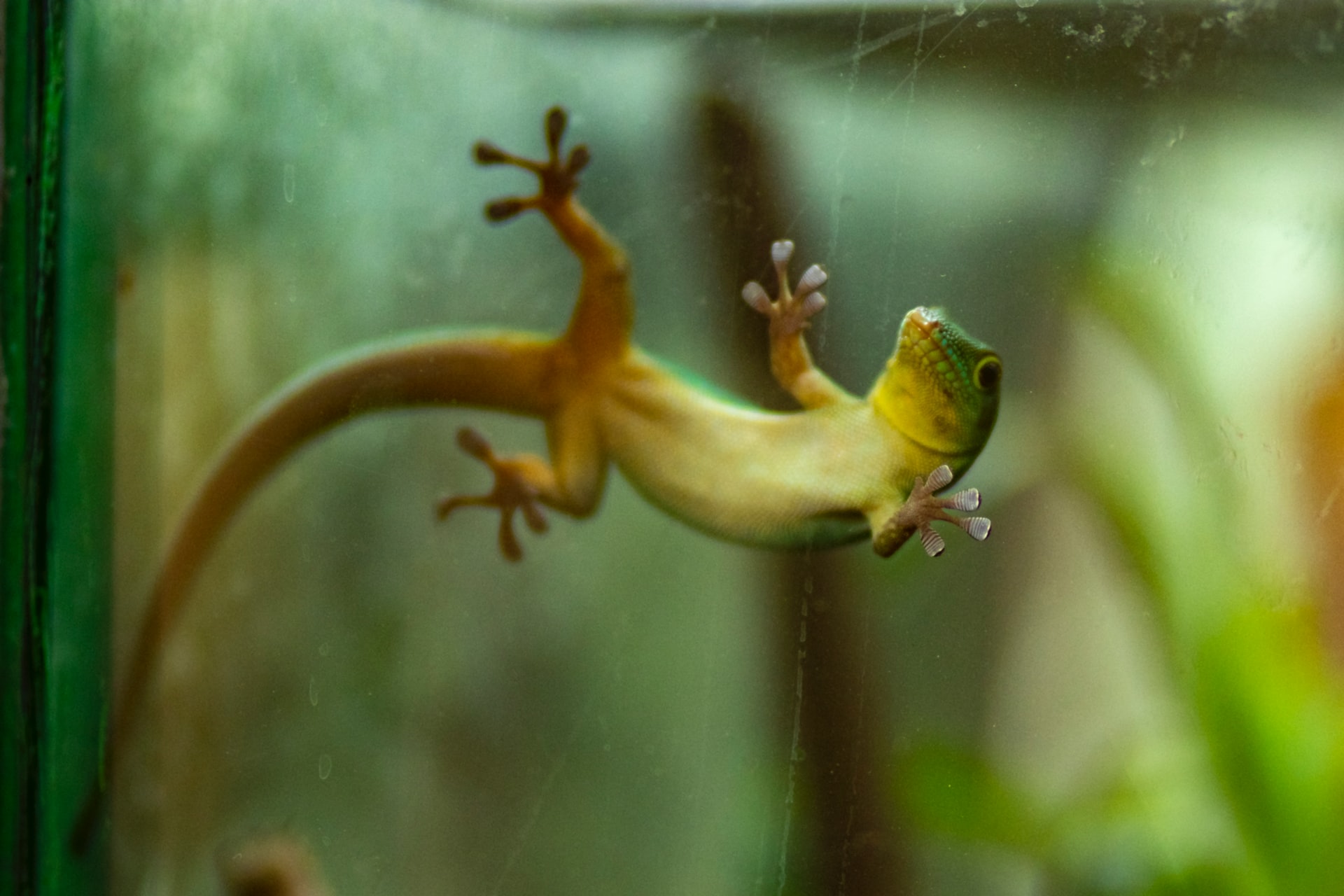
van dar walls forces air purifier HEPA filter catch tiny particles

What The Data Says on HEPA Filters Releasing Viruses and Other Particles Back into the Air

Okay, so that’s the theory, but where’s the data to prove it? Good news. Scientists in Japan have tested this. They shot plutonium particles that were 100-200nm in size at HEPA filters. For reference 100-200nm is roughly the same size as the COVID-19 (60-140nm) and many other viruses.

Tiny plutonium particles stuck and re-release from HEPA filter into the air

They then measured how many were re-released back into the air over a 20 day period. They did this while blowing air forward through the filter and in a reverse direction. The scientists even measured whether ‘jolting’ the filter would dislodge more particles.

They found that when blowing air forwards through the filter, there was a very minimal re-release of particles back into the air. Much lower than the 0.03% of particles that would normally get through a 99.97% filter anyway.
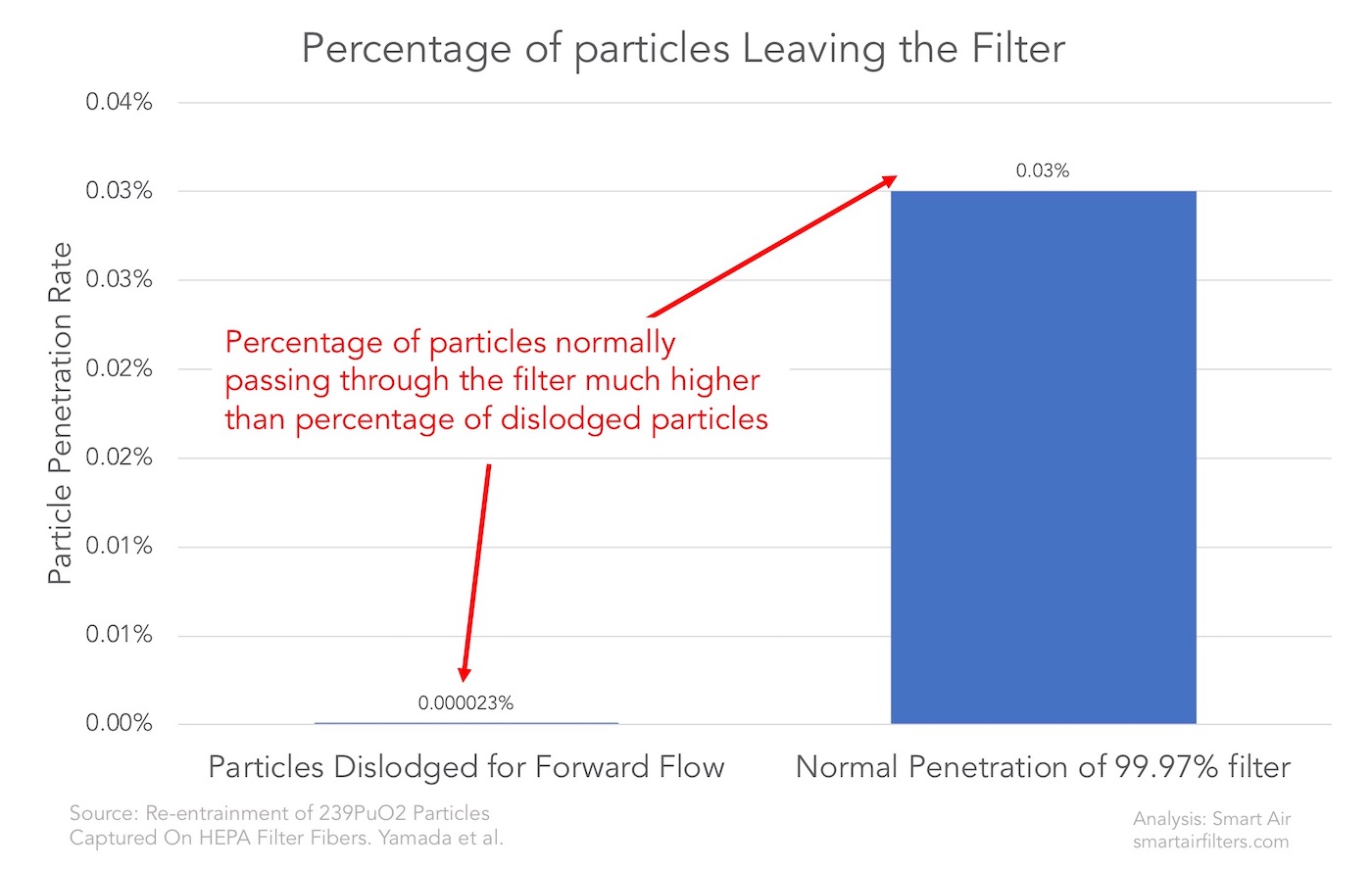
Air purifier HEPA filter dislodge very few particles re-release into air for normal air flow

Things got interesting when they blew air through a really full (well-used) filter in a reverse direction. In this case, more particles were dislodged.

Used HEPA filter dislodge re-release particles into air for reverse flow

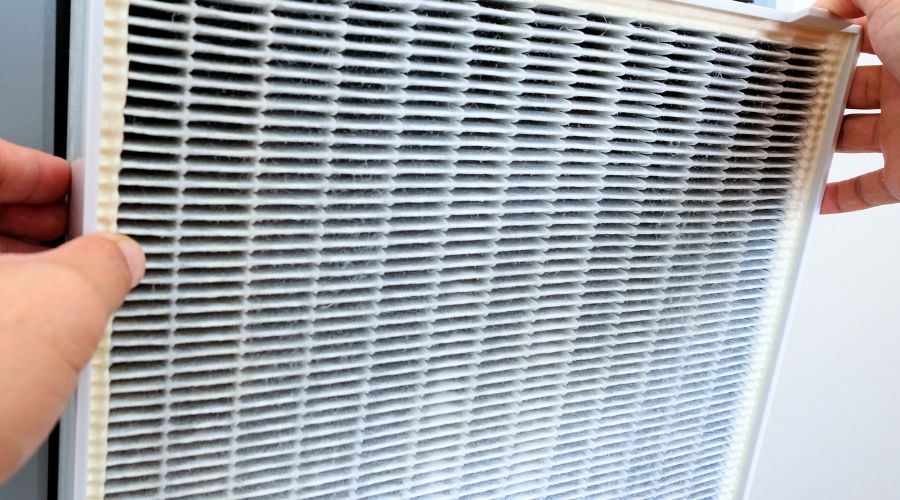
This makes sense, clogged/full HEPAs are more likely to release viruses and other particles back into the air. But only when air is blown through the filter in a reverse direction.

This is an extreme case, unlikely to occur unless a used filter is re-inserted into an air purifier in the wrong direction. However, the scientists concluded that filters should be handled with care when removing and replacing them.

Used HEPA filters handle with care dislodge particles

Are Particles and Viruses Dislodged from HEPA Filters Really a Health Risk?

Data shows that some particles can become dislodged from HEPA filters during use. Despite this, the health risk may be minimal, since:

  • The number of particles dislodged in the forward-flow direction is far less than what would get through the HEPA filter anyway.
  • If we’re considering viruses, they typically die within 3-24hrs on dry surfaces. That means that any viruses that do escape the HEPA filter will most likely be dead by the time they do.
Bottom Line
Bottom Line: Do HEPA Filters Re-release Dirty Pollutants and Viruses Back Into the Air?
Data shows that HEPA filters can re-release tiny amounts of particles back into the air. Unless the filter is turned around, these amounts are much less than what normally passes through a 99.97% filter.
Smart Air

Free Guide to Breathing Safe

Want to learn more about breathing clean air? Join thousands more and stay up to date on protecting your health.
Subscribe
Notify of

1 Comment
Inline Feedbacks
View all comments
JGir
2024-05-28 2:39 pm

Thanks for the info/sources 🙂 have always been curious about that.

Also, I would assume most bacteria and viruses that get caught would die at an accelerated rate, due to the airflow. Especially on vacuum filters.

Just a thought.

Who we are
Clean Air Social Enterprise
Smart Air is a certified B Corp on a global mission to make clean air accessible through science, education, and affordable air purification

Subscribe to our newsletter and be part of the clean air movement
The Sqair
Up to 36m² (387ft²)

A stylish, minimalist purifier that blends seamlessly into any modern home

SA600
Up to 60m² (645ft²)

Engineered with dual filters to deliver maximum air purification performance

The Sqair
Up to 36m² (387ft²)
CADR: 508 m³/h
New
SA600
Up to 60m² (645ft²)
CADR: 508 m³/h
Blast Mini Mk II
Up to 89m² (958ft²)
CADR: 743 m³/h
Blast Mk II
Up to 114m² (1,227ft²)
CADR: 950 m³/h

HEPA Filters

Remove PM2.5, PM10, dust, pollen, allergens, and viruses

Carbon Filters

Remove VOCs, smoke, formaldehyde, and odors

CO₂ Monitor

Measure CO₂, temperature, and relative humidity

HEPA Filters
Remove PM2.5, PM10, dust, pollen, allergens, and viruses
Carbon Filters
Remove VOCs, smoke, formaldehyde, and odors
Left Right
CO₂ Monitor
Measure CO₂, temperature, and relative humidity

Latest Articles

Smart Air low cost purifiers

Smart Air is a social enterprise and certified B Corp that offers simple, no-nonsense air purifiers and provides free education to protect people from the harms of air pollution.

Certified B-Corp air purifier company
Follow Us on Social Media!Join the Squad & Protect Your Health With Us!
Smart Air FacebookSmart Air TwitterSmart Air InstagramSmart Air YouTubeSmart Air LinkedIn