
If the question is about cleaning the air in our homes, this is a huge myth! Here’s the hard data.
You can find tons of people online (even smart journalists!) saying that plants are effective air purifiers. The evidence I see cited most often is the NASA study on plants. It feels scientific, and it’s from NASA, so it seems authoritative. Many pages cite it, like this one:
There’s an entire Wikipedia entry devoted to it.
I read the original NASA study to get to the bottom of this claim. It turns out that the NASA plant tests were done in small, completely sealed plexiglass containers surrounded by growing lights. For an idea of size, here’s what their indoor setup looks like next to a stick-figure version of myself.

I’m not sure what your home is like, but that’s nothing like my home. In NASA’s defense, it’s a decent approximation of a spaceship.
Differences Between the NASA Plant Study and Our Homes
The NASA plant setup also has a key difference with our homes. They pumped in the chemicals (formaldehyde, benzene, and trichloroethylene) at the beginning of the test, and that was it. But in our homes, the common chemical sources of gases like formaldehyde constantly emit the chemicals for at least 1-2 years.
Why this matters to us is because the real question is not IF plants can filter out gases like formaldehyde, but HOW MUCH of the gases can they remove from the air? The NASA study convinced me that plants can remove chemicals like benzene and formaldehyde. But it didn’t demonstrate whether plants can remove a meaningful amount of gases and chemicals from our homes.
Can Plants Filter Out Gas Pollutants?
What we need are tests in more real-world conditions. These scientists in China (original article) tested whether plants can remove volatile organic compounds (VOCs) in a setup more similar to our home.
The 10m2 room was still sealed, so that’s unrealistic. But it makes three big improvements from the NASA plant test:
- It contains a constant source of VOCs like formaldehyde (in this case, office desks).
- At 10m2, the experiment room is much larger than NASA’s box—more like a room in our homes.
- The room has no special growing lights for plants (just like most people’s homes).
They tested multiple times with an army of plants that people have specifically said reduce VOCs. They tested snake plants, aloe, and spider plants.
And what happened? During the tests, VOCs increased from .17 PPM to .24 PPM. Even an army of plants wasn’t enough to deal with the gas pollutants coming from normal office furniture.
Is There NO Evidence That Plants Help Remove Formaldehyde?
I should say that some people claim to have found the effects of plants in real-world conditions. For example, these researchers claim that 9 potted plants in a classroom in Portugal reduced particulate by 30% and VOCs by 73%!
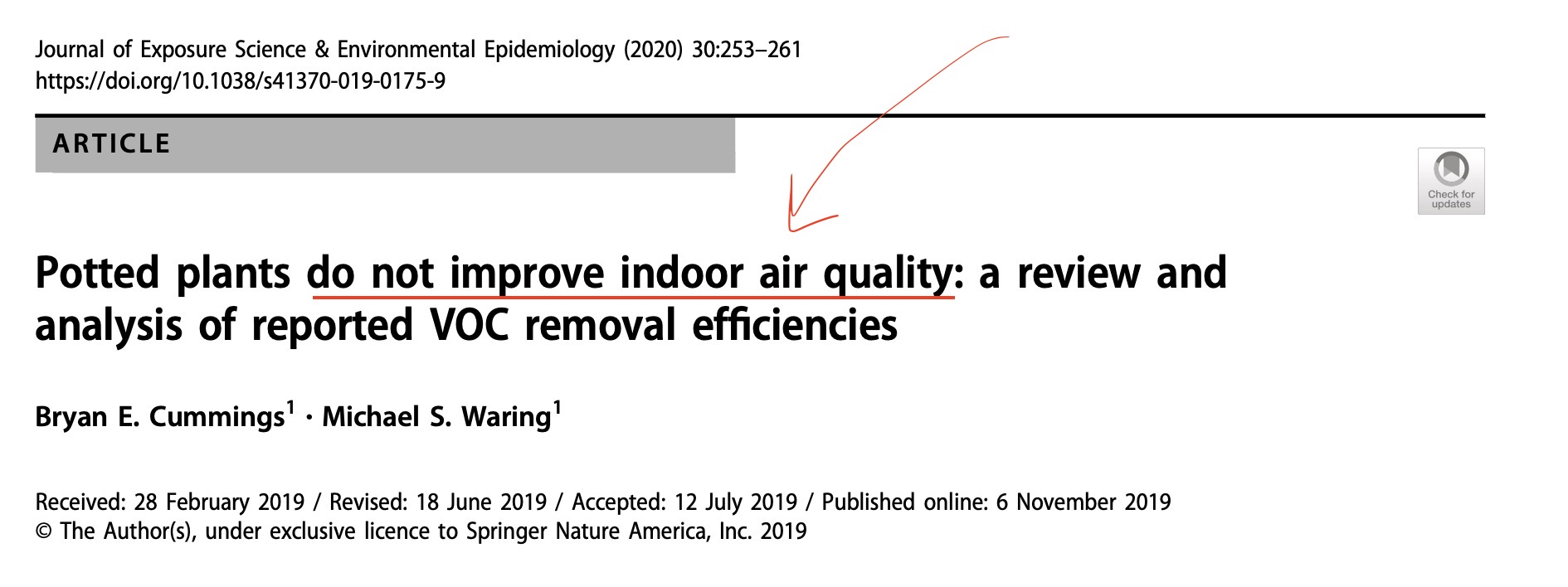
That stretches my imagination, at least. When a team of researchers systematically reviewed the studies on plants as purifiers, they concluded that plants “do not improve air quality.”
If you like plants, great! I have several in my home. They can make our homes better. They’re just not good air purifiers.
Free Guide to Breathing Safe
Want to learn more about breathing clean air? Join thousands more and stay up to date on protecting your health.






The Chinese team did NOT publish their results in any peer review medical journal. You’ve just pointed to a news site in China. Other studies that support the NASA findings were published in scientific journals. So it does seem strange that you are basing all this article on some information that was published in a TV news site in China. This doesn’t seem right if you actually want to contradict other research findings. Observe that you actually mentioned that “The Chinese team claimed to be testing formaldehyde, but these detectors aren’t that specific” – so can we actually rely on… Read more »