Researching air purifiers can be a faff. We're here to help...
🅕 Find
🅐 Actual
🅕 Filter
🅕 Facts
Spot marketing tactics used by manufacturers to sell units that are expensive, loud, inefficient, or all the above! How to choose the right one for you then?
FAFF1 - CADR
You won't run it on top speed, it will be too noisy. Make sure you get the Clean Air Delivery Rate (CADR) on all speeds. The CADR should be appropriate to your room size at the noise level you will be running it (see also FAFF2).
FAFF2 - Noise
Manufacturers sneakily quote top speed clean air rate but low speed noise. Noise matters! 69% of teachers with air purifiers turn it down or off due to high noise levels. If only one noise level is listed and it is less than 30dBA, it will be the lowest setting. We recommend you aim for < 40dBA noise levels for continuous filtering but don't forget to check the CADR at this speed.
FAFF3 - HEPA efficiency
The term HEPA isn’t regulated, only the grading is. Look for 'regulated terms' like: E10-12, H13-14, U15-17. If the word HEPA is used without a grade but the % efficiency is high, it could be using additives which simply adds more chemicals in the air in order to increase the efficiency of weaker filters. Ask for the grade before you purchase and be aware that terms like True HEPA and Medical HEPA are fluff.
FAFF4 - Stay away from additive technology
Not all companies will own up to using ionisers as they don't have to (unless you are selling in California!). Ionisers produce ozone, which is a lung irritant. See the EPA guidelines on ionisers and always check before purchasing.
FAFF5 - Airflow
Commercial models may clean the air too quickly for domestic CADR tests. Instead manufacturers quote airflow/total air change instead FAFF5 - If comparing purifiers with airflow, ask if it's measured at the inlet (much higher) or outlet (closest to CADR). Without knowing this, it is hard to compare products.
FAFF7 - Bargain brands
Amazon is amazing for finding bargain low cost OEM air cleaners that appear under multiple brand names from different sellers. Check that filter replacements are sold by a UK company for assurances that this model will be supported.
FAFF8 - Filter lifespan
The lifespan of your filter depends on how polluted your air is; with the right conditions, it might last more than one year. The filter lifespan can't be the same for both UK and any other country. Filter replacements are a huge 'after-sales' market - so be wary of replacement lights! Smart Air provides a filter lifespan calculator for more accurate estimates.
FAFF9 - Virus tests
NASA research shows all filters can trap virtually 100% of nanoparticles, including the virus. If a brand has paid for a test to use for marketing, you can be sure it will pass on the cost of it to you!
FAFF10 - Built in sensors
‘Good’ may be based on Beijing air quality, not UK AQI. A built-in sensor may seem a great idea, except you are measuring the cleanest spot next to the air cleaner! A sensor on the opposite side of the room is better FAFF10 - If you are UK based, don't rely on auto-mode unless 'good' is relative to US AQI (the closest to UK AQI).
FAFF11 - Purifier placement
The placement of your air cleaner is crucial if you want to achieve 100% of the declared CADR. Find out how the minimum distance the air cleaner has to be from the wall. It's usually in the manual which you may not see until after purchase. For example, the Blast is 10-15cm from the back of the unit to the wall, the Levoit is 38cm from all sides.
FAFF12 - UV lights
Although ‘room’ UV is effective, it doesn’t mean it is in an air cleaner. The HEPA is doing all the work, the air passes too quickly for internal UVs to be effective. The EPA recommends against purchasing air cleaners that emit ozone, which includes those that contain UV lights.
FAFF13 - PM0.3 particle perplexity
Even 'trusted' brands get hung up on PM0.3 - it's just the smallest size that travels in a straight line, not the smallest size that can be trapped. HEPA is graded. As with FAFF9, all filters will trap virtually 100% of nano-particles including the virus so don't believe claims that most brands only trap PM0.3 and larger.
FAFF14 - HEPA differentials
Watch out for a product marketed as '2.5 times more efficient than HEPA H13'. This is based on the minute differential between H13 & H14, or H13 plus additives! For example, The Blast H13 filters actually tested at 99.975% efficiency - typical for H13 is 99.95. Not quite enough to make it H14 but this difference ‘could’ be marketed as increase from H13 by a factor of 2! How much extra are you willing to pay for an extra 0.045% efficiency difference between H13 and H14 at first pass only?
FAFF15 - Putting this into practice
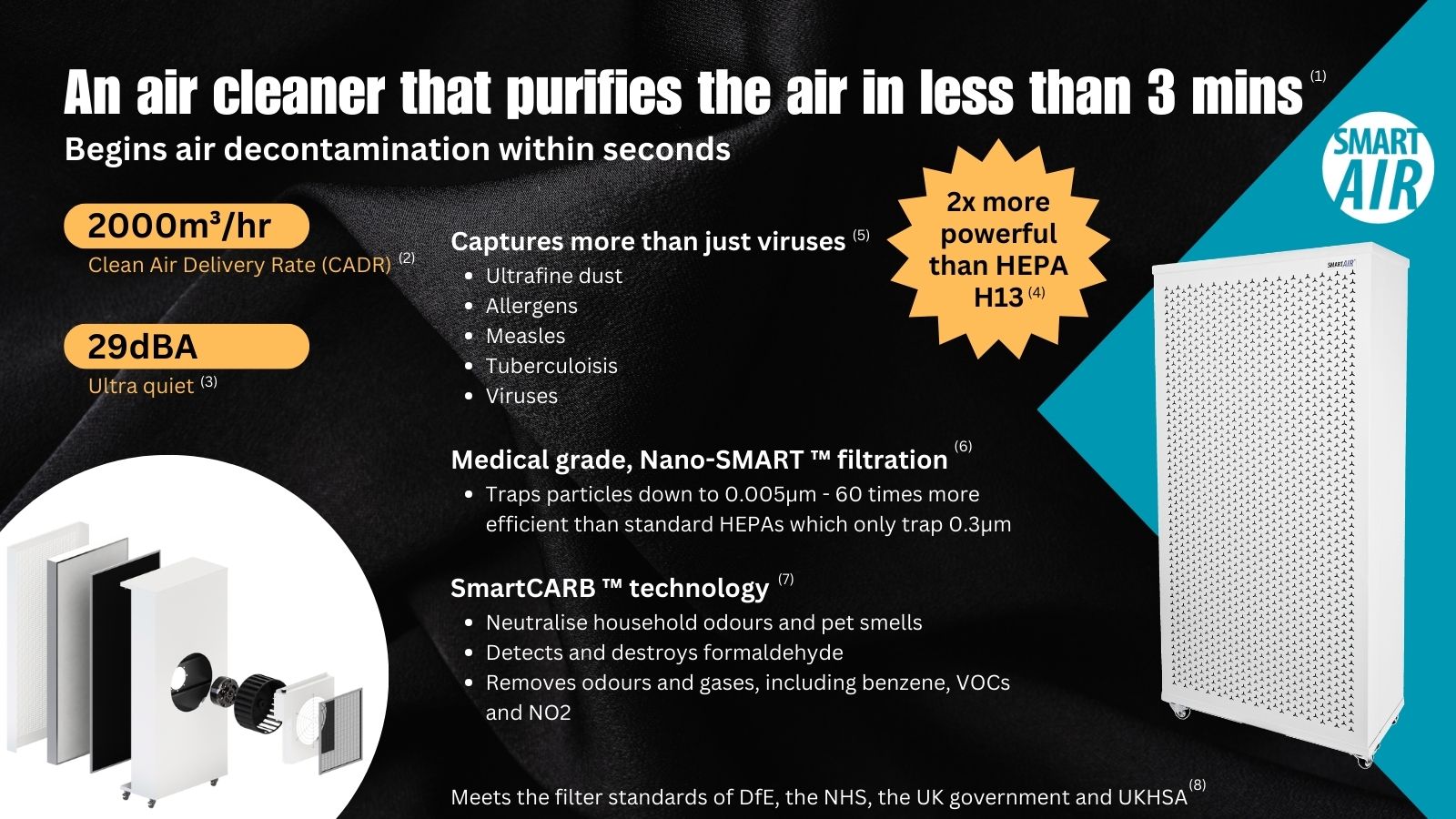
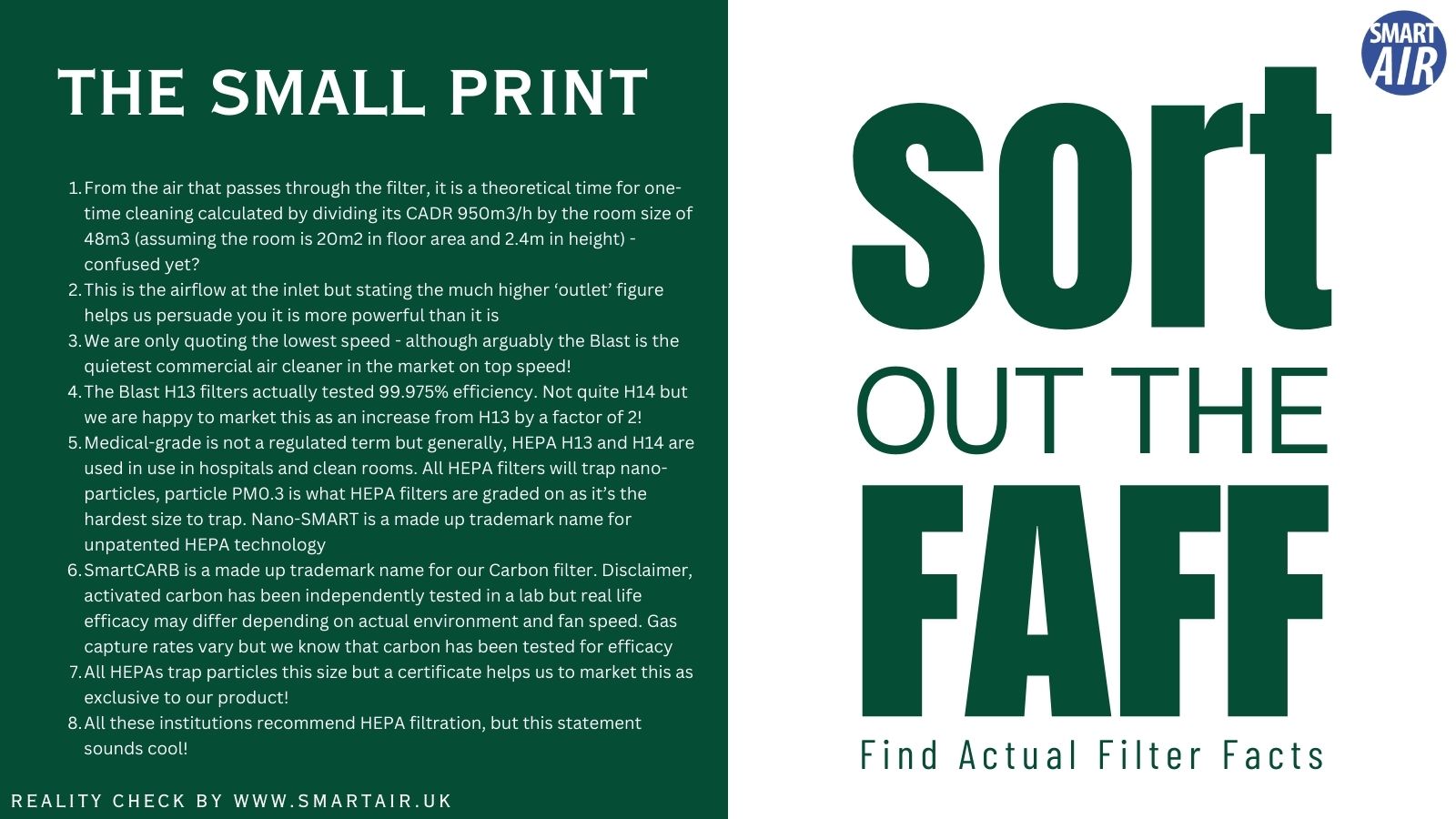
In an unregulated market, time spent on research can save you a lot of 💰💰. We hope you enjoyed this series outlining marketing tactics. We have demonstrated these tactics here with a Blast spoof Ad...