
25-26 financial year
Commitment to achieving Net Zero
Smart Air UK / Airbon is committed to achieving Net Zero emissions by 2040. We fully support NHS and public sector ambitions to decarbonise supply chains and create a more sustainable health system.
Our reduction plan integrates low-carbon logistics, sustainable packaging, responsible manufacturing, and energy-efficient operations.
Baseline emissions footprint
Our baseline emissions are calculated using a combination of actual emissions based on logistics data and estimates based on annual expenditure.
| Scope 2 | Scope 3 upstream | Scope 3 downstream |
| 2,344.93 kg CO₂e | 27,010.70 kg CO₂e | 3,537.34 kg CO₂e |
| 25-26 base year total | 32,892.97 kg CO₂e | Less offset 28,892.97 kg CO₂e |
These figures cover the reporting period 1 April 2025 – 31 March 2026 including:
- Office Operations: Energy-efficient practices, hybrid work model, and waste reduction
- Warehousing & Logistics: Primary warehouse in Kent for storage (see below for distribution) and for the large GLA programme, a warehouse in Orpington so deliveries in London can be carried out using their electric fleet
- Freight & Distribution: Evergreen Freight (sea freight) Royal Mail & FedEx for UK-wide delivery
- Product Sustainability: Reduction of plastic packaging and responsible manufacturing processes
- 98% plastic-free packaging achieved in 2023 across product lines
- 50L of plastic packaging eliminated per Blast air purifier
- 99% of Sqair air purifier packaging is plastic-free
- 52 leading product certifications achieved, ensuring environmental responsibility
- 67% of supply chain partners are ISO 14001 certified, demonstrating their commitment to environmental management
- 100% of supply chain partners are ISO 9001 certified, ensuring quality and efficiency
- Carbon emissions measured:
Scope 1 Emissions
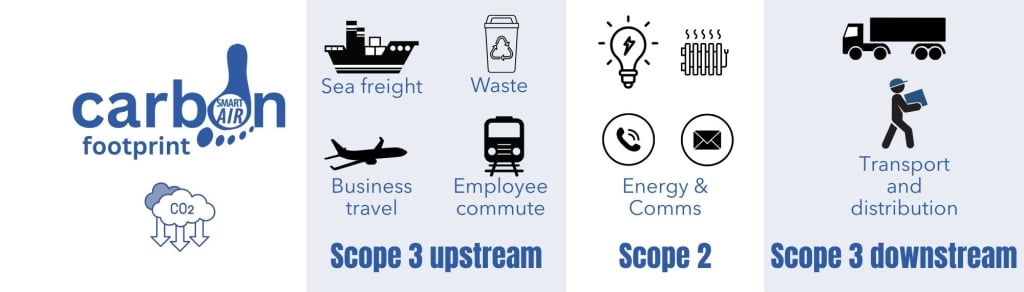
Smart Air UK does not generate Scope 1 emissions, as we do not own or operate any fuel-burning equipment or vehicles. As a tenant, our office energy usage falls under Scope 2, while transport, distribution, and supplier emissions are accounted for under Scope 3.
Scope 2 Emissions (UK Operations)
- Headcount: 6 employees
- Office Energy Use: Our rented building promotes energy-saving practices, including signs to ask for lights to be switched off when not in use, centralised heating, and waste separation.
- Employee Commuting: Hybrid work model with public transport and walking-only travel when in the office, minimising transport emissions.
| Total | Scope 2 | 2,344.93 kg CO₂e |
| Office Energy | Lighting Usage (kWh) | 109.52 |
| Office Energy | Heating Usage (kWh) | 32.27 |
| Office Energy | Permanent Equipment Usage | 684.48 |
| Office Energy | Temporary Equipment Usage | 328.55 |
| Remote Work | Heating/Cooling Usage | 1,190.11 |
Data based on exact employee hours at home and in the office, and UK electricity emission factor (0.184 kg CO₂e/kWh)
Scope 3 Emissions (UK Operations & Supply Chain)
Upstream
- Freight & Logistics: Evergreen Freight follows ISO14064-1:2018 standards and has a Greenhouse
- Gas Inventory Team working on annual carbon reduction targets.
- Warehousing (Essex & London): We use 3PL but emissions aren’t measured. Our calculations are based on the m3 of our pallet storage
- Waste & Packaging: We actively reuse packing materials, recycle toner cartridges, reduce paper use, and collect cardboard waste for recycling.
| Total | Scope 3 Upstream | 27,010.70 kg CO₂e |
| Shipping | Cost of sales - Freight | 20,093.54 |
| Warehouse | Warehouse (3rd party) | 2,155.01 |
| Business | Business (meals / travel) | 4,757.39 |
| Waste Management | Recycled Packaging Use | 0.03 |
| Commute | Public Transport | 4.74 |
Shipping and warehouse data based on actual weight and dimensions. Commute is based on staff surveys. Business meals and waste management are estimates from £ spent
Downstream
- Royal Mail aims for Net Zero by 2040, using 5,000+ electric vans and green logistics. Currently, they estimate an average emission of 0.218 kg CO₂e per parcel
- FedEx is transitioning its parcel fleet to electric and provides carbon tracking tools. We are therefore using exact emission data for our deliveries
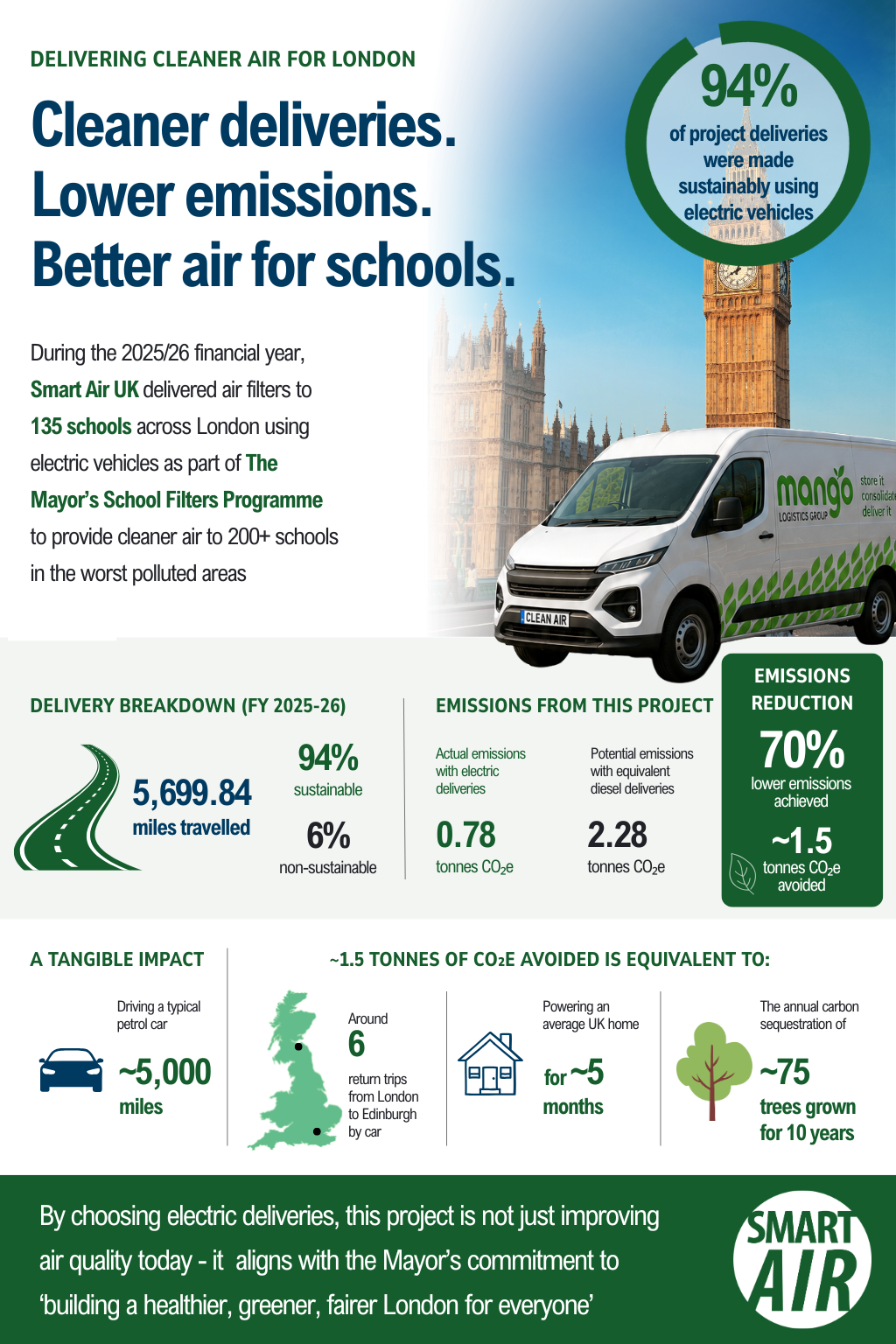
- Mango Logistics were used for the ‘last-mile’ electric distribution into London as part of the Mayor’s School Filters Programme (see below).
| Total | Scope 3 Downstream | 3,537.34 kg CO₂e |
| Royal Mail | Transport and delivery | 513.98 |
| FedEx | Transport and delivery | 2,240.00 |
| Mango | Transport and delivery | 783.36 |
Downstream data based on accurate figures for FedEx and Mango, see bullets above for explanation
How we calculate our emissions
This emissions report focuses on the categories required for public sector contracts, ensuring compliance with reporting standards while providing an accurate reflection of our operational footprint. While broader corporate emissions tracking is valuable, this report prioritises the essential data relevant to procurement criteria.
Additional emissions categories may be explored in future sustainability assessments as our environmental strategy evolves.
To ensure accuracy, we have prioritised actual data over broad estimates when calculating emissions:
- Royal Mail, shipping, and warehouse emissions are determined by weight, dimensions, and item quantity, ensuring precise freight calculations
- FedEx and Mango couriers are able to provide actual figures based on mileage
- Commuting emissions are directly based on employee surveys, rather than industry averages
- Office energy use and remote work emissions are calculated using exact employee hours, factoring in heating, lighting, and equipment energy consumption
- Business meals and travel, and recycled packaging use are calculated based on spend (£ spent) rather than assumed impact
This approach ensures our emissions reporting reflects real operational impact rather than inflated generic estimates.
In this reporting period, we were awarded the Mayor of London’s School Filters Programme to supply air filters to 200 schools in some of the most polluted areas across London. This contract significantly increased our warehouse, shipping and distribution emissions compared with 2024/25. By choosing Mango Logistics as our delivery partner, 94% of deliveries were completed using electric vehicles. We estimate this reduced emissions from distribution by around 70% compared with using equivalent diesel vehicles.
Future reductions: planned structural changes
Building on the measures already implemented, we will continue to identify opportunities to reduce emissions across our operations and supply chain. Particular focus will be placed on improving logistics efficiency, reducing transportation emissions intensity and evaluating lower-impact product designs.
Key emission-reducing initiatives include:
- Consolidated B2B and public sector deliveries - As our sales mix increasingly includes larger business and public sector contracts, we will seek to reduce the number of individual deliveries through greater use of consolidated shipments. This approach has the potential to improve vehicle utilisation and reduce emissions per unit delivered.
- Low-emission logistics partnership – For larger public sector contracts, we will partner with local EV logistics company to offer last-mile delivery using electric vehicles and cargo bikes where appropriate. These measures are intended to improve delivery efficiency and support reductions in downstream transportation emissions associated with product distribution.
- Product design and material optimisation - In 2026, we will launch the Airbon range of air purifiers. Approximately 95-97% of the product weight consists of wood-based material, reducing reliance on plastic and metal components compared with conventional product designs. As the range is introduced, we will assess its impact on emissions associated with purchased goods and materials and identify opportunities for further reductions.
- Packaging and circularity improvements - We will continue to review packaging materials and processes to minimise waste and encourage reuse where practical, supporting broader resource-efficiency objectives across the business.25 onwards.
As these initiatives are implemented and further data becomes available, we will continue to monitor their impact and incorporate measurable emissions reductions into future reporting periods.
Carbon reduction measures
To reduce emissions and progress towards Net Zero, we commit to the following actions:
- Supply chain optimisation – Partnering with logistics providers that prioritise low-carbon transport, electric vehicle fleets, and sustainable freight solutions. We will also collaborate with our warehouse partners to implement carbon tracking tools for improved emissions monitoring.
- B2B growth strategy – Expanding our business-to-business operations to reduce distribution emissions by consolidating shipments - sending more products to single destinations instead of multiple individual addresses.
- Energy-efficient office practices – Continuing our commitment to hybrid working, waste separation, and energy-saving initiatives, such as promoting refillable water bottles and bamboo travel cups to reduce single-use waste.
- Ongoing emissions monitoring – Strengthening engagement with our shipping and distribution partners to track, report, and actively reduce emissions on an annual basis.
- Scope 3 offsetting initiatives – We have partnered with Carbon Footprint to support certified tree-planting projects, offsetting 4 tonnes of CO₂e emissions, primarily covering our shipping freight emissions (2,508.25 kg CO₂e) which we will be unable to reduce via this plan. This initiative substantially decreases our overall carbon footprint and aligns with our commitment to responsible environmental action.
Monitoring and governance
Our team will review and update our Carbon Reduction Plan annually. We commit to full transparency in tracking our carbon footprint and ensuring alignment with NHS sustainability targets. Further details on our supply chain sustainability initiatives can be found here.
Next review: May 2027

