
Imperial College London has released the CHEPA (Classroom HEPA) calculator, a tool designed to help schools understand how HEPA air filtration might reduce airborne particles and infection risk in classrooms.
We spent some time exploring the calculator using realistic UK primary classroom assumptions and varying only the things schools can actually control - airflow (CADR) and building leakiness (draughty). Below are our impressions: what we found useful, where the tool is less helpful, and how much weight we think schools should place on the results.
What we liked
1. It shows how much airflow matters
One of the clearest messages from the calculator is that fan speed (or CADR) matters just as much as having a HEPA filter at all. Using the same classroom assumptions and varying only how air tight a classroom is:
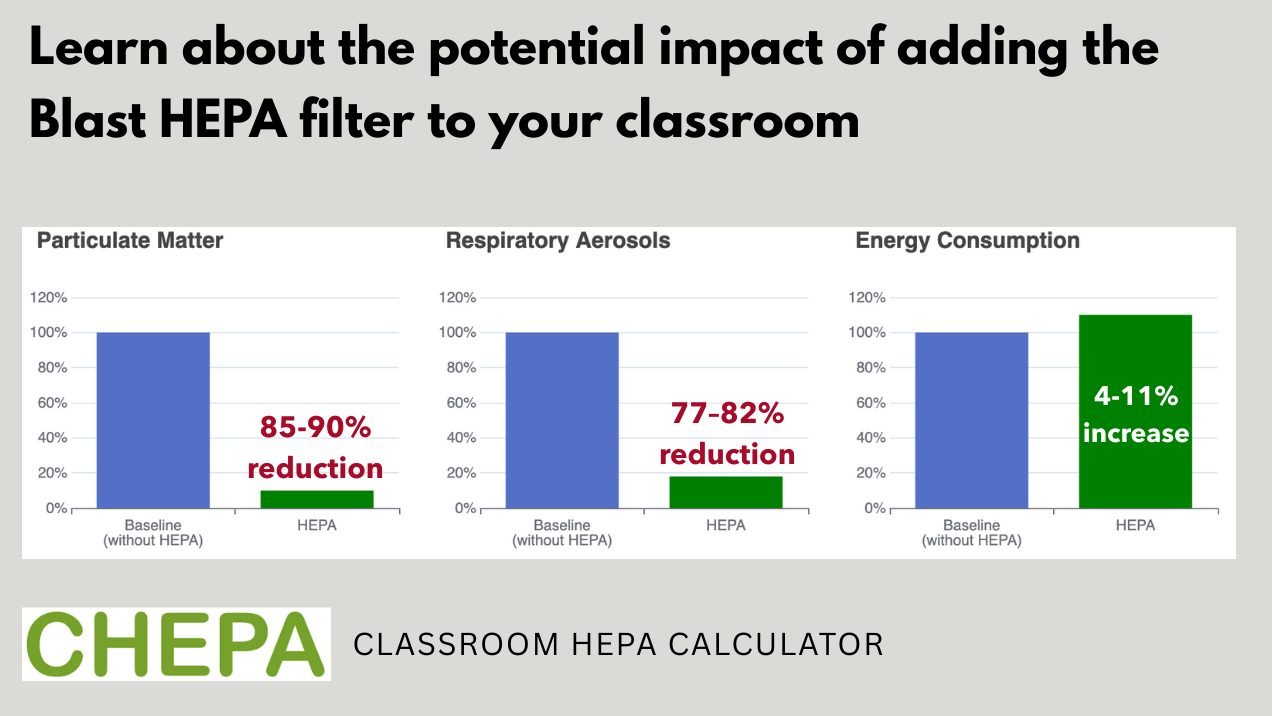
- At higher airflow, the calculator suggests approximately 77–82% reduction in respiratory aerosols and 85–90% reduction in particulate matter, depending on building airtightness.
- At lower airflow, reductions fall to approximately 57–64% for respiratory aerosols and 70–78% for particulate matter.
This reflects a reality schools often discover too late: if an air cleaner has to be run on lower speeds, its impact will be smaller. The calculator makes that trade-off visible.
2. It distinguishes between particles and infection risk
We appreciated that CHEPA does not treat “clean air” as a single concept. The calculator separately estimates:
- Reduction in particulate matter (PM)
- Reduction in respiratory aerosols and infection risk
These are related but not the same. Viruses are not floating around on their own; they are carried in tiny respiratory aerosols. HEPA filters don’t “catch viruses”, but they do remove the aerosol particles that carry them. The calculator reflects this by showing consistently lower infection-risk reduction than PM reduction, which feels realistic and responsible.
3. It highlights where HEPA adds the most value
Another useful insight is how strongly results depend on how airtight a classroom is.
- In more sealed classrooms, HEPA filtration delivers larger relative reductions
- In draughty classrooms, natural air leakage already dilutes aerosols, so the additional benefit is smaller
That may sound counterintuitive, but it makes sense. It also helps explain why HEPA filters may feel transformative in some rooms and underwhelming in others.
What can be made clearer
Some questions won’t map cleanly onto every classroom
While the calculator is careful to label its outputs as approximate, some of the input questions are necessarily generalised and may not reflect all classrooms within the same school equally well.
Older buildings, temporary or pre-fabricated classrooms, and rooms that behave very differently thermally or aerodynamically may not fit neatly into options such as “relatively well-insulated” or “draughty”. In those cases, the model can still be informative, but perhaps there should be caution in over-interpreting the results.
This isn’t a flaw so much as a reminder that the calculator is a simplified representation of complex buildings, and local knowledge still matters.
2. Energy impacts are relative and can be misread
The calculator includes an “energy consumption” output, which is helpful in principle, but it’s easy to misinterpret.
What it’s really showing is:
- Airtight rooms retain heat better
- Running air filtration in those rooms has a higher relative energy impact
- Draughty rooms lose heat anyway, so the incremental impact looks smaller
Without context, this could be misread as “HEPA wastes energy”, rather than “building fabric matters”.
3. Behaviour and noise are missing from the model
Two of the biggest real-world constraints on HEPA performance are:
- How noisy a unit can be before it’s turned down
- How consistently it’s actually left running
The calculator can’t account for this, but it’s worth flagging prominently. A unit run sold based on CADR at high speed but consistently turned down to the lowest speed will not perform as well as anticipated.
What this means for schools
HEPA filtration almost always reduces respiratory aerosols, but the scale of that benefit depends on how aerosols would otherwise accumulate in a room.
- Rooms with limited or no window opening
- High and continuous occupancy
- Long lesson blocks
- Winter conditions where ventilation is restricted
In spaces where dilution through ventilation is limited, inconsistent, or constrained by comfort or outdoor air quality, HEPA can play a significant role in reducing airborne exposure. In other rooms, HEPA filtration can still support overall indoor air quality by reducing fine particles, even where ventilation is generally good.
We like the CHEPA calculator because, used thoughtfully, it’s a helpful decision-support tool
Footnote:
All scenarios were based on a typical UK primary classroom (60–80 m², 2.5–3 m ceilings, 21–30 pupils, age 5-11, 1 external wall, 1 gas radiator, less than one device per two pupils) with variations in building airtightness and clean air delivery rate (CADR).

