
This article accompanies our Ultimate Guide to Homemade Face Masks for Coronavirus article, and covers our testing method and provides the original data.
WATCH: Smart Air’s Paddy Explain How We Ran These Tests
The Cambridge researchers used a fancy piece of kit called a Henderson apparatus to run their tests. This allows for the controlled generation of microbial aerosols and a close control of flow rate and relative humidity. In our tests, we chose to mimic this testing method as closely as possible, but with some noticeable differences. Here’s our setup:

First off, we used ambient air pollution for our tests. The air we breathe contains thousands of tiny particles, some of which are the same size as viruses. We did this so as not to have to work with any nasty viruses or bacteria. We lined two fans up in series to generate a strong airflow, enough to blow through each material at 0.3m/s. That’s similar to speed of the air when exhaling through your mouth.

At the end of our test tunnel, we placed a 10cm x 10cm specimen of each material on the end of the tube, and adjusted the fan to measure 0.3m/s on our anemometer. For some thick materials, our two-fan setup wasn’t powerful enough to reach this speed. Our results reflect which materials these were.
After setting up the material and the airflow, we then proceeded to use our Met One GT521 laser particle counter to measure the number of particles the materials could capture. Met One is the company that makes the big BAM monitors that most governments use to measure air pollution, so we’re in good hands here.
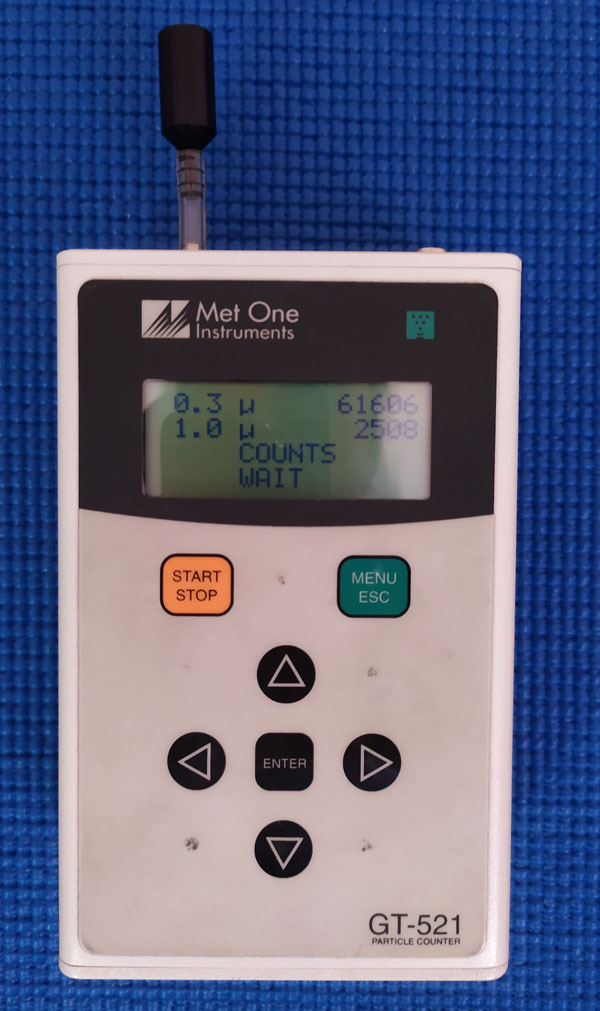
We tested the particle capture effectiveness of each material at capturing 1.0 micron and 0.3 micron particles. The 1.0 micron size mimics the Bacillus atrophaeus bacteria used by the Cambridge researchers (0.93-1.25 microns in size). It’s also a size that can be considered similar in range to coronavirus droplets (5-10µm). 0.3 micron particles are typically considered the most difficult to capture, and so was chosen here as a ‘worst case scenario’. It can give a reasonable estimate for effectiveness of each material at capturing 0.1 micron particles – the size of the coronavirus when not in droplet form.
For each material, downstream air was samples for 30s with and without the test specimen in place, and repeated 3 times. Averaging these values gave us our 0.3 and 1.0 micron capture effectiveness for each material.
Open Data On Best Materials for Covonavirus Face Masks
As part of Smart Air’s open-data policy, we are providing all the data in our experiments available for free for people to download and analyse. The data can be downloaded here:
Ultimate DIY Face Mask Materials for Protecting Against Coronavirus Virus.xlsx
WHAT NEXT?
Along with wearing masks, air purifiers with HEPA filters are also one of the best ways to stay safe from a variety of pollutants in our air including viruses and dangerous PM2.5. A recent CDC study confirmed significantly lower COVID-19 infection rates in schools that used HEPA air purifiers. HEPA filters can significantly lower the risk of a variety of deadly diseases including diabetes, heart disease, cancer, and high blood pressure.

Read More: Four Steps to Choosing the Best Air Purifier
Smart Air is a certified B Corp committed to combating the myths big companies use to inflate the price of clean air.

Experience breathing truly clean air with gimmick-free, effective air purifiers that won’t break the bank. Join the clean air movement.

Free Guide to Breathing Safe
Want to learn more about breathing clean air? Join thousands more and stay up to date on protecting your health.






Hi, thanks for sharing the experimental setup! I was wondering if it is possible to simplify the setup for use at home? I have been using a low cost particle counter connected to a PC for data collection. However, when I use e.g. the surgical mask the ambient sensor reading drops to zero – it might be that where I live the ambient pollution is too low? So I have used a pollution source instead of relying on the ambient pollution. How critical is the tube length, diameter and fan to the experimental setup?
What are the specs of a kitchen “tea” towel since there is so much variation on the market?
Hi. Excellent work and thank you for all your information. I propose test the cotton pads commonly used for make up remove, I being used 1 cotton pad between 2 layer of non woven polypropylene (from shopping bags) like a sandwich. I think it works like a depth filter based in Brownian motion and diffusion effect. Thanks a lot.
Hello,
thank you for this test and for sharing all that valuable information.
This latest test says paper towel is actually a pretty good filter.(96%/47%) or am I mistaken?
However, in your older kitchen paper towel test the results were less favourable (about max. half the filtering capacity).
Am I mixing something up?
thx.
Hey guys, thanks so much for this info, I read your original artlcle before I started making masks for family, friends, neighbors etc. I’ve been using two layers of 100% cotton (from quilting supplies) and making a filter layer inside made from 100% recycled bottles ( Whole Foods reusable grocery totes). If you do another round of testing, it would be great if you added that sort of layer, for example test the combinations – 2 layers of cotton w/ a coffee filter and/or the polypropylene layer. Thanks for doing this and publishing this.