
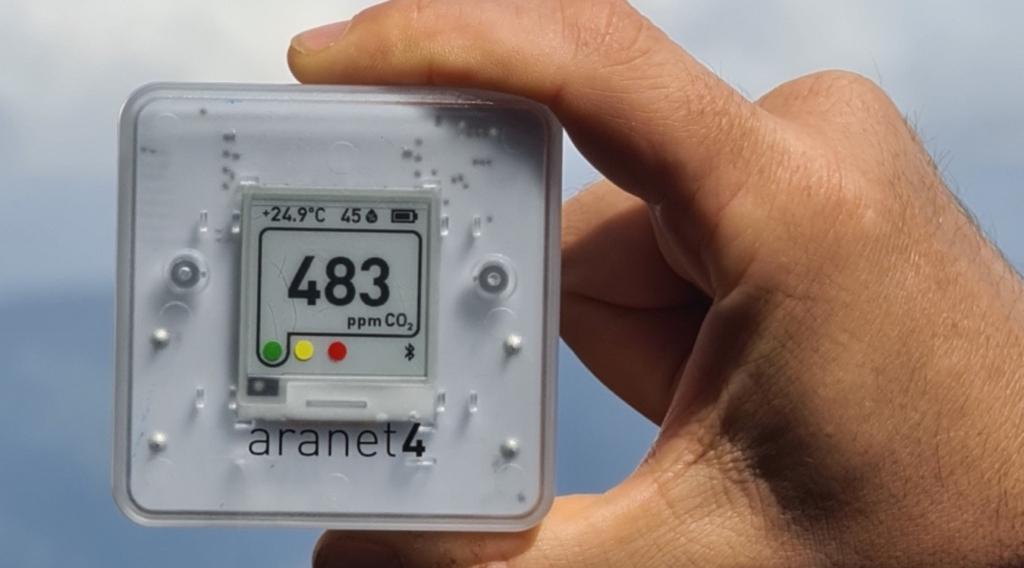
Portable Carbon Dioxide (CO2) monitors are growing popular in home and office. CO2 monitors can help measure ventilation and help lower the spread of respiratory viruses. But what are the best and most accurate CO2 monitors on the market? To find out, Smart Air analyzed CO2 monitor test data to bring you recommendations for the best CO2 air quality monitors in 2023.

Why Use CO2 Monitors?
CO2 monitors can help measure how well a room is ventilated. The higher CO2 levels are, the worse the ventilation. Why is ventilation so important when it comes to the spread of respiratory viruses? The CDC has released data showing strong correlations between poor ventilation and high COVID-19 spread.


Factors for choosing a CO2 monitor for Home and Office
When buying a CO2 monitor, some important factors to consider include:
- Mobility: A monitor can either be permanently installed or portable. Portable CO2 monitors are more versatile, and can be used for multiple rooms
- Sensor Time Response: A monitor needs to be responsive to changes in CO2 levels. Some monitors take a few minutes to respond, but good monitors respond in a few seconds.
- Data processing: A monitor must be able to export recorded data to a hard-drive for further analysis.
- Accurate Background Calibration: A monitor should record a value of 400 parts per million (ppm) outdoors. This indicates that it is accurately calibrated.
- Calibration Method: Monitors can allow automatic or manual calibration, or both. Automatic calibration is easier and more straightforward than manual calibration. However, manual calibration can produce results more quickly, especially when the monitor shows significant inaccuracy.
Recommended CO2 Monitor Technology
In general, CO2 monitors with non-dispersive infrared (NDIR) sensors work very well. Cheaper devices with several sensors that measure Volatile Organic Compounds and Formaldehyde alongside CO2 are not recommended. This is because they likely use a different type of sensor which is less accurate.
Best CO2 Monitors for COVID-19
Below are the best CO2 monitors that are in line with the above factors. These recommendations are based on extensive CO2 monitor tests. All monitors had accuracies at or above 94%. For full details on the monitor tests, check out the test data.
Note: R2 is used as the measure of correlation of the monitors. R2 measures how much variance exists between the actual value of CO2 versus the calculated value by each monitor. An R2 of .7 is represented by an correlation of 70% in this article.
Aranet 4
Expensive relative to the competition, but the Aranet 4 is very accurate, with readings closely tracking the reference CO2 detectors used. It is recommended to do a weekly calibration of the Aranet 4 monitor. Data can also be collected with an app.
Price: $290 USD
Correlation: 98%
Average Deviation: 1.5%
Sensor accuracy: ±30 ppm or ±3%

Temtop M2000
A less expensive option, Temtop is highly correlated and with good background calibration. However, it does not contain any data export function.
Price: $170 USD
Correlation: 96%
Average Deviation: -15%
Sensor accuracy: ±50 ppm or ±5%

Wohler CDL 210
More expensive than most of the other options, the Wohler CDL 210 is one of the highest correlation. Moreover, it enables continuous logging and subsequent data export to PC (even with no power). However, Wohler sacrifices some portability as it has to be plugged in during measurement.
Price: $269 USD
Correlation: 99%
Average Deviation: -0.2%
Sensor accuracy: ±50 ppm or ±5%

AZ 7755
For the same price, the AZ 7755 boasts a higher correlation than most monitors on the market. Data can be stored and analyzed on a PC with the appropriate cable.
Price: $269 USD
Correlation: 98%
Average Deviation: -0.9%
Senor accuracy: ±50 ppm or ±5%

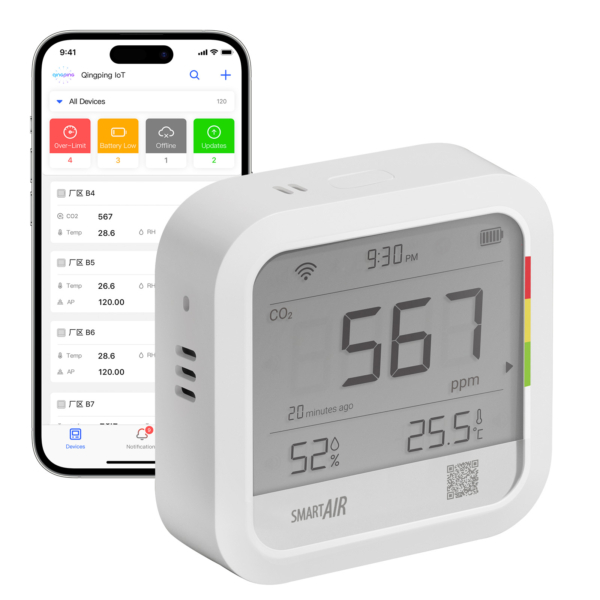
Update: Smart Air CO2 Monitor
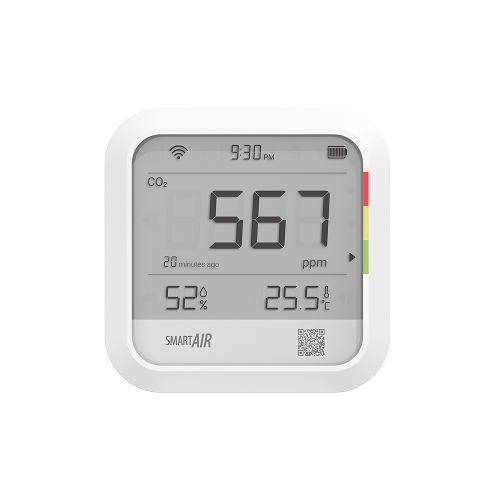
The new 3-in-1 air monitor from Smart Air measures CO2, temperature and relative humidity. Long-lasting with a battery life of up to 30 days, our low-cost monitor gives you the flexibility of choosing the alert thresholds and the frequency of recording. Check out here.
Free Guide to Breathing Safe
Want to learn more about breathing clean air? Join thousands more and stay up to date on protecting your health.








TO CALCULATE THE NUMBER OF RE-BREATHED BREATHS PER HOUR take the CO2 level, subtract 400, and then divide by 40. e.g. If someone smokes marijuana and then breathes it straight into their partner’s mouth, that is a re-breathed breath. If you went up to someone with Covid (or without) and had them breathe directly into your mouth or nose that is a re-breathed breathe. The formula above lets you easily calculate you how often you are doing this per hour (but without the marijuana). If you have a CO2 monitor, you can easily transform the CO2 level into something meaningful… Read more »
A suggestion for any CO2 monitor manufacturers reading this: Why don’t you add a “Percent re-breathed air” calculation – so that users have an important usable measure available? For everyone else, you can actually calculate this fairly easily: Simply take the CO2 figure, subtract 400, and then divide by 400. This will give you the percent of re-breathed air. e.g. If the monitor reads 500 then about 0.25% of the air you breathe has already passed through another human (who may have Covid). If it’s 2400 then 5% of the air is second hand. (So every 20th breath is equivalent… Read more »
Some of these CO2 monitors also seem to measure PM2.5, have any tests been done on their PM2.5 accuracy? For example. the DM1307 looks like it may be a good option for something that is very accurate for CO2, and if it also measures PM2.5 accurately, then a good value compared to the PM2.5 list against PurpleAir and such.
Also– PurpleAir claims to detect down to 0.3 micron, what are your thoughts on whether that would help directly detect possible viral levels?
Otherwise, great stuff on the blog posts! Just wish you had more affordable shipping to North America!
I’ve ordered the cheapest listed Tyler, to supplement my Aranet4 – it apparently now comes with a 2Ah battery. Hopefully replaceable!
Of interest CO2 at around 420ppm would appear generally heavier than air (0.038%) – unless the air itself was particularly ‘heavy’ (humid)?
By the way, the device you have pictured as a “SA1200P” is not the actual device model.
It’s manufacturered by someone in china and resold/rebranded under dozens of different names.
It was my first CO2 meter! It’s not bad. But I’m fairly confident it’s not 98% accurate. I suspect it’s a problem of temperature compensation, but I saw mine read 380 once outdoors.