
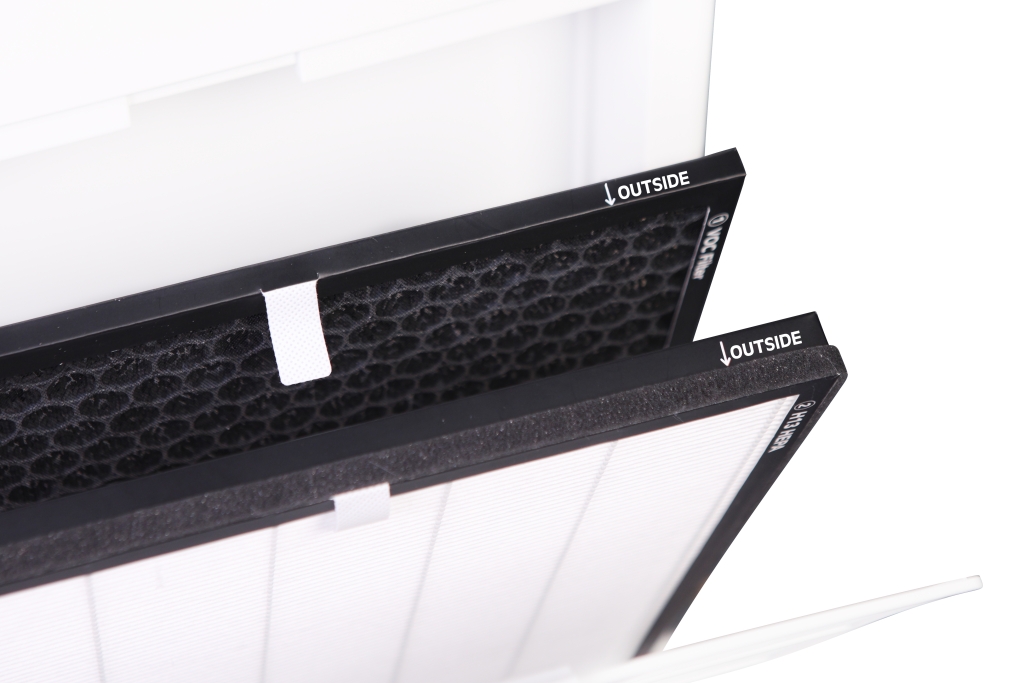
Data shows face masks can protect you from COVID-19, but how about air purifiers? Can an air purifier with HEPA filters remove COVID-19 and other viruses?
Can Air Purifiers and HEPA Filters Remove COVID-19 Virus?
To answer this question, we need to first answer if HEPA filters can capture particles as small as viruses, such as the coronavirus. The COVID-19 coronavirus measures 0.06 – 0.14 microns in diameter.

HEPA filters – the workhorse of any purifier – must remove 99.97% of particles “greater than or equal to” 0.3 microns.

But the definition only mentions particles 0.3 microns and above. What about smaller particles like the coronavirus and other viruses? Can HEPA filters capture these?
This exact question has led to years of confusion and false advertising claims about HEPA filters and is now leading to more misinformation about whether HEPA filters can or cannot capture and remove the coronavirus that causes COVID-19.

Why HEPA Filters are Great at Capturing COVID-19 Virus
The fact that HEPA filters are so good at removing tiny virus particles like COVID-19 is surprising. It’s surprising because our intuition about filters is wrong. Like most people, I had the intuition that HEPA filters work like a net.

If a particle is smaller than the holes in the net, it gets through. Makes sense! However, it turns out that particles as small as the coronavirus, and other nano-particles get captured using a scientific phenomenon called diffusion.
Learn more about the science behind diffusion and how it captures nano-particles »
Diffusion is surprisingly effective at capturing tiny virus-sized particles. According to NASA, HEPA filters capture “virtually 100% of particulates.”

Researchers at the University of Minnesota tested this question with weaker fiberglass furnace filters and higher-grade HEPA filters. In their test, they shot particles of silver from 3 to 20 nanometers at the filters (that’s roughly 5 to 30 times smaller than coronavirus particles).

The results showed that filters captured 99.99% of particles smaller than 5 nanometers. Bingo! HEPA filters are incredibly effective at capturing nanoparticles–even smaller than the coronavirus.
Read More: Can UV Light Kill the Coronavirus?
Do I Need a Medical Grade Air Purifier?
It may seem logical that to filter out viruses, a medical-grade air purifier is needed. Turns out, medical-grade air purifiers are more often than not a marketing gimmick. Normal, HEPA filter air purifiers can filter viruses.
Caveat: HEPA air purifiers are not a silver bullet. They can filter out viruses from the air in homes, offices, and schools, but other steps such as good hygiene and disinfectants should still be used in conjunction with HEPA air purifiers.
Air purifiers that contain HEPA filters or even lower grade filters can capture virtually all sizes of solid particles, including particles 0.1 microns in diameter – or the same size as the coronavirus.
Explore more: What types of filters do I need to protect myself from all types of pollutants?
Free Guide to Breathing Safe
Want to learn more about breathing clean air? Join thousands more and stay up to date on protecting your health.




Can you explain how activated charcoal filters breakdown ozone? I understand it knocks one oxygen atom off making an O2 and an 01. 02 is great. What happens to the other O1? And what’s the percentage of ozone at this happens to? Does it breakdown every ozone molecule? Also, what would be the best filter to filter viruses, smoke particles and ozone? Can we get an all in one filter and what would be a reasonable price and brand name? Thank You 🤔
This is a great article, but I think you should update it to make it clear that SARS-CoV-2 (and other respiratory viruses) do not travel naked through the air but rather are carried in aerosols, with approximately 85% of the total exhaled viral load contained in aerosols below 5µm in diameter. Jose-Luis Jimenez, Linsey Marr, Richard Corsi, & other world-leading experts in aerosols and IAQ put together an amazing FAQ that discusses this and many, many other questions about airborne Covid transmission. Here’s the relevant paragraph and link: “While the size of an individual SARS-CoV-2 virus is very small (120… Read more »
great idea
Thank you for providing such a helpful information about Air purifier. We will visit again soon..
Hi everyone.
1. Even if HEPA catch virus particles, what next? They will stay on it, is it? HEPA would not kill virus,bacteria etc??
2. There are air purifiers using a Thermodynamic Sterilising System (TSS) to destroy airborne mould, bacteria, viruses, dust mites, pollen and pet allergens. Air is drawn into the unit by convection and heated up to temperatures close to 200°C. This temperature effectively sterilises the air, killing harmful viruses and bacteria and destroying allergens with no residue. Air is then cooled and returned to the atmosphere.
3. There is also plasma air purifiers, what about them??