
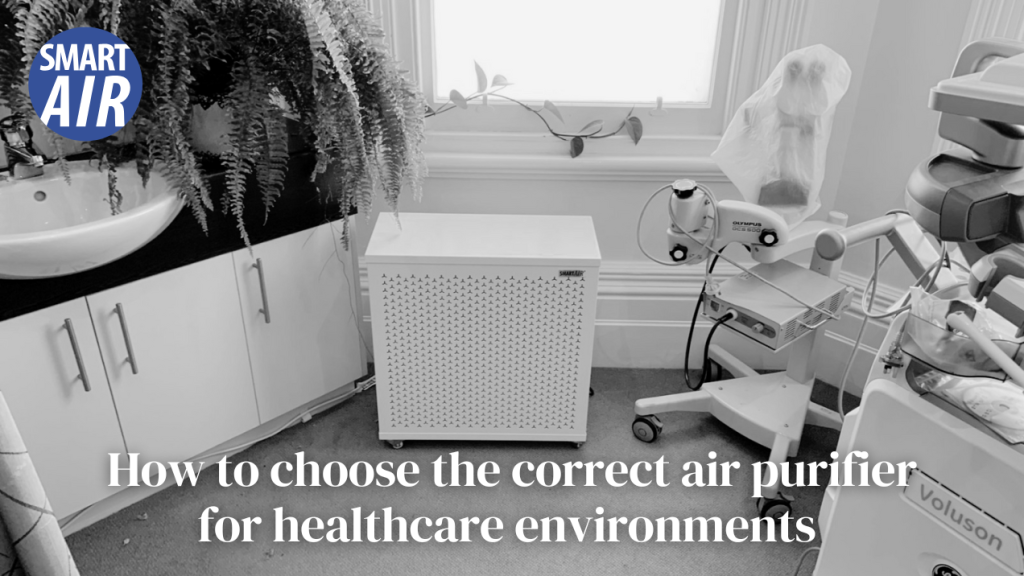
From GP surgeries to dental clinics and treatment rooms, clean air is vital in any healthcare setting. But with hundreds of air purifiers out there from £50 gadgets to £1000+ machines – how do you know what actually works? This guide cuts through the jargon and tells you exactly what to look for when choosing an air purifier for a healthcare environment.
Why air purifiers matter in healthcare spaces
Healthcare environments carry a higher risk of airborne transmission. Think about it:
- You’ve got a steady flow of patients and staff.
- People are in close contact – often indoors and for extended periods.
- Vulnerable groups (elderly, immunocompromised) are regularly present.
Coughs, sneezes, viruses and bacteria don’t just vanish, they linger in the air, sometimes for hours. And without proper ventilation or filtration, they’re free to circulate. This is where air purifiers come in, by removing harmful particles from the air and reducing the risk of airborne transmission. But, that’s only true if you choose the right one.
What to look for in a clinical air purifier
- True HEPA filters (H13 or H14): A true HEPA filter (H13 or H14 grade) is the most effective for air cleaning:
- Captures 99.95–99.995% of airborne particles down to 0.3 microns.
- Includes viruses, bacteria, allergens, dust, and mould spores.
🔍 Watch out for: “HEPA-type” or “HEPA-like” filters. These are just some marketing gimmicks but they don’t actually meet certified filtration standards.
- CADR (Clean Air Delivery Rate): CADR tells you how much clean air a purifier can deliver every hour. It’s the key number that determines whether a purifier is powerful enough for your room.
💡How much CADR do you need?
Use this rule of thumb: Room volume (m³) × 5 (air changes per hour) = Minimum CADR (m³/h)
Example: For a 20m² room with a standard 2.5m ceiling = 50m³ 50 × 5 = 250 m³/h CADR Aim for 5–6 air changes per hour (ACH) in standard clinics and up to 8–12 ACH in high-risk areas.
- Quiet operation: Nobody wants a purifier that sounds like a vacuum cleaner. For healthcare settings, keep it under 50 decibels on high settings. That’s about the volume of a normal conversation – enough to work around, but not disruptive.
✔️ Ideal for consulting rooms, treatment areas and waiting spaces
✖️ Anything above 60 dB can be distracting for staff and patients
- No ozone, no UV: Some purifiers use ionisers or UV light to “zap” germs. Sounds clever but these come with serious downsides:
- Ozone is a known respiratory irritant (and banned indoors in some countries)
- UV components can produce harmful by-products if not properly designed
- Most don’t provide real-world protection unless used in sealed chambers
In healthcare settings, filtration is safer and more effective than unregulated “active” technologies.
- Easy to maintain: In a busy clinical environment, the purifier should be:
- Easy to move (if needed between rooms)
- Simple to operate (no fiddly settings)
- Quick to change filters (ideally tool-free)
💡Pro tip: Choose a model with readily available filters, not something you need to special order every six months.
Final thoughts
Choosing the right air purifier for a healthcare environment is about science-backed performance. You need clean air, fast turnover, and safe, proven filtration. If you're unsure which model fits your room size or risk level, we can help. At Smart Air, we test every purifier ourselves and we’ll give you the data, not the sales pitch.
Want help picking the right air purifier for your clinic? Drop us an email on [email protected].

