
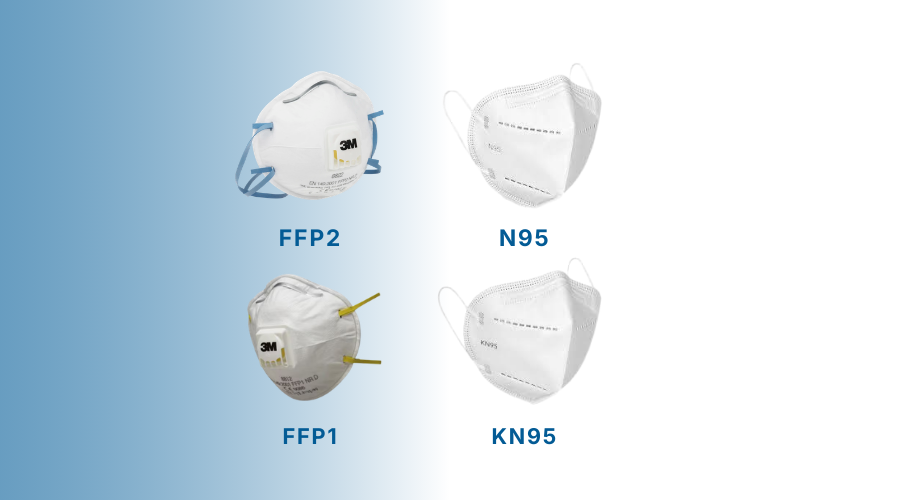
Mask ratings can be confusing: N95, KN95, FFP1, FFP2, P2, or surgical mask? This quick run-down of mask specifications covers mask types, mask ratings, and their effectiveness at filtering particles.
Let’s begin by discussing mask types or certification types. There are generally three commonly used, disposable masks: single-use face masks, surgical masks, and respirators.

N90 mask VS N95 mask
Other variations of the N95 mask include N90, valved N90, valved N95, KN90, and KN95. In the case of the N90 mask, “N” means not resistant to oil while the number 90 indicates the mask’s ability to filter out 2.5 p.m. dust particles.
Summary: Mask Standards and Effectiveness
- Single-use masks (normally one layer, very thin) are typically only effective at capturing larger dust particles but can do so fairly well.
- Surgical mask standards have higher requirements for capturing virus-sized (0.1 microns) particles, however, they vary by region.
- Pollution masks (respirators) typically capture >90% of virus-sized particles. You can use the rating system in the table above to see the exact proportion each certification requires. This includes ratings such as N95, KN95, FFP1, FFP2 and FFP3.
Mask Standards Vary by Country
Each country has its certification standard for each mask type. For example, Europe uses the EN 14683 standard for surgical masks, whereas China uses the YY 0469 standard. Each standard varies a little by country, however they are broadly similar. For respirator masks, China uses the KN standard (e.g. KN95) and the US uses the N standard (e.g. N95).
Read more: what’s the difference between KN95 and N95 masks »
Requirements Are Lowest for Single Use Face Masks
The standard with the lowest requirements on filtration effectiveness is the single-use face masks (not to be confused with surgical masks). Surgical masks have higher requirements, and respirators have the highest requirements. Respirators also usually fit tighter around the face (data shows they score higher on fit effectiveness) than surgical masks and single-use face masks.

Coronavirus & Mask Livestream
Wondering whether masks work to protect you against the coronavirus? Check out our livestream recap covering all the info here!
3M vs. FFP1 vs. FFP2 vs. N95 vs. KN95? What Do Mask Numbers and Letters Mean?
A visitor to the website asked this in the comment section on coronavirus and Pitta masks a few days back:
Could you please explain: if a mask is FFP2 or 3, but NOT 3M – what does it mean exactly concerning COVID-19? Thank you!
Here’s an explanation of the difference between N95, 3M, and PM2.5, to help you out.
N95, N99, FFP1, FFP2 and FFP3 Mask Ratings
The ratings cover (most importantly for us) the filtration level, among other things. You can think of them like G, PG, PG-13, R ratings for movies. The movie ratings cover who can watch them.

EN 149:2001+A1:2009 / ASTM F2100 / NIOSH
These are standards for masks. They specify the rules and testing methods companies should follow to rate their masks. These standards define the N95, FFP1, and FFP2 ratings above. Using the movie rating analogy, you can think of it like this: the people reviewing movies and choosing the appropriate movie rating must have a set of rules to decide if the movie is considered PG-13 or R. They’ll follow these rules to rate the movie. These standards are the set of rules for masks.
Why are there so many? Standards labeled “EN” are for the EU. ASTM F2100 (NIOSH) is for the US. Many other countries will have their own rating systems too.
3M Masks?
3M is a company that manufactures masks. They generally produce masks that meet KN95 or N95 standards. Buying masks from a trusted company may reduce the odds of the masks failing quality standards.
What Are KF94 Masks?
KF94 is a respirator mask standard in South Korea. KF94 masks are similar to N95 and KN95 masks, but instead of filtering out 95% of particles, they filter out 94%. In Korea, KF94 respirator performance standards are not considered to be equivalent to N95 or FFP2 respirators, while Korea’s 1st class respirators are.
PM2.5 vs. N95
As we now know, N95 is a mask rating. PM2.5 refers to “particulate matter” or a fancy way of saying “pollution particles” that are in the air. The 2.5 refers to the size of these particles as being 2.5 microns or smaller. This picture can give you a visual example of how big PM2.5 particles are.

FFP2 vs. N95
FFP2 and N95 masks are quite similar regarding filtration effectiveness. The key difference is that FFP2 follows the European EN 149 standard, while N95 follows the American NIOSH standard. FFP2 must filter at least 94% of airborne particles, while N95 must filter at least 95%.
Medical Grade Air Purifiers?
This article has covered medical-grade masks, but they’re just one tool in protecting against airborne pollutants and viruses. When indoors, HEPA air purifiers are extremely effective at removing viruses and other pollutants from the air. So what is the deal with medical-grade air purifiers? Do you really need a “medical grade” purifier?
Learn more: what are medical grade air purifiers »
1. Three randomized studies have found surgical masks are just as effective as N95 masks at preventing virus transmission. They hypothesize the main reason for this is that any mask can reduce the hand-to-face contact, although we don’t know this for sure.
2. If you’re wearing a mask with a valve, you are protected. The valve does not bring in any outside air into the mask. Fit-test data has found that masks with valves are often among the highest scoring.

However, valves will not protect other people as well. If you are sick, and you breathe out, some of the moisture from your breath can expel through the valve, potentially putting others in danger.
3. Tests have found that DIY masks can filter a percentage of virus-sized particles. While they’re not as effective as surgical or N95 masks at filtering viruses, they can still provide some benefit. They can also reduce hand-to-face contact.
Free Guide to Breathing Safe
Want to learn more about breathing clean air? Join thousands more and stay up to date on protecting your health.






You are selling masks, so misleading claims would benefit your sales. Please understand your claims are taken with a grain of salt. Anyone with a modicum of sense would seek an independant source to validate this. Respirator masks of the highest level are the only masks that offer consistent noticeable protection against viruses is the consistent message given by research outside of mask vendors and government agencies
It looks like somebody got a decimal wrong on here! The Most Penetrating Particle Size is 0.3 microns, not 3.0 microns!
https://www.epa.gov/indoor-air-quality-iaq/what-hepa-filter
Filtration Efficiency: This refers to a mask’s ability to filter out particles, typically measured as a percentage. The higher the filtration efficiency, the better the mask is at trapping particles. Commonly used metrics include Particle Filtration Efficiency (PFE), Bacterial Filtration Efficiency (BFE), and Viral Filtration Efficiency (VFE). Higher-rated masks generally have higher filtration efficiency.
The effectiveness of different masks at preventing the spread of respiratory droplets and reducing the risk of exposure to the SARS-CoV-2 virus, which causes COVID-19, can vary based on the mask’s material, design, and fit.
One commonly used rating system is the N95 rating, which is used by the National Institute for Occupational Safety and Health (NIOSH) in the United States. N95 masks are designed to filter out at least 95% of airborne particles, including those that are too small to be seen by the naked eye. They are considered to be highly effective in preventing the spread of respiratory viruses such as COVID-19.