

Newly renovated apartments and offices typically have high levels of formaldehyde. One of the most effective ways of removing formaldehyde is to run a formaldehyde cookout. But what is a formaldehyde cookout and how do you run one? In this article, we show how to run a cookout in your home or office, in just 5 simple steps.
What is a Formaldehyde Cookout?
The name ‘cookout’ comes from the idea that you ‘cook’ the formaldehyde ‘out’ of your building. By heating up your building, materials that contain formaldehyde will off-gas more quickly, allowing formaldehyde levels to reduce more rapidly.

Subscribe to Smart Air on YouTube

What is the standard HCHO level?
According to research, average concentrations in older houses without UFFI are typically below 0.1 (ppm). Levels in households with a high concentration of fresh-pressed wood products can exceed 0.3 ppm.
How Effective Are Cookouts for Formaldehyde Removal?
Tests run by Smart Air show a single cookout reduced formaldehyde by 67% from 0.3 PPM to 0.1 PPM. This is one of the most effective methods to reduce formaldehyde levels within just hours.

How to Run a Formaldehyde Cookout: 5 Easy Steps
Before getting started with your cookout, here are some basic things you should know:
Time required per cookout: 4-12 hours (8+ hours recommended)
Recommended minimum number of cookouts before occupying space: 3
We recommend running each cookout for at least 8 hours. This allows enough time for your room to really heat up, and for the formaldehyde to be off-gassed. In addition, a single cookout test can’t remove all the formaldehyde in one go. That’s why we recommend running at least 3 cookouts before moving in. If you have the time, then running more is recommended.
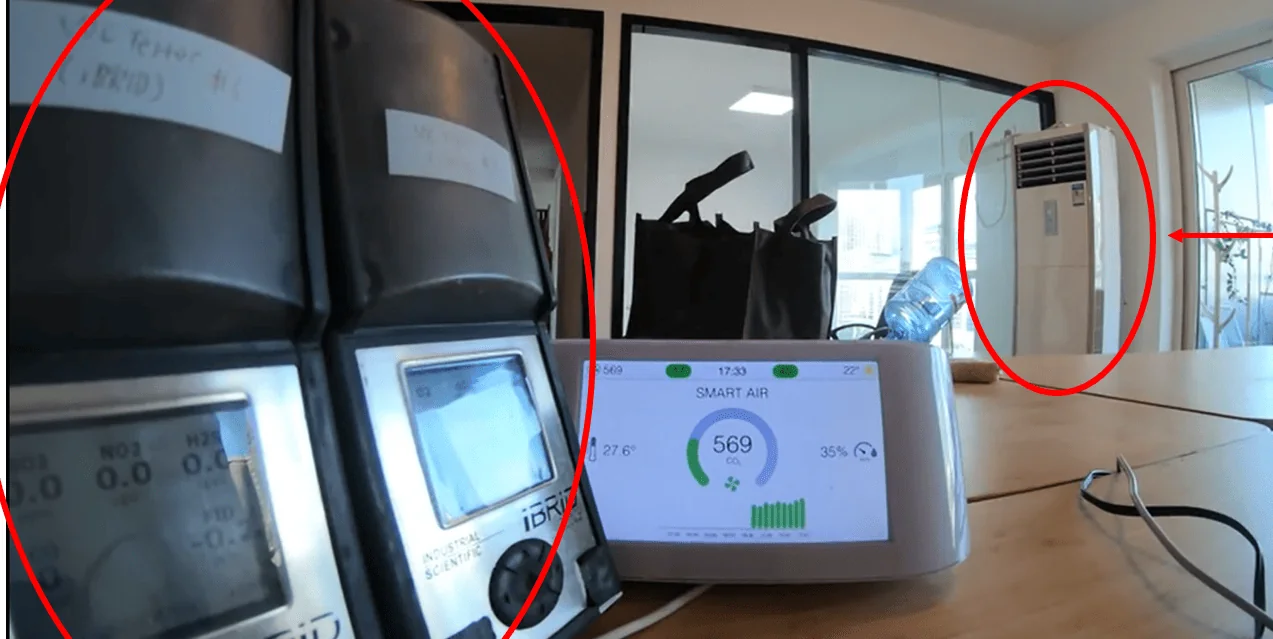
Step 1: Seal the Room and Turn Off the Ventilation
Close all windows and doors to restrict airflow in the room. Doing this allows it to heat up more quickly.

Step 2: Heat Up the Room
Aim to raise your room temperature to around 30-35 degrees C (86-95 F). Research has shown that formaldehyde “off-gases” 1.5-3 times quicker in this environment. If you don’t have an air-con or electric heater, you could use your property’s central heating system.

Step 3: Leave the Room Immediately
Leaving the room prevents you from being exposed to increased levels of formaldehyde!

Step 4: Let it Cook!
Let the room cook for at least 4-12 hours (we recommend 8+) to give the room enough time to heat up properly.

Step 5: Release the Built-up Formaldehyde
During the previous step, formaldehyde will have built up in the room. Return to the room, turn off your heating, and open all doors and windows. This will allow the built-up formaldehyde to escape the room rapidly.
Repeat the above 5 steps a minimum of 2 more times.

BONUS: Want Smart Air Professionals to Help You?

Smart Air can help you with formaldehyde removal and air quality testing. Smart Air is a certified B Corp started by University of Chicago Professor Thomas Talhelm to combat the myths big companies use to inflate the price of clean air.
Free Guide to Breathing Safe
Want to learn more about breathing clean air? Join thousands more and stay up to date on protecting your health.







What is the time you typically use to air out the rooms in between sessions? Maybe 20 minutes or a few hours? Also, when airing out the rooms for the first and second session, can people be in the house during the airing out for over 10 hours? We have a construction worker currently wanting to do work in the house during the times we’re airing out the rooms. This content is so helpful thank you!
Hi. Thank you for your content and efforts. In addition to heating and humidifying, can a UV lamp with ozone generation be used to increase formaldehyde off-gassing and cookout from new furniture?