
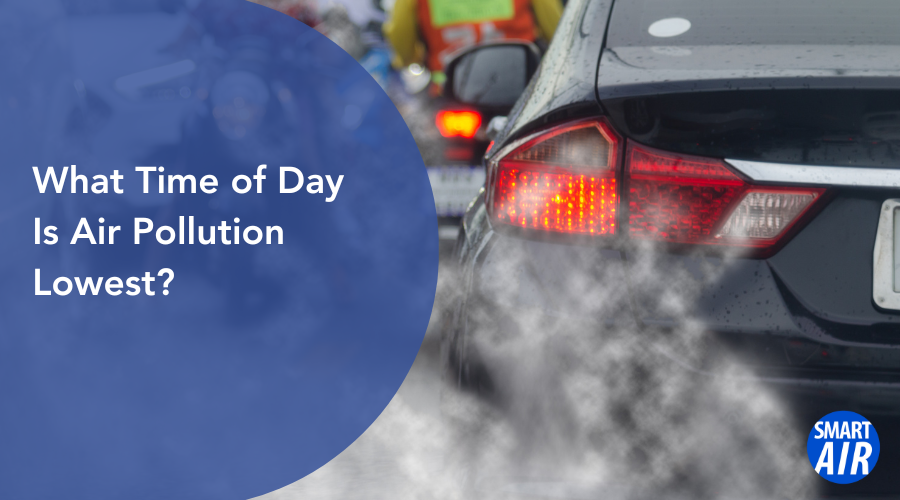
My intuition has always been that there is less air pollution at night because there are fewer cars on the road and fewer factories humming at that time of day.
Pollution Time of Day Guesses
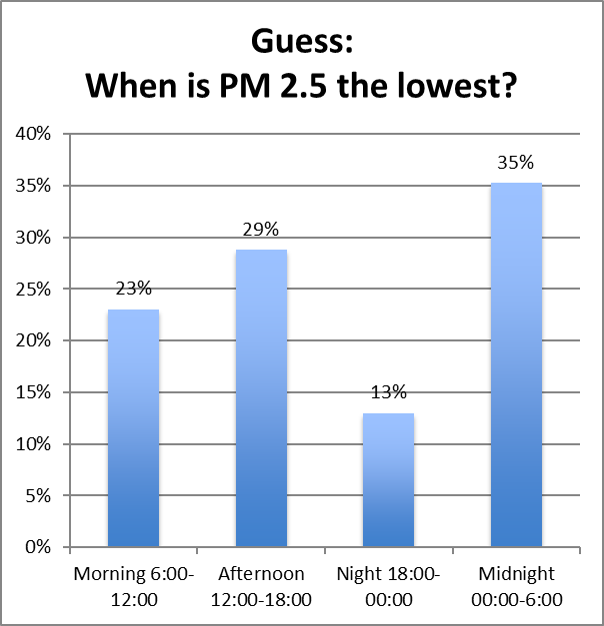
Apparently, I’m not alone: 139 voted for their guess about what time of day has the least air pollution (lowest PM2.5), and nighttime came in first.
I also know people who arrange their schedules to work out in the morning to avoid the worst pollution. But how accurate are our intuitions?
Time of Day Pollution Data
To get to the bottom of it, I analyzed thousands of hours of PM2.5 data from the US Embassy in Beijing. When I finally got the answer, I was surprised:

Instead of during the quiet of the night, it’s the afternoon–right around rush hour–that PM2.5 is the lowest. So if you’re planning a picnic or insist on exercising outside, you’re usually best off between noon and 6 pm.

Air Quality in the Morning Vs Nighttime
Researchers discovered that particulate matter concentrations are greater in the morning and at night. It is especially active between 7:00 and 10:00 a.m. and 9:00 and 11:00 p.m. (LST). On the other side, it is lowest in the afternoon, particularly from 3:00 and 5:00 PM (LST).
What about other cities?
Is that how PM2.5 generally works, or is it unique to Beijing’s activity or climate? Fortunately, US consulates in several other cities publish their historical data.
Shenyang
In terms of climate, Shenyang is pretty similar to Beijing, and its daily PM2.5 patterns are very similar (although nighttime isn’t quite as bad as Beijing):

Chengdu
The pattern in Chengdu is similar. PM2.5 is lowest in the afternoon and highest in the morning.

Shanghai
The picture starts changing when you get to the south. In Shanghai, PM2.5 is lowest in the afternoon (like in the north), but there’s also a dip in the very early morning:

But also note that the scale is really zoomed in for Shanghai and Guangzhou (below). The difference between the lowest and the highest averages for Shanghai is only about 4 micrograms, as opposed to about 25 micrograms in Beijing.
Guangzhou
Guangzhou’s pattern was virtually identical to Shanghai’s: a dip in the very early morning and a dip in the afternoon.

Pollution and Time of Day Worldwide
Maybe this is just a China pattern? A 2018 study analyzed data from all around the world, and found a similar pattern–PM2.5 tends to be lowest in the afternoon.


Why Is Pollution Best at Rush Hour?
How does it make any sense that pollution is the lowest during rush hour? Read more on why pollution is worse at night.

But keep in mind that the air is NEVER safe on average in any of the five cities at any time of day. So take “safest” with a grain of salt!
Open Data
All of the data is available from the US Embassy and consulate websites. Thanks to Josh Malina for collecting and analyzing the consulate data.
Caveat: Gas Pollutants
It’s important to point out that this analysis uses data on particulate pollution. There are other types of pollution out there. One big one is ozone pollution, which tends to be highest around midday.
Free Guide to Breathing Safe
Want to learn more about breathing clean air? Join thousands more and stay up to date on protecting your health.





This is really interesting and contradics other information I’ve read online. As an asthma sufferer who likes the outdoors, it’s really important for me to know when it’s safest to go out. It makes sense that polution is lower in the afternoon as it will be warmer and the air will rise and expand, carrying those particulate matter with it. Thank very very much for sharing this important data.
Would you say this also goes for villages, where most pollution is caused by people burning various materials to warm their houses up, and not by cars?
Thanks a lot, man. Very useful data. I’ll workout in the afternoon from now on
Hi Thomas
You did an appreciable work with proof of concept. Indeed it helped to understand the different timings of concentration of pollutants.
thanks