
Companies sell activated carbon filters (also called “charcoal filters” or “carbon air filters”) to remove chemicals like formaldehyde and benzene, but does carbon really work to remove VOCs? The Smart Air lab put real-world carbon air filters to the test.
Who Needs Carbon Filters Anyway?
I wrote early on that my number one concern in China is particulate pollution. It’s on so many people’s minds that nowadays even the guy I buy kebabs from knows the word “PM2.5.”

HEPAs do an amazing job at removing particulates, but particulates aren’t everything. Gases like volatile organic compounds (VOCs) are so small that they slip through HEPAs. “VOC” is a big category, including things like benzene and formaldehyde. VOCs can cause cancer, throat irritation, dizziness, and other not-fun side effects.

When I published the instructions for how to build your own purifier, I wasn’t comfortable recommending activated carbon because I hadn’t tested it, and I didn’t want to just trust what the big filter companies said. So this year, I set out on a journey to test whether carbon actually works.

Put to The Test: Does Carbon Really Work?
I soon learned that gas testing is not easy. First off, “harmful gases” is not a natural category. You can buy a particle counter that will detect all particles of a certain size, but there is no detector that will detect all gases. Instead, you need one for each type of gas, and that is not cheap.
In this case, my scientific curiosity cost me $3,542 for this Industrial Scientific Ibrid MX6. It detects VOCs, carbon monoxide, sulfur dioxide, hydrogen sulfide, and nitrogen dioxide. It uses a photo-ionization detector to measure VOCs from 0-2,000 parts per million with a resolution of .1.
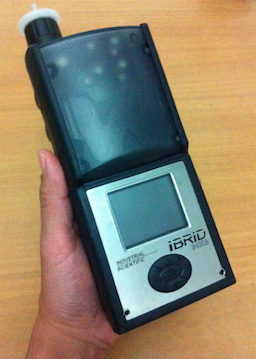
Next, I needed a source of gas pollution. Interestingly enough, my apartment didn’t have enough VOCs to register on the MX6–nor did 8 other Beijing apartments I tested. (That speaks to whether purifier companies should scare people into thinking that everyone needs carbon.)
Because I didn’t have detectable VOCs in my home, I had to go out and find VOCs to pump into my room. I chose cigarettes because they are known to emit VOCs like benzene and formaldehyde.
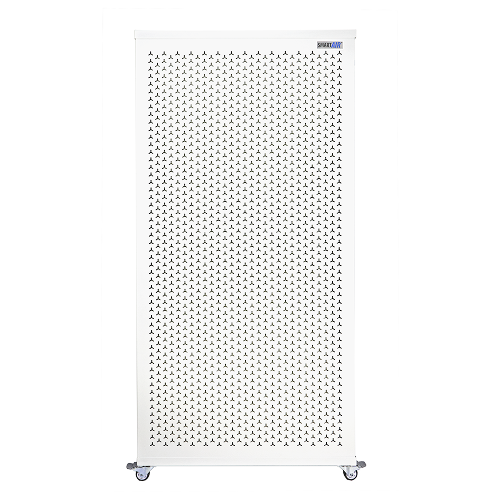
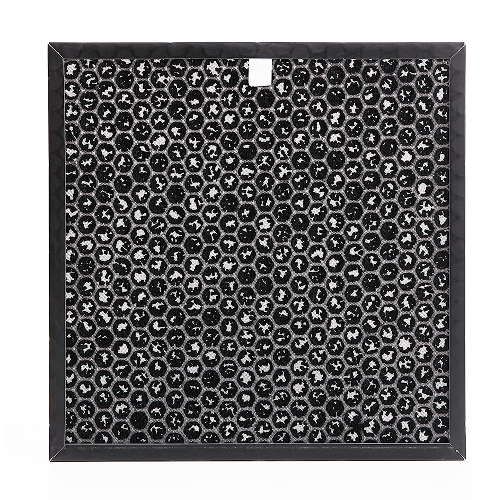
In each test, I burned 3 Marlboro cigarettes in an enclosed 3.78 m2 porch. At the same time, I ran the Cannon on high for five tests with a composite carbon filter on the front:
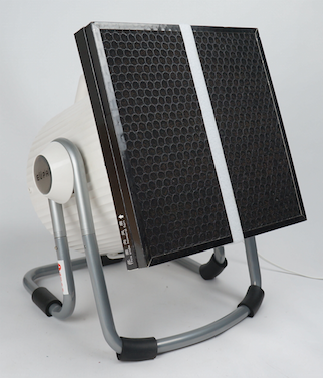
I ran four control tests with a fan but no filter. That way the room still has air flow, but no carbon. The cigarettes burned out after about 15 minutes, and I left the fans on for another 30 minutes.
Results: Does Activated Carbon Filters Really Work?
Looking at the Cannon + carbon alone after the cigarette was extinguished, the VOCs dropped. Here is the data from one test:

But maybe the VOCs would have just dissipated on their own? From there, we can zoom out to include the time the cigarette was burning and the test where we had just a fan (no filter). From there, it becomes clearer that the carbon was removing VOCs above and beyond just having a fan on.
Averaging across all of the tests, the VOCs reached a maximum of about 1 ppm while the carbon was on. Without the carbon, VOCs reached 1.5 ppm.

After the cigarette burned out, the Cannon cleared the air of VOCs in just over 15 minutes on average. Without carbon, the air still had VOCs after 30 minutes.
Averaging over all of the tests, the carbon removed 38% of VOCs by the time the cigarettes burned out compared to the fan-only condition. The Cannon removed 68% after another 5 minutes and 100% by 20 minutes after the cigarettes burned out.

Test data showed that activated carbon filters effectively removed VOC gases compared to just a fan alone.
Thus, I’ve decided these filters are ready for game time. I’ve started shipping these tested carbon filters via our website and Taobao.

Does Everyone Need Carbon?
Does carbon really work? Yes. But does everyone need carbon? Purifier companies have a financial incentive to convince people to buy carbon filters. They make more money if they can scare people into buying carbon. But does everyone need carbon?
I don’t want to scare people into buying carbon. Why? In most homes, my MX6 detected zero VOCs. I only found VOCs in homes that had an obvious source of pollution such as remodeling or smoke. And in all of the places where the MX6 detected VOCs, I was able to notice a chemical smell. That makes sense since lots of VOCs have noticeable smells, like benzene, toluene, and formaldehyde.
Now, I don’t want to say that VOCs are never a problem. Photoionization detectors like the MX6 are not the most sensitive test type out there. I bet I’d pick up small amounts of VOCs if I sent air samples to a laboratory.
However, scientists have used fancier methods and found similar results. For example, scientists in Hong Kong tested homes and found that most non-smoking homes did not have unsafe levels of VOCs. We need more tests like this to be sure.
For now, I will not be using carbon in my home, but I think it is right for people whose homes have:
- 1. Renovations completed recently
- 2. Freshly painted home
- 3. Smoking
- 4. Odors
- 5. Nearby sources of gas pollutants (such as living near a factory)
- 6. Symptoms such as inflammation and asthma
Do I Still Need The HEPA?
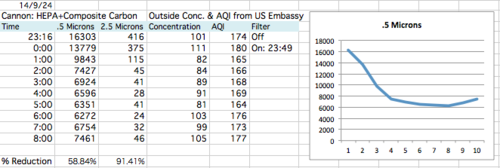
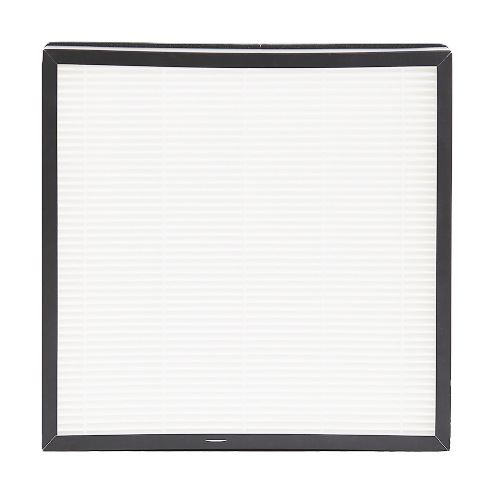
Yes. Carbon captures gas pollutants, not particulate pollution. I wouldn’t have even tested this, but Anna accidentally forgot to attach the HEPA and unknowingly ran a regular particulate room test with carbon only.
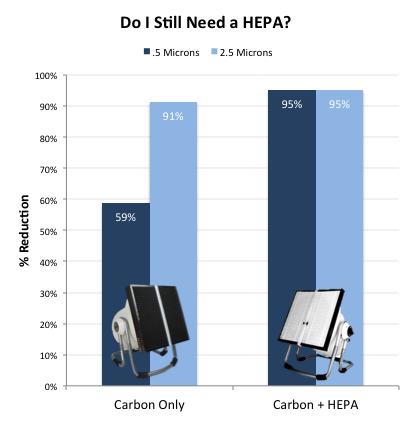
The results weren’t pretty–far below the 95% reduction with the added HEPA. Thus, I do not recommend using carbon only.
As always, I’m posting the raw data and more details on the methods for fellow nerds below.
Does Carbon Really Work: Open Testing Methods
During the gas test, all of the doors and windows were closed. Because the test took place on an enclosed porch, there were several windows, which means the room was less well-sealed than an interior room.
During the test, I burned three Marlboro cigarettes pointing straight up in an ashtray on the floor. The gas detector was on a small ledge at just above waist height, only a few feet laterally away from the cigarettes. The purifier was placed a couple feet from the cigarettes in the center of the porch with the air stream pointing upward.
Limitations
Burning three cigarettes in a small room is extreme. With the exception of airport smoking lounges, few places will have this much smoke in one place. However, the test does demonstrate that carbon reduces VOCs.
Many people have asked me how long carbon filters last. Unfortunately, I don’t have a good answer to that. The carbon filter I used was still effective after several of these powerful smoke tests, which should be far more VOCs than a normal person would face, but I cannot say more than that.
VOC Info: The PID lamp has an eV rating of 10.6. eV ratings determine what types of VOCs PID machines can detect. With a rating of 10.6 eV, this machine probably reliably detected benzene, which has an ionization potential of 9.25, and perhaps toluene, which is at 8.82.
This PID lamp is not designed to detect formaldehyde, which has an ionization potential of 10.88. However, I later conducted tests with formaldehyde samples and found that the MX6 could detect it, and an engineer at Industrial Scientific told me he thought it was plausible that the machine would pick up on formaldehyde, although not 100% reliably.
Detector Info
The MX6 came with a pump to draw in air (as opposed to versions that passively sample air). During the test, the MX6 had a filter on designed to prevent particles from entering the machine. I zeroed the machine if necessary before the test.
Early Tests
As I started doing the tests, I was still figuring out how to do the tests–it seems simple when you look at the results, but tests like this are not easy! For the first three control tests, I had not yet decided to let the MX6 run for 30 minutes after the cigarettes burned out, so data is limited for those three occasions. However, the conclusions are similar with those three tests excluded.
Control Condition
In the control condition, I used a Honeywell fan on the low setting to approximate the airflow of a Cannon on high with a filter on it. The point is that filters lower the airflow, so the Honeywell may be a better approximation of the amount of airflow during the experimental condition.
In addition, I ran tests with an IQ Air Health Pro Plus (1) with the filters removed and (2) with the pre-filter only as additional control tests. The results were similar to the Honeywell fan-only tests. I’ll use the IQ Air tests as the control condition in tests of the IQ Air’s ability to remove VOCs in the future.
Gas Test Data
The table below summarizes the gas tests. Because the raw data file is large, I’m making it available as a download from this file: Cannon VOC Tests
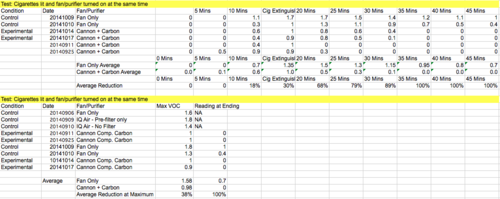
Data: Carbon-only test

Free Guide to Breathing Safe
Want to learn more about breathing clean air? Join thousands more and stay up to date on protecting your health.






I built a walk-in cooler ( 800 CF) in my commercial kitchen, putting the panels together and sealing them with Lexel caulking, later to find out it has 391 grams of VOC’s per liter of material. When i finished it and closed the door, the smell and was intolerable due to the Toluene present in the Lexel. I decided to cook it out and after several months of cooking it at 95 degrees F along with an exhaust fan ducted to outside the building, I still have some smell, maybe 10% of the original, even after sealing all of the… Read more »
Wow! I am a science teacher and you seem to have been pretty explicit on your test as one variable per test will give more accurate information. And to Anna, thanks as we learn a lot from our mistakes as well. The Nestlé Toll House s chocolate chip cookie and the pretzel were mistakes, but awesome ones. 😉. Mistakes only give us more information :-). Funny, I had asked the questions to your exact answers shortly before finding your article.🙏 Amen to finding the answer. I retired from teaching science two months ago, but I will never retire from learning.… Read more »
I know you said your industrial detector targets “VOCs, carbon monoxide, sulfur dioxide, hydrogen sulfide, and nitrogen dioxide”, but does that cover ozone caused the photocatalytic reaction of UV with NOx and VOCs? Because that’s probably the largest air pollutant you’re going to experience in Beijing apart from the PM2.5. That’s what our Federal EPA measures daily and in some of our States, it’s at harmful levels for a good majority of the year, especially if you live in a valley. You might also want to have a radon gas detector if you live in an area where that is… Read more »
Recommended time of replacement for Carbon filters? i’m just wondering if it’s okay to retain the carbon while changing HEPA filter every 6mos, or do they need to be replaced at the same time.
Great article! Tremendous insights.