
With increasing awareness of indoor air quality and electromagnetic fields (EMFs), customers are starting to ask us about the levels of EMFs in our air purifiers and air quality monitors. Are these devices emitting harmful EMFs? Can they still improve indoor air quality without unwanted side effects?
Here’s what you need to know...

What are EMFs?
Electromagnetic fields (EMFs) are invisible energy waves produced by electrical and wireless devices. They exist in both natural and human-made forms. The sun, for instance, emits EMFs in the form of ultraviolet rays, while power lines, mobile phones, and microwaves generate artificial EMFs. These fields can be broken down into three main types:
- Radio-frequency (RF) fields: Emitted by wireless communication devices such as mobile phones, Wi-Fi routers, and Bluetooth gadgets.
- Magnetic fields: Generated by power lines, electrical wiring, and some household appliances.
- Electric fields: Present wherever electricity flows, such as around electronic devices and power cords.
Some devices may emit high levels in one type of EMF but low in another. While research is ongoing, some people prefer to minimise their exposure, particularly in their homes and in their sleeping areas.
The role of air purifiers
Air purifiers help improve indoor air quality by removing airborne pollutants such as dust, allergens, pet dander, and volatile organic compounds (VOCs). They operate using various technologies, including:
- HEPA filters: Capture fine particles like dust, pollen, and smoke
- Activated carbon filters: Adsorb gases, odours, and VOCs
- UV-C light: Neutralises airborne bacteria and viruses
- Ionisers: Release negatively charged ions to attract and remove airborne particles
Do air purifiers emit EMFs?
Like all electrical devices, air purifiers produce some level of EMFs, but in most cases, this is relatively low like other household appliances. However, certain types of air purifiers may contribute more to RF exposure than others:
- Ionisers: These generate charged particles and often produce higher EMFs, particularly in the RF range
- UV-C air purifiers: While they do emit some EMFs due to their power supply and ballast, their levels are typically much lower than those of ionisers
- Wi-Fi-enabled models: Air purifiers that connect to apps via Wi-Fi or Bluetooth may contribute to higher RF exposure
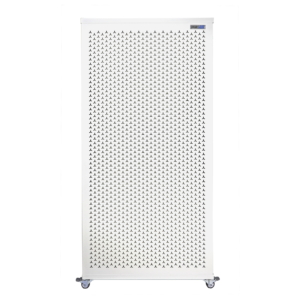
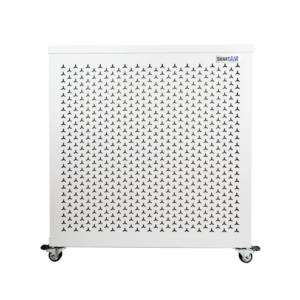
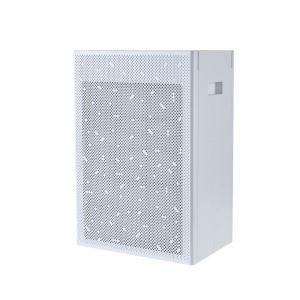
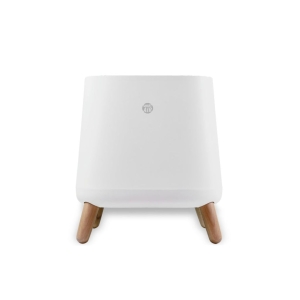
If you are looking to reduce EMFs, consider a non-smart model i.e. one that can be used without a wireless connection - like the Smart Air range of air purifiers. Our air purifiers are also HEPA & Carbon only, with no ozone or additive technology.
The role of air quality monitors
Air quality monitors measure indoor air conditions, tracking pollutants such as particulate matter (PM2.5 and PM10), carbon dioxide (CO2), humidity, and VOCs. More advanced models integrate with smart home systems, providing real-time tracking and alerts.
By using an air quality monitor, you can:
- Identify pollution sources in your home
- Adjust ventilation and filtration strategies accordingly
- Gain insights into seasonal or activity-related changes in air quality
Do air quality monitors (AQMs) emit EMFs?
Air quality monitors generally require constant Wi-Fi or Bluetooth connectivity to sync data with apps, contributing to higher RF exposure. However, you can also choose to use your air quality monitor in real-time measurement mode without needing a network connection.
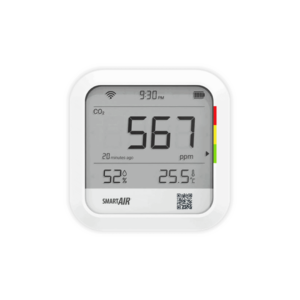
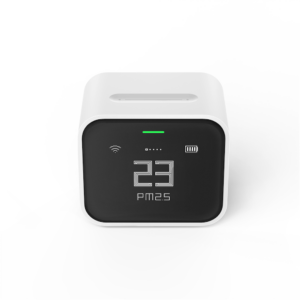
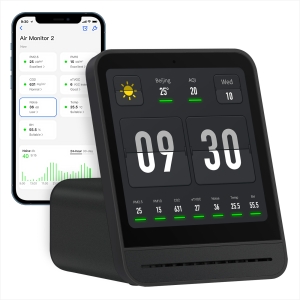
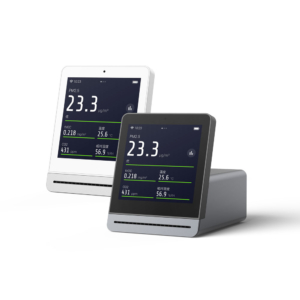
With Smart Air AQMs, you need to connect to Wi-Fi for the following:
- To check for Firmware updates
- For the QP Lite and the CO2 monitor, the device settings can only be adjusted via the app
- For local weather date on the QP Pro and QP Pro 2
- To save your historical data
If minimising EMF exposure is important to you, consider using your device for real-time monitoring only. Many customers are curious about running historical data only after initially purchasing their device but after a while, it is used just to see the current data reading. In this case, you can disconnect the device from Wi-Fi but keep the app on your phone - check this monthly for firmware updates. To update the firmware, re-connect your device to the app (if it doesn't reconnect, remove it from the app and add it again).
Finding balance between EMFs and air quality
For those concerned about both EMFs and air quality, here are some practical steps:
- Choose low-EMF air purifiers that rely on mechanical filtration rather than ionisation or additive technology
- Purchase mechanical air purifiers with no Wi-Fi or keep Wi-Fi-enabled air monitors and purifiers at a reasonable distance from sleeping or resting areas to reduce prolonged exposure
- Opt for air quality monitors that offer manual or offline readings rather than requiring constant wireless connectivity
While EMFs are present in all electronic devices, they vary in intensity depending on the type of device and its features. By choosing the right air purifier and air quality monitor, you can create a cleaner, healthier home while keeping EMF exposure to a minimum.
Making informed choices ensures you can breathe easy—both in terms of air quality and peace of mind.

