

When I started Smart Air in 2013, I wanted to buy an air quality monitor. I had two options. I could buy a US$260 Dylos or spend thousands of dollars on the crazy expensive particle counters. Since then, the market has exploded with new air quality monitors as cheap as 99 RMB. But are they any good?
Putting Air Monitors to the Test:
Dylos dc1700 vs. Laser Egg vs. AirVisual Pro
To get to the bottom of it, Smart Air tested three popular pollution monitors on the market: the Dylos DC1700, the Kaiterra Laser Egg, and the Node.
Dylos

The Dylos is the trusty particle counter Smart Air has been using since 2013. We’ve used it to perform purifier comparison tests, and air quality tests in places like China and India.
Laser Egg

The Laser Egg from Kaiterra (formerly Origins) is a popular, more technologically savvy device.
AirVisual Pro

The AirVisual Pro (formerly the AirVisual Node) is a fancier version, including a large screen, pollution forecasts, and even a CO2 monitor.

The Government Comparison
We placed the machines outside the Smart Air office in Beijing, on Dongzhimen Waidajie. That’s about 1.3km away from the government PM2.5 monitor at the Agricultural Exhibition Center.

We ran the machines for six days. The Laser Egg and the AirVisual Pro give output in PM2.5 micrograms, and the Dylos gives a number of 0.5 micron particles. As a result, we converted it to PM2.5 micrograms using the semi-official formula (0.5 microns – 2.5 microns)/100.
Here are the results for the first (72-hour) test outside our office in Beijing:

Low-Concentration Test
Next, we tested days with extraordinarily low PM2.5, over a period of 48 hours. That’s helpful because concentrations in homes—where most people use pollution monitors—are also typically low. We know this from tests we’ve done on air quality in Beijing and Shanghai. So with this data, we should be able to test how good the devices are at measuring low concentration levels.

Eyeballing both graphs, all three machines did a pretty good job of tracking the official numbers. Combining both tests, we found that both the AirVisual Pro and the Laser Egg correlated r = 0.98 with the official PM2.5 numbers.


For non-nerds, 0.98 is incredibly close to identical! The Dylos had the lowest correlation at r = 0.90, but still incredibly high (and similar to our previous test).

These correlations are all extremely high, suggesting that they’re all tracking government data well.
Average Deviation
Another way to measure accuracy is to look at on average how far the numbers were from the government data. The AirVisual was the closest: it was off from the official numbers by an average of 4.8µg/m3. The Laser Egg was consistently further than the government machine, with an average deviation of 6.5µg/m3. The Dylos was off by an average of 9.1µg/m3.

Next, we looked at deviation in the low range. The Laser Egg had a higher deviation in the lower range. However, even these deviations were not large.

The Airpocalypse Test
To test accuracy at extremely high concentrations, we burned a cigarette in a closed 15m3 room. Our goal was to see how well the particle counters were at reading concentration levels over a whole range of values, including toxic levels. With the help of cigarettes and a partner NGO in Beijing, we managed to get the concentration above 1,000µg/m3!

For this test we also had another machine (Sibata LD-6S) on hand as a reference. This is an industrial PM2.5 dust indicator, with an accuracy of ±10% and a repeatability error of ±2%. The LD-6S was used as our baseline monitor.

It’s clear from the data the Laser Egg and the Dylos had a hard time measuring high levels of concentration. In contrast, the AirVisual and the LD-6S matched very closely. Both were able to measure concentrations over 1,000µg/m3. The chances you’ll need to measure concentrations this high outside of experiments are slim, but the AirVisual did surprisingly well.
Take-Home Message
Overall, the three particle counters were reasonably accurate compared to the government machines. They’re all suitable for giving an approximate indoor air pollution (AQI) reading in your home. Of all three, the AirVisual scored the highest. It had the lowest deviation from the government machines and the highest accuracy in the “crazy bad” test.
Usability
Since all three machines are reasonably accurate, the question then really comes down to: How easy it is to use the device? And what features do they have?
The Dylos (1800 RMB)
The Dylos easily lose this fight. It has no phone connectivity, and downloading the data is a terrible pain—and that’s if you have one of the old-school pin connecter cables. With new, much cheaper particle counters now on the market, the price is also far too high for what you get.
The Laser Egg (499RMB)
The Laser Egg is an entry-point pollution monitor. It gives reasonably accurate results with a simple interface. It’s not feature-rich, but it does what it says on the box. The Laser Egg is a great low-cost way of testing the air in your home–ideal for making sure your purifier is doing the trick.
The AirVisual Pro (Node) (1,480RMB)
To our eyes, the airVisual offers the best features. For starters, it can measure CO2, temperature, and humidity. That makes it more of an ‘environment monitor’ than just a particle monitor. If you have indoor sources of air pollution (VOCs) like new furniture or remodeling, high CO2 levels can mean that those indoor pollutants are building up. However, at 1,480RMB (over $200) it’s not cheap.
Conclusion: Which air quality monitor is top?
After passing our tests, we will start shipping the Laser Egg air quality monitor and the AirVisual Pro through our stores in China, India, and Mongolia. They’re both great options for anybody wanting a solid device for both home use and research (if you’re a nerd like us). Go take a look!
Over the next few months, we hope to get a larger pool of air quality monitors together and run more extensive tests. This is only the beginning! Once we’ve independently verified more devices, we may well be adding them to our shop as well.
UPDATE: The QP Air Quality Monitors
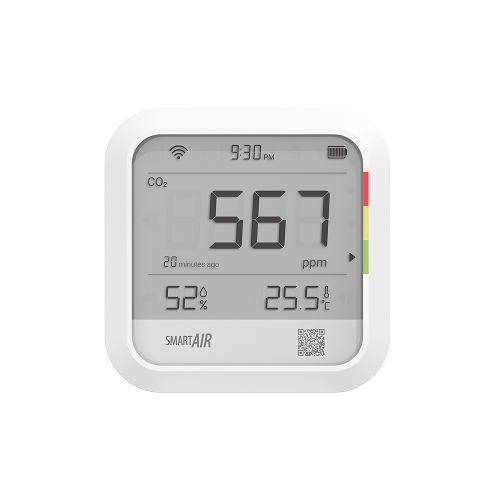
Since publishing this article, Smart Air has tested a new set of air quality monitors: The QP Lite and QP Pro+. After testing out the monitors, we were impressed with their accuracy and functionality. We have replaced the Laser Egg on our Clean Air Shop, with the QP monitors.

Free Guide to Breathing Safe
Want to learn more about breathing clean air? Join thousands more and stay up to date on protecting your health.








Hello,
Thank you for this review. I am curious if you have any recommendations for outdoor sensors that can be used to monitor pollutants, especially PM2.5, outdoors?
Hi Paddy, great tests and information. Do you have any data on the internal sensors these devices use if we were to try and build our own IoT device? I’ve seen the OPC-N3 mentioned a few times, buit I’m far from an expert in this. We’re looking to build a low-cost sensor array across multiple locations.
Please also have the air monitors available for sale in the Philippines. With the volcano erupting all the time people want more than just a visual check on whether there is ash in the air.
Thank you for this very very useful website. I am currently researching to find the best air quality monitor. The Laser Egg and the Airvisual are leading the race so far. Have you heard of Huma-i and Air Mentor? I would love to see some test results about them as well.
P.S. Why on earth is the Laser Egg twice the price in Europe?! It‘s almost as expensive as the Airvisual.
Hi. Have you tested these outside? I have the DC1700 & AirVisual Pro at my workplace, both claimed to work outdoor as well. We are doing continuous outdoor air monitoring at my workplace.