Clean indoor air is not only essential for our health and wellbeing, it offers relief to asthma and allergies sufferers and reduces disease transmission. This is especially important in clinical rooms with no windows and limited airflow.
In this article, we do a deep dive into how to meet Public Health England (PHE) guidelines to reduce airborne contaminants in treatment rooms.
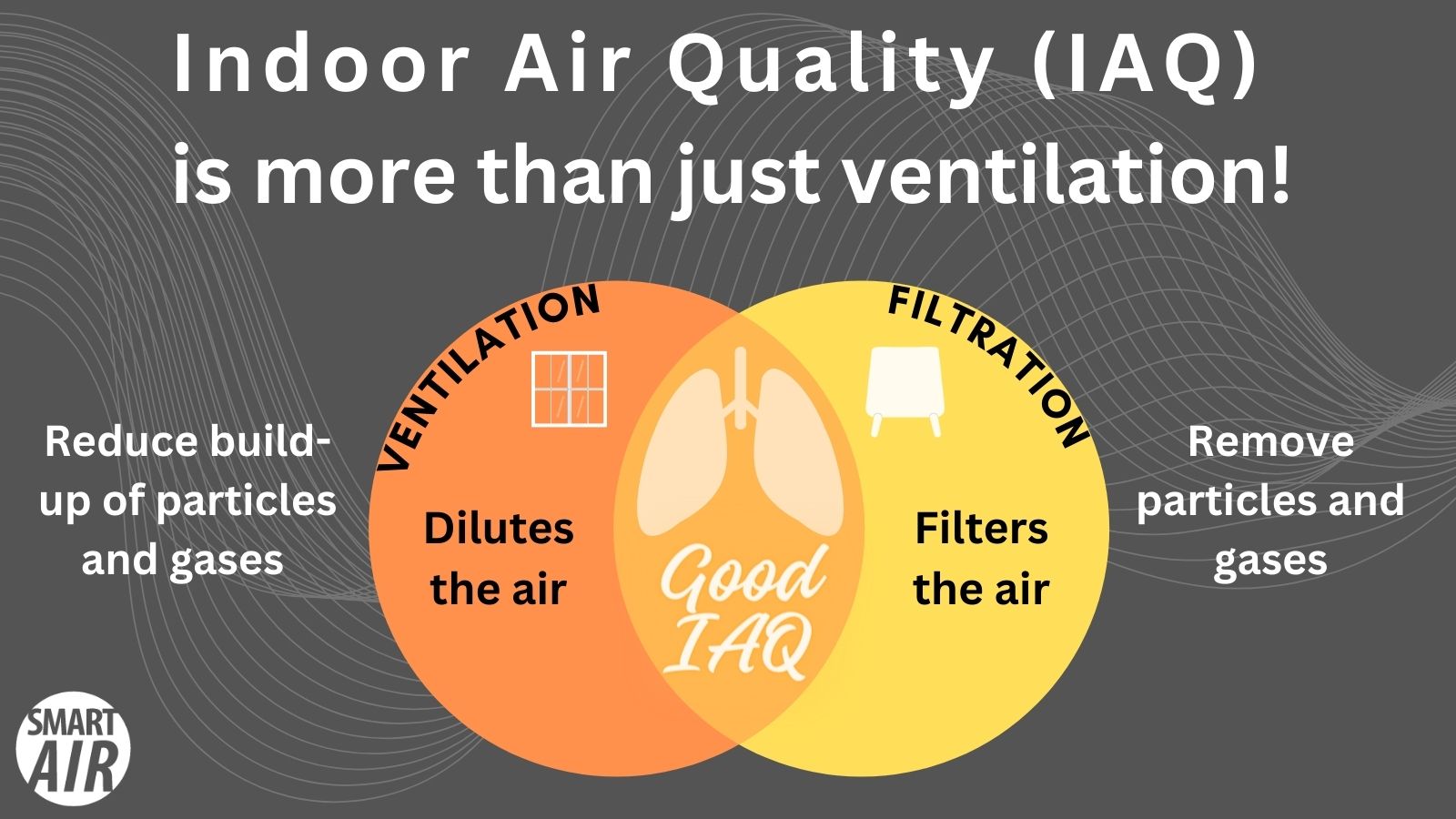
Good ventilation doesn't translate to good indoor air quality
Many UK hospitals rely heavily on natural ventilation as their main source of airflow in patient wards. However natural ventilation is highly dependent on weather conditions, the opening sizes of windows, doors or leakage etc making it uncertain and difficult to control.
Mechanical ventilation systems are more reliable. There are two types – recirculating ventilation and fresh air ventilation, which also delivers fresh air and is often counteracted with heating for thermal comfort (HVAC).
The focus on mechanical ventilation has been considerable since the pandemic started. The HVAC solution for infection control in the UK is 'increased filtration' (requires a costly refit and lengthy construction work); or 'increased ventilation' (requires additional heating to compensate, leading to higher carbon emissions and energy costs).
Although increasing ventilation is the only viable HVAC solution, at best it dilutes airborne particles rather than removes it and it also assumes 'good' outdoor air quality. So, if your goal is to reduce airborne infections and pollutants, then filtration needs to play a bigger role in healthcare settings.
Understanding 'air changes' helps you find the right solution
Current UK healthcare guidance for new buildings and major refurbishments specifies a minimum of 10 air changes per hour (ACH) for treatment rooms. One ACH occurs when a volume of air delivered is equal to the volume of the room.
However as fresh air enters and mixes with 'contaminated' air in the room, not all the contaminated air is removed by one air change. Under well-mixed conditions, one air change removes approximately 63.2% of air contaminants, and a second air change removes about 63.2% of what remains, and so on (let's refer to this as Contaminant Removal ACH for the purpose of this article).
 | 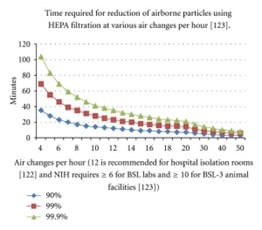 | |
| Table source: CDC - Guidelines for Environmental Infection Control in Health-Care Facilities | Chart source: Aerobiology and its Role in the Transmission of Infectious Diseases |
This means that a room with 10 ACH can take 28 minutes to reduce the starting contaminant concentration by 99%.
Exceeding PHE guidelines can reduce your bioburden
We're going to show you that it's not just possible to meet PHE guidelines for treatment room, it can be exceeded with low-cost portable filtration.
1. Choose a Portable Air Cleaner that delivers the full ACH required by Public Health England
Not only can air cleaners deliver the equivalent ACH, it can do so at substantially lower energy costs and carbon footprint than mechanical ventilation. It is also a cheaper solution that can be implemented within a week.
2. Top up with the mechanical ventilation ACH to exceed guidelines
Ventilation is crucial, we are not suggesting here that it is a supplementary measure. Ventilation air changes should be based on room dimension/occupants but consider filtration for particle removal - ie. use portable air cleaners to deliver the full PHE requirement. If your mechanical ventilation is functioning as required, then you have the added bonus of even more clean air!
Before you start calculating your requirements, we recommend that you check / re-confirm the mechanical ventilation ACH. This recent research found airborne SARS-CoV-2 may transmit infection for nearly 5 hours in a hospital setting where the HVAC 'should' have been delivering 6 ACH (note, ACH not validated by the researchers before commencing project).
Combining ventilation and filtration is the best way reduce bio-aerosols at source, but...
...not all portable air cleaners are equal
To work out how to source a portable air cleaner to deliver the full ACH for your space, you will need to do a little bit of maths. Multiply your room volume (length x width x height) by the number of air changes recommended by PHE:
Room volume x ACH = CADR
This calculation shows you the minimum Clean Air Delivery Rate (CADR) an air cleaner needs. Be mindful that most manufacturers only show the top speed CADR which will be too noisy for continuous usage. To see how this works in practice, we are going to look at a dental treatment room scenario with 10 ACH, as per guidelines.
Practical example:
- Room volume of 25m3 - 3m (length) x 3.47m (width) x 2.4m (ceiling height)
- Multiplied by 10 (ACH) - The PHE guideline for treatment rooms
- Results - CADR of 250m3/hr
This shows you need a portable air cleaner to deliver at least 250m3/hr but how effective is this for infection control?
- Based on Room ACH, the air is replaced every 6 minutes.
- But with Contaminant Removal ACH (63.2% on each air change), it will take 28 minutes to purge the room of 99% of airborne contaminants.
Now that you understand what this means in practice, let's apply this to air cleaners.
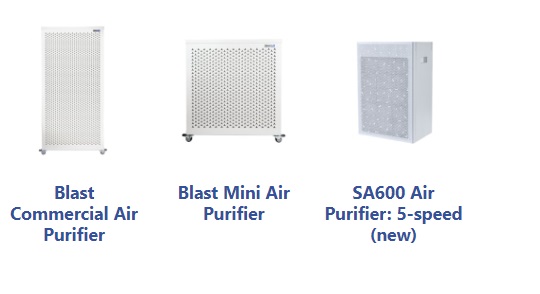
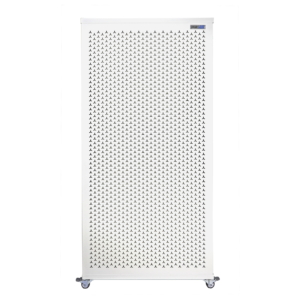
Based on the room dimensions in this scenario, Smart Air's SA600 air cleaner just about delivers 10 ACH on speed 2 (good noise levels) so we will use this as the base for comparing with our larger commercial air cleaners:
| SA600 air cleaner (sp 2) | Blast Mini air cleaner (sp 2) | Blast air cleaner (sp 2) |
|---|---|---|
| Speed 2 CADR – 245 m3/hr Noise levels – 43 dBA Air changes: 9.8 ACH | Speed 2 CADR – 450 m3/hr Noise levels – 43 dBA Air changes: 15.6 ACH | Speed 2 CADR – 680 m3/hr Noise levels – 37 dBA Air changes: 27 ACH |
| Room ACH: every 6 mins 99% contaminant removal: 28 mins | Room ACH: every 4 mins 99% contaminant removal: 18 mins | Room ACH: every 3 mins 99% contaminant removal: 9 mins |
The difference in Room ACH is minimal and not enough to justify a higher purchase cost. However, for infection control, the larger Blast removes contaminant concentration by 99% in just 9 minutes. In fact, the Blast in this room size at top speed takes just 2 minutes!
In this dental room scenario, these same times represent 'fallow time' enabling the room to be used sooner with the right size air cleaner.
If you are addressing infection, prevention and control in healthcare, this highlights the benefit of exceeding PHE requirements.
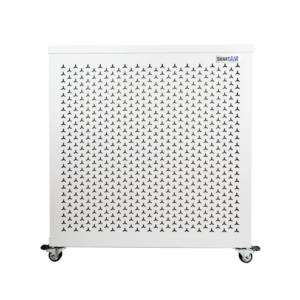
Here's a recap of how long it takes 3 different air cleaners to remove 99% of aerosol contaminants at noise levels for continuous use (speed 2):
- SA600 - 28 minutes
- Blast Mini - 18 minutes
- Blast - 9 minutes
Note: This article is not about filter efficiency but addressing the air changes required to remove starting contaminant concentration, and assumes perfect air-mixing. It doesn't cover UVGI (in room, not inside air purifiers), nor the complex calculations required when the source of contamination is constant.
Portable air filtration is an affordable, quick, construction-free, way to reduce the bio-burden and may be the only viable option in older buildings with poor ventilation. It is hoped that filtration will be factored in for new buildings but there may still be some areas that will benefit from 'localised' filtration at breathing levels for faster particle reduction.
It is important to consider that increased airflow (whether air cleaners or HVAC systems) is essential for air mixing, so you'll need to strike a balance between...
- thermal comfort -
- reducing the viral load -
- noise levels -
- price (upfront and ongoing) -
The Blast is ideal for healthcare, not just because of the cost (£485 ex VAT) and the fact that it is quietest air cleaner in its class (43dBA on top speed). But also because filtered air is spread out over the large outlet, so it can feel less draughty than smaller air cleaners even though it delivers substantially more filtered air. In fact when we compared the Blast to two other air cleaners currently in NHS hospitals, we found it not only quieter and cheaper, it produced 27% less carbon emissions and cost less to run.
Tips:
- Don't just look at price as an air cleaner must be correctly sized to be effective.
- Be wary of great visuals and trademark claims, these are often a way to help you part with more money for less clean air.
- No matter what manufacturers state, you are almost guaranteed never to run an air cleaner on top speed for prolonged periods of time so always check the clean air delivery rate at lower speeds.
- Don't assume your HVAC/Ventilation ACH figures are correct. Check frequently.
- No additional gimmicks are needed for a HEPA air cleaner to work efficiently. In fact, adding things like ionisers and UV to an air cleaner can release ozone and increase particle pollution when it is the HEPA filter doing all the work.
- There’s no such thing as a 'medical-grade' air cleaner, it is simply a marketing strategy. Look for HEPA H13 or H14 filters in an air cleaner.
- Use the illustration above to help you select an air cleaner based on contaminant removal ACH.
- If you need any help in working out your requirements, contact us.
Further reading:
https://time.com/6143799/covid-19-indoor-air-cleaning/
63% replacement of room air contaminants (Bearg, 1993, p. 64)
Understand the difference between replacing the air with the room volume equivalent (room ACH) and the percentage of particles removed (contaminant removal ACH). Look for a portable air cleaner with the highest CADR at the lowest noise levels (check out our page on air cleaners being switched off at hospitals due to noise).