The NHS has ambitious aims to be the world’s first net zero national health service. Yet since COVID-19 started, hospitals increased the use of mechanical ventilation / HVAC to reduce the bioaerosol load.
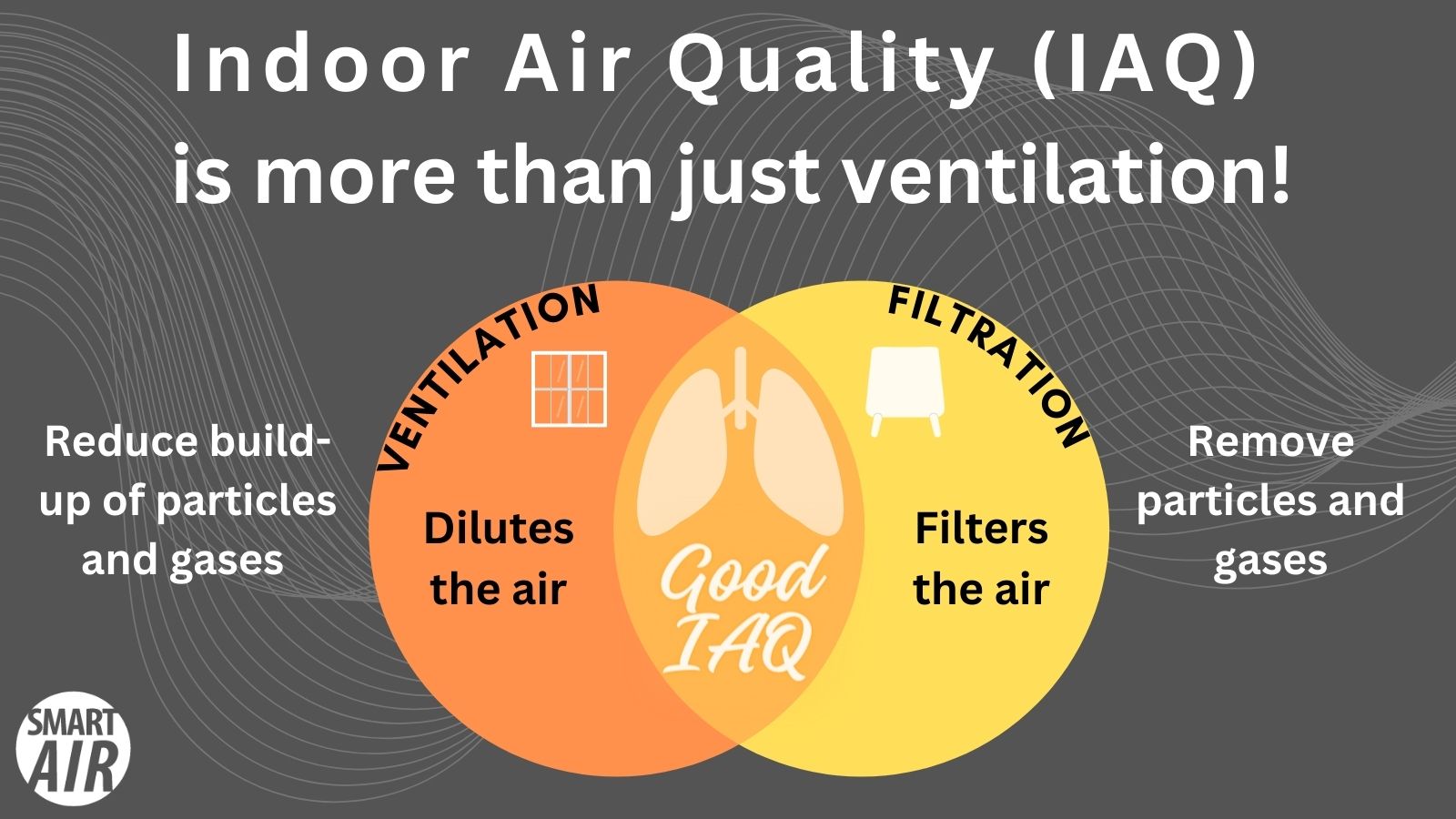
Making adjustments to existing ventilation lowers infection rates by diluting the air and is a quick fix. However, ventilation doesn't remove particles from the air, cost more with high energy prices and it also increase energy consumption substantially.
- Mechanical ventilation in operating theatres accounts for 90–99% of hospitals’ energy consumption ¹
- 84% of carbon emissions in UK hospital operating theatres comes from energy usage ²
Rather than filtration being a 'supplement' to ventilation, we think it is a vital part of indoor air quality (IAQ).
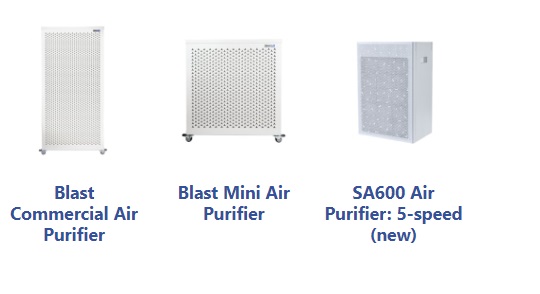
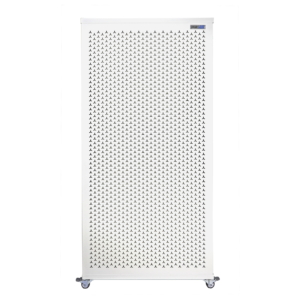
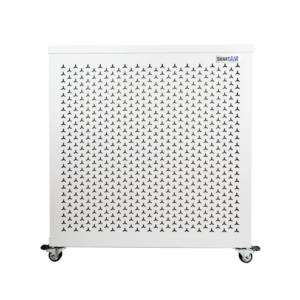
While filtration in HVAC can be improved to F7 grade, this can be costly and time-consuming. However portable air cleaners like the Blast and the Blast Mini can offer localised filtration at HEPA H13 grade at low cost.
There has been a number of recent peer-reviewed studies looking at the efficiency of both ventilation and filtration at removing bioaerosols with the results lending credence to the significance of filtration in infection prevention and control:
- Portable Air Cleaners were found to be 63% more effective at clearing aerosol particles than ventilation alone, due to ‘localised’ filtration ³
- Global firm, Stantec, modelled 22 variations of ventilation adjustments (with and without portable air cleaners) to identify the different ways to reduce aerosol particles. Best case particle reduction results were: ⁴
- Up to 17% particle reduction from ‘ventilation only’ adjustments
- Up to 45% particle reduction from ‘ventilation adjustments with portable air cleaners’
Both these studies show that combining ventilation with portable air cleaners is a more effective way of reducing bio-aerosols and lowering your carbon footprint. But it doesn't just stop there!
Smart Air’s Blast outperforms other portable air cleaners currently in UK hospitals
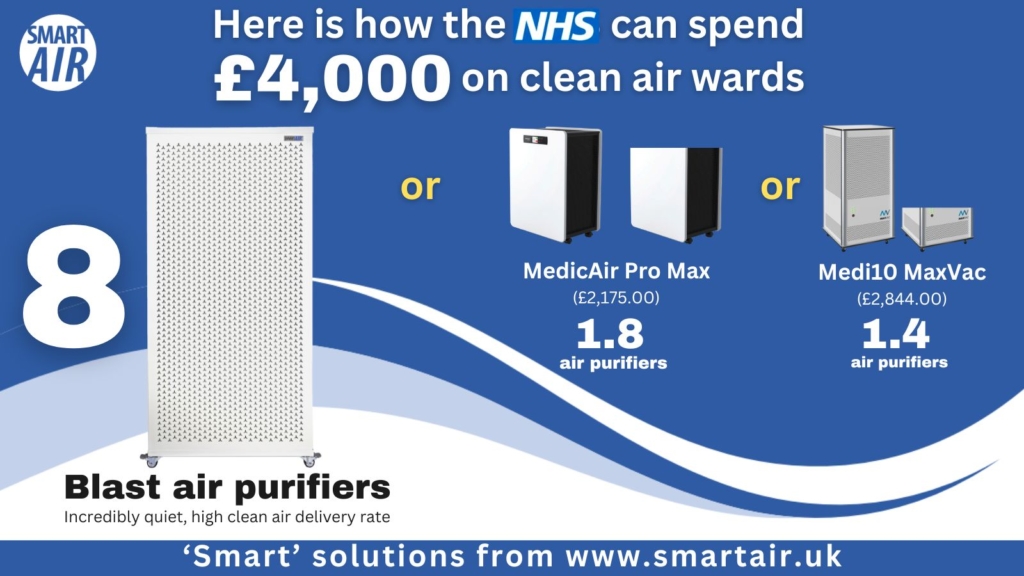
Not all portable air cleaners are equal. Here's a comparison we did between the Blast and 2 other brands currently in NHS hospitals across the UK.

Source: Smart Air UK
* Simulations based on typical costs/emissions per unit on maximum speed, 24/7 for a whole year
Choosing the Blast air cleaner over others can help hospitals reach net zero faster:
- 412% more cost-effective per m3/hr
- 27% cheaper to run
- 270mg less high level nuclear waste
- Maximum noise levels of 43dBA make it the quietest portable air cleaner in its class
Making the “Smart” choice has never been easier!
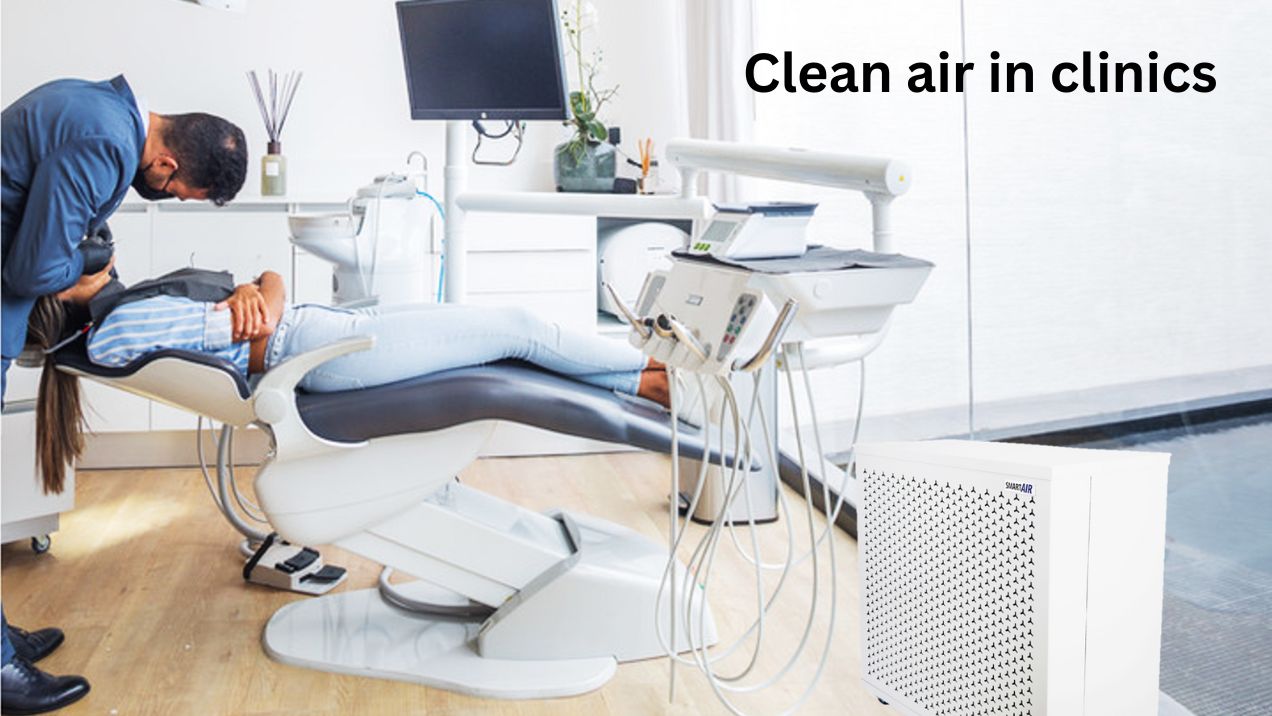
Clean air tools for hospitals, GP surgeries and clinics
Are HEPA Filters recyclable?
Unfortunately not, but do note that hospital ventilation systems will also use filters that aren't recyclable. We upgraded the frame to durable cardboard which is not only more eco-friendly, it is also lighter and cheaper to ship.
Our filters are among the deepest pleated on the market which extends lifespan and efficiency. The Blast filter media, when opened, is a staggering 14m2 in size. This enables it to last over a year on full speed, 24/7, and even longer if operated only during working hours.
Long filter lifespan reduces the frequency of replacements, aligning with principles of the circular economy by minimising waste and maximising resources. By choosing durable, high-performance filters, hospitals can effectively balance the need for clean air with environmental responsibility.
Get in touch with us at [email protected] for more details.
- The carbon footprint of the operating room related to infection prevention measures: a scoping review, 2022: http://www.sciencedirect.com/science/article/pii/S0195670122002286
- The impact of surgery on global climate: a carbon footprinting study of operating theatres in three health systems, 2017: http://doi.org/10.1016/S2542-5196(17)30162-6
- Ventilation and air cleaning to limit aerosol particle concentrations in a gym during the COVID-19 pandemic, 2021: https://www.sciencedirect.com/science/article/pii/S0360132321000706
- IBEC webinar 'Strategic Airflows - Ventilation as a Key Defence Against Infectious Diseases', 2024: https://weareibec.org/clean-lessons-events/ventilation-infectious-disease/