
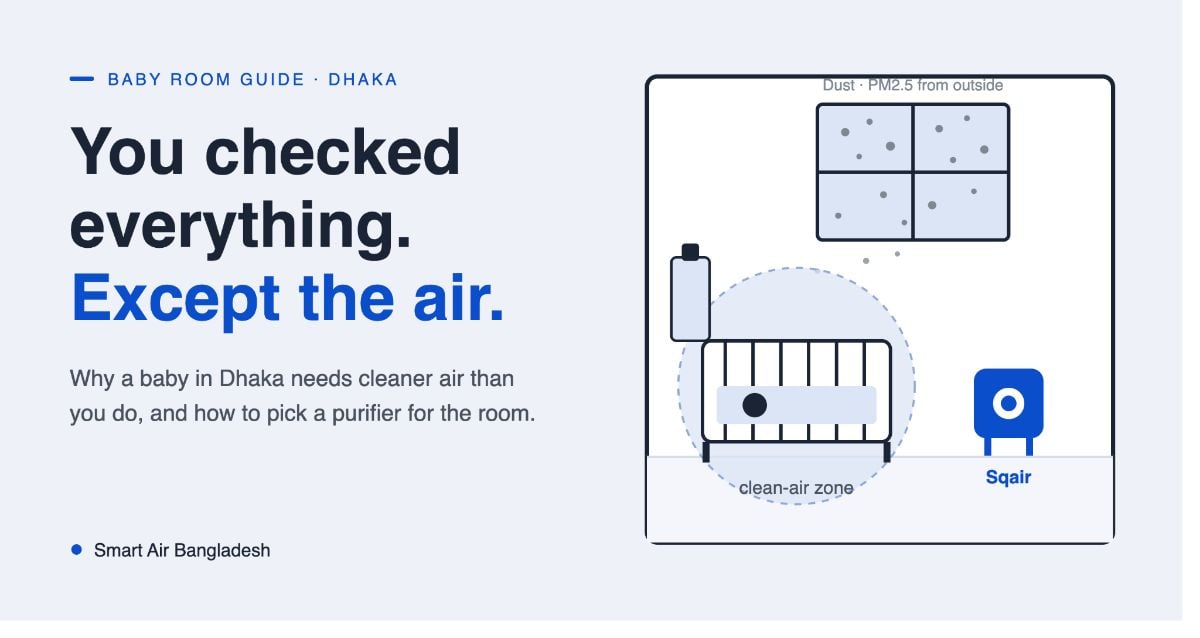
The cot is up. The mattress has been aired on the balcony, the sheets washed twice, the bottles sterilised and lined up by the sink. Before the baby comes home, you check the room one last time: the fan, the mosquito net. Everything looks ready.
Parents in Dhaka take care of everything that goes into a baby’s body. The air is the one thing that rarely makes the list, because you can’t see it or check it by looking. Yet it’s the thing a baby takes in most: through every nap, every breath, and every night. If you’ve searched for “air purifier for baby room”, you’re already asking the right question. This guide explains why the air in a baby room matters more than the air you breathe yourself, what Dhaka puts into it, and what you can do about it this week.
Why does the air in a baby room matter more than the air you breathe?
Because a baby takes in more and has less to fight it with. The World Health Organization (2018) explains that children breathe faster than adults, so they absorb more of whatever is in the air, and that they live closer to the ground, where some pollutants are most concentrated. All of this happens while their lungs, brains and the body’s defences against infection are still being built. The same report notes that dirty air can affect how well a child’s lungs work even at lower levels.
A baby’s age matters too. When researchers from icddr,b and Johns Hopkins measured the fine dust in the air (the PM2.5 number on your phone’s air app) where 257 babies in Mirpur slept, they found the link between polluted air and chest infections in babies under one year old, but not in children aged one to two (Gurley et al., 2013). The authors’ reading is that infants may be harmed more by fine particles than older children are.
A newborn also spends most of the day in one room, asleep or feeding, and that one room is the easiest air in Dhaka to change.
What is in the air of a baby room in Dhaka?
Mostly the same air as the street, plus whatever the home adds. When a Jahangirnagar University team measured PM2.5 inside 43 Dhaka homes, the air inside was on average about five times dirtier than the World Health Organization says is safe for a day, and most of that dirt had come in from outside. Closing the windows slows that down. It doesn’t stop it. Get more information on what that PM2.5 number on your phone means in our PM2.5 guide, and on how Dhaka’s air changes through the year in our air quality in Dhaka guide.
And that dust isn’t just dust. When scientists in Dhaka took PM2.5 apart to see what it’s made of, they found tiny bits of metal, mostly iron, copper, chromium and manganese, from vehicle exhaust and from brakes and tyres grinding on the road; zinc and nickel from factories; black soot from anything that burns; and sulfur, most of it from the coal in brick kilns and from diesel (Jawaa et al., 2024; Begum & Hopke, 2019). It also carries lead. In Bangladesh, most of that lead comes from old vehicle batteries broken open and melted down in backyard workshops, and UNICEF and Pure Earth count around 35 million children in the country with too much of it in their blood (UNICEF, 2020). For a baby, lead is the part to worry about most, because it goes to the growing brain first. The air carries gases too: nitrogen oxides from traffic, sulfur dioxide from burning fuel, and ozone, which builds up on sunny afternoons (Pavel et al., 2021). Some of these gases react in sunlight and stick to the dust, and together they make the grey haze that sits over Dhaka on winter mornings. A HEPA filter catches all of the particles, including metals and lead. The gases are what it can’t catch, and we come to that below.
What comes in changes with the season. In 2025, Dhaka spent at least two months with PM2.5 above 100 µg/m³, deep in the red “unhealthy” zone on any air app, and most of it in winter, IQAir’s World Air Quality Report found. If your baby arrives between November and February, the first weeks at home fall in the dirtiest air of the year. The monsoon is the cleaner half.
Add image with annaul AQI color outline in Dhaka, as used in AISD workshop slidedeck
A few things add to it inside the flat:
- Construction next door. The World Bank’s Breathing Heavy report (Raza & Mahmud, 2022) found the highest PM2.5 in Dhaka at sites with major construction and traffic, and that children under five living near them were more likely to have coughs, breathing difficulty and chest infections. If a building is going up beside yours, keep the baby’s room window on the far side shut and run the purifier through the day, not just at night.
- Cooking. The same Jahangirnagar study linked longer cooking time to higher PM2.5 indoors. Keep the kitchen door closed while you fry, and use the exhaust fan.
- Mosquito coils and incense. Burning one coil releases as much PM2.5 as 75 to 137 cigarettes, a US and Malaysian research team measured in Environmental Health Perspectives (Liu et al., 2003). A net over the cot does the same job without the smoke.
- Fresh paint and new furniture. That new-paint and new-sofa smell is a mix of chemical gases (VOCs) that keep coming off long after the work is done, according to the US EPA. If you can, finish the baby’s room a few weeks early and air it out on cleaner days.
What health problems in babies are linked to polluted air?
Mainly chest infections and the coughing and wheezing that come with them. Two studies done in Dhaka show how close the link is.
In the Mirpur study above, every extra hour per day that PM2.5 in the baby’s sleeping space stayed above 100 µg/m³ went with a 7% higher rate of chest infections in babies under one (Gurley et al., 2013). Those homes spent about five such hours a day over the line, even though most families cooked mainly with gas or electricity. The study was in a low-income community, so the numbers won’t match every flat, but the direction is clear: fewer hours of dirty air in the room meant fewer infections.
Outdoor air tells the same story. A Stanford, icddr,b and Atomic Energy Centre team followed child clinic visits in Dhaka for over ten years and found that pneumonia in children under five rose by 3.2% for every 10 µg/m³ rise in PM2.5, a change too small to notice from the window. Most of the children were two or younger, and the link was stronger on days when brick-kiln smoke made up more of the pollution (Sherris et al., 2021, in Environmental Pollution).
The harm doesn’t stop at infections. Research from around the world points to three longer-term risks, and each one hits hardest in babies and toddlers.
Asthma. When researchers in the UK and Spain pooled 41 studies on children living near traffic, they found that the more fine dust, soot and exhaust gas a child breathed, the higher the chance of developing asthma (Khreis et al., 2017). A separate review of birth cohorts found the risk starts even earlier: breathing polluted air during pregnancy was consistently linked to asthma later in childhood (Bettiol et al., 2021).
COPD. Most people think of chronic obstructive pulmonary disease, where the airways narrow for good and breathing gets harder year by year, as a smoker’s disease. But lungs keep growing until the late teens, and polluted air slows that growth. In 2026, a Swiss team that measured babies’ breathing in their first month and again at age six found that children with a higher inherited risk of COPD fell behind in lung growth, but only when they grew up in areas with higher PM2.5 (European Respiratory Society, 2026). Their “higher” averaged 15.3 µg/m³, less than a quarter of Dhaka’s 2025 average. The researchers’ view is that COPD can begin with lungs that never reach their full size in childhood.
Stunted growth, in body and brain. When researchers from the National University of Singapore and Harvard matched four rounds of Bangladesh’s national health survey with satellite PM2.5 data, children whose mothers breathed the dirtiest air during pregnancy were more likely to be stunted, too short for their age (Goyal & Canning, 2018). Over half the children in the sample lived where the yearly average was above 46 µg/m³, and their risk of stunting was about 13% higher than children in the cleanest areas. The brain is at risk too. UNICEF’s Danger in the Air paper warns that fine particles can cross into the bloodstream and reach the brain, where they can inflame tissue and damage the connections a baby’s brain is building in its first 1,000 days (UNICEF, 2017). The paper counted 12 million babies under one in South Asia living where outdoor air is more than six times the WHO limit. Dhaka’s 2025 average was more than 13 times.
None of this means your baby will get sick. It means the hours of clean air you give them count, and the Mirpur numbers suggest they count most in the first year. If a cough lingers, breathing is fast, or the chest pulls in with each breath, see your child’s doctor, whatever the air reading says.
Is an air purifier safe in a baby’s room?
A HEPA air purifier for baby room use is safe, as long as it doesn’t make ozone and isn’t too loud for the room. Those are the two things to check.
Does the purifier make ozone?
Some purifiers sold as “ionisers” or “ozone generators” work by releasing a gas called ozone into the room. The US EPA warns that ozone irritates the lungs even in small amounts, and Mayo Clinic allergist James T C Li advises against them in a child’s room because they can make breathing problems worse. A purifier that is just a fan pushing air through a fine HEPA filter has none of this. Smart Air’s purifiers work that way, with no ioniser.
How loud is too loud for a baby?
The recommended limit for infants in hospital nurseries is 50 decibels, quieter than normal conversation, the figure a University of Toronto team used in Pediatrics when they tested infant sleep machines (Hugh et al., 2014). Their advice for anything that makes sound in a baby’s room is to keep it as far from the cot as you can and keep the volume low. A purifier is the exception to ‘keep it low’, and this matters in Dhaka. At its lowest speed a purifier is nearly silent, but it is also moving very little air: the Sqair Chemical Warfare moves 300 m³ of air an hour at full speed, and on low only a small share of that. In a Dhaka winter, with PM2.5 leaking in from outside at over 100 µg/m³, that is not enough to keep the room clean. A quiet purifier on low can give you a false sense of safety. So run it on medium or high, and choose a machine that stays quiet at those speeds. Then put it across the room from the cot, cord out of reach, where a crawling baby can’t pull it over.
Which air purifier fits a baby room?
Which purifier cleans the whole baby’s room?
One that can clean the whole room and stays quiet enough on medium or high to run all night. In most Dhaka flats, the baby’s room is a bedroom of a few hundred square feet, and that points to the Sqair Chemical Warfare. It’s rated for rooms up to 380 sq ft. Its noise runs from 27 decibels on low to 52 on high. On medium, the speed to use on most nights, it stays under the 50-decibel nursery limit above, about as loud as a fridge humming. On high, which you’ll want on bad winter days, it reaches 52 decibels, which Smart Air compares to soft rainfall. That steady, even sound is much like the hum of a ceiling fan that many Dhaka parents already use to settle a baby, and some find the purifier does the same job on its own. There is no ioniser, so no ozone, and no lights on the dial to glow over the cot. It comes with two filters in the box: a HEPA filter for Dhaka’s dust and PM2.5, and a carbon filter for the gases HEPA can’t catch, the kind that come off fresh paint and new furniture (our HEPA vs carbon filter guide explains the difference). The HEPA filter needs changing about every 3 months in Bangladesh at 8 hours a day, so plan on four a year if it runs nights only, and more if it runs around the clock. If you want more cleaning power at the same noise, the SA600 moves 500 m³ of air an hour against the Sqair’s 300, in the same noise range (27 to 51 decibels), so it can clean the same room on a lower, quieter speed, and it has no ioniser either. It costs more, but in Dhaka’s winter a bigger machine on a lower speed is the quietest way to clean air fast.
How do I know the Sqair actually works?
How do you know it works? HouseFresh, an independent review site that buys every purifier it tests with its own money, ran the Sqair in a sealed room the size of a small home office, filled with incense smoke, and tracked the particles with two sensors. It cleared the room in 32 minutes on high, ten minutes faster than the Mila, which costs more than twice as much. Reviewer Danny Ashton measured 35.5 decibels on low and 49.1 on medium from three feet away (a different method from Smart Air’s figures, and both under 50) and noted that the absence of lights suits a bedroom. The Sqair has stayed in his bedroom since.
What about the air right beside the cot?
For the cot itself, there’s the QT3. It doesn’t clean a room; it sends a stream of filtered air about 4 feet (1.2 metres) from its outlet, enough to cover a cot or a stroller, at 29 decibels on low. It comes in two versions: one that runs off any USB port and one with a built-in battery that lasts 2 to 4 hours away from a socket, handy for the stroller or a rickshaw ride. In HouseFresh’s test it cleared a car cabin in under an hour. Think of it as a helper, not the main machine: it cleans the air right around the baby while the room purifier cleans the room. Use it together with one, not instead of one. No ioniser, no ozone, and a filter change about every 2 months when used 8 hours a day in Bangladesh.
How do I know the air in the baby’s room is actually clean?
By measuring it. A purifier cleans the air; a monitor lets you see it. Picture a winter night with the purifier humming on medium and the street outside deep in the red on your phone’s air app. Is the room actually clean, or does it need high? You can’t tell by looking, and PM2.5 has no smell. A small monitor on the shelf answers that in one glance, and over a few days it shows you which setting your room needs.
The Temtop S1+ is the simple option. It shows PM2.5, temperature and humidity, has a light that turns green, orange or red so you can read the room from the doorway, and sounds a buzzer when PM2.5 climbs into the unhealthy range, which is exactly the alert you want on a winter night. It runs about two months on one charge and connects to your phone. The QP Pro 2 shows more on one screen: PM2.5, the coarser PM10 dust, CO₂ (a sign the room needs fresh air), temperature, humidity and noise, which is handy for checking the purifier isn’t louder than it should be by the cot. Smart Air stocks a range of indoor monitors; any one that reads PM2.5 will do the job.
What should I do now?
Five steps, in order. Most parents finish the list in an afternoon.
- Measure the room. Length times width, in feet. A 12 × 14 ft bedroom is 168 sq ft. The right air purifier for a baby room is one rated above that number; up to 380 sq ft, the Sqair Chemical Warfare covers it. That rating assumes a closed room, so keep the baby’s room door and windows shut while it runs; leave them open and no purifier can keep up with the street. Bigger than that, or a room that opens onto the living area, needs the next size up, or two purifiers; our buying guide for Bangladesh (see our guide) covers the larger models.
- Check the filters. You want two. HEPA catches Dhaka’s dust and PM2.5, metals and lead included. Carbon soaks up what passes straight through HEPA: the chemical gases (VOCs) from fresh paint and new furniture, cooking smells, and exhaust fumes if the window faces a busy road, a factory or a generator. The Sqair Chemical Warfare comes with both, so there’s nothing to choose; if you’re looking at another machine, check before you buy.
- Place it. Across the room from the cot, at least 15 cm from the wall so air can move around it, cord tucked away. Don’t put it on the floor beside the cot where a crawling baby can reach the dial.
- Run it on medium, all night, every night. A purifier only cleans while it’s on, and in Dhaka’s winter, low speed doesn’t move enough air to keep up with what leaks in from outside. Medium is the everyday setting; turn it to high when the outdoor AQI reading is red or purple. On bad winter days, keep it on through the day too, with the windows and door shut. If high is too loud for the room, size up to a quieter machine rather than turning the speed down.
- Put the filter date on the calendar. About 3 months for the Sqair Chemical Warfare at 8 hours a day, sooner if it runs around the clock or if a monitor shows the room no longer clears the way it did when the filter was new. Our guide on how often to change a HEPA filter (see our guide) shows the simple test.
What it costs to run is small: at full speed the Sqair Chemical Warfare draws 38 watts, less than most ceiling fans, and on low just 6, about the same as one LED bulb.
Frequently asked questions
Do I really need an air purifier in a baby room in Dhaka?
For most homes, yes, and not only in winter. The air inside Dhaka flats is close to the air on the street, and babies breathe faster and are harder hit by it than adults. A purifier in the one room where the baby sleeps is the simplest way to cut the hours of dirty air.
Can an air purifier help with my baby’s cough?
It can bring down the dirty air that is linked to coughs and chest infections, which is what the icddr,b study in Mirpur measured. It is not a treatment. A cough that lasts, fast breathing or a chest that pulls in with each breath needs a doctor.
Where should I put the air purifier in a baby room?
Across the room from the cot, at least 15 cm from the wall, with the cord out of reach. Keep the door and windows shut while it runs. It does not need to be next to the baby to clean the baby’s air.
Is it safe to run an air purifier all night near a baby?
Yes, if it is a HEPA purifier with no ioniser. The Sqair Chemical Warfare runs between 27 and 52 decibels, and on medium, the speed to use most nights, it stays under the 50-decibel limit used for hospital nurseries. Running it all night is the point; it only cleans while it is on.
HEPA or carbon filter for a baby room?
Both. HEPA catches the fine dust that is Dhaka’s main problem. Carbon soaks up the chemical gases (VOCs) and exhaust fumes that HEPA lets through, which matters if the room was painted recently, has new furniture, gets cooking smells, or sits close to traffic, a factory or a generator. The Sqair Chemical Warfare has both filters built in.
How often do I change the filter?
About every 3 months for the Sqair Chemical Warfare and every 2 months for the QT3, at 8 hours a day in Bangladesh. If it runs around the clock, sooner. A monitor tells you for certain: when the room no longer clears the way it used to, the filter is full.
Back to that last check of the room before the baby comes home. The fan, the net, the thermometer. Now there’s one more thing on the list, and it’s the one your baby will use most.
Take one step to protect your baby’s air. Answer 3 quick questions to find the right purifier, or contact us for a free air quality audit of your baby’s room.
References
- Ashton, D. (2025a, December 17). Smart Air QT3 review. HouseFresh. https://housefresh.com/smart-air-qt3-review/
- Ashton, D. (2025b, December 17). Smart Air Sqair review. HouseFresh. https://housefresh.com/smart-air-sqair-air-purifier-review/
- Begum, B. A., & Hopke, P. K. (2019). Identification of sources from chemical characterization of fine particulate matter and assessment of ambient air quality in Dhaka, Bangladesh. Aerosol and Air Quality Research, 19(1), 118–128. https://doi.org/10.4209/aaqr.2017.12.0604
- Bettiol, A., Gelain, E., Milanesio, E., Asta, F., & Rusconi, F. (2021). The first 1000 days of life: Traffic-related air pollution and development of wheezing and asthma in childhood. A systematic review of birth cohort studies. Environmental Health, 20, 46. https://pmc.ncbi.nlm.nih.gov/articles/PMC8053261/
- European Respiratory Society. (2026, September 6). Origins of COPD may lie in how some children’s lungs develop, but only when they are exposed to polluted air [News release]. https://www.ersnet.org/news-and-features/news/origins-of-copd-may-lie-in-how-some-childrens-lungs-develop-but-only-when-they-are-exposed-to-polluted-air/
- Goyal, N., & Canning, D. (2018). Exposure to ambient fine particulate air pollution in utero as a risk factor for child stunting in Bangladesh. International Journal of Environmental Research and Public Health, 15(1), 22. https://www.mdpi.com/1660-4601/15/1/22
- Gurley, E. S., Homaira, N., Salje, H., Ram, P. K., Haque, R., Petri, W., Bresee, J., Moss, W. J., Breysse, P., Luby, S. P., & Azziz-Baumgartner, E. (2013). Indoor exposure to particulate matter and the incidence of acute lower respiratory infections among children: A birth cohort study in urban Bangladesh. Indoor Air, 23(5), 379–386. https://doi.org/10.1111/ina.12038 (author manuscript: https://stacks.cdc.gov/view/cdc/29737/cdc_29737_DS1.pdf)
- Hugh, S. C., Wolter, N. E., Propst, E. J., Gordon, K. A., Cushing, S. L., & Papsin, B. C. (2014). Infant sleep machines and hazardous sound pressure levels. Pediatrics, 133(4), 677–681. https://doi.org/10.1542/peds.2013-3617
- Jawaa, Z. T., Biswas, K. F., Khan, M. F., & Moniruzzaman, M. (2024). Source and respiratory deposition of trace elements in PM2.5 at an urban location in Dhaka city. Heliyon, 10(4), e25420. https://doi.org/10.1016/j.heliyon.2024.e25420
- Khreis, H., Kelly, C., Tate, J., Parslow, R., Lucas, K., & Nieuwenhuijsen, M. (2017). Exposure to traffic-related air pollution and risk of development of childhood asthma: A systematic review and meta-analysis. Environment International, 100, 1–31. https://pubmed.ncbi.nlm.nih.gov/27881237/
- Li, J. T. C. (n.d.). Ozone air purifiers: Can they improve asthma symptoms? Mayo Clinic. https://www.mayoclinic.org/diseases-conditions/asthma/expert-answers/asthma/faq-20058187
- Liu, W., Zhang, J., Hashim, J. H., Jalaludin, J., Hashim, Z., & Goldstein, B. D. (2003). Mosquito coil emissions and health implications. Environmental Health Perspectives, 111(12), 1454–1460. https://pmc.ncbi.nlm.nih.gov/articles/PMC1241646
- Nahr, M. S. S. (2026, March 25). Bangladesh’s air remains the second-worst globally in 2025. The Business Standard. https://www.tbsnews.net/bangladesh/environment/bangladesh-2nd-most-polluted-globally-only-14-cities-meet-who-air-quality
- Pavel, M. R. S., Zaman, S. U., Jeba, F., Islam, M. S., & Salam, A. (2021). Long-term (2003–2019) air quality, climate variables, and human health consequences in Dhaka, Bangladesh. Frontiers in Sustainable Cities, 3, 681759. https://doi.org/10.3389/frsc.2021.681759
- Raza, W. A., & Mahmud, I. (2022, December 8). In Bangladesh, an urgent call for clean air [Blog post on the World Bank report Breathing Heavy: New Evidence on Air Pollution and Health in Bangladesh]. World Bank Blogs. https://blogs.worldbank.org/en/endpovertyinsouthasia/bangladesh-urgent-call-clean-air
- Sherris, A. R., Begum, B. A., Baiocchi, M., Goswami, D., Hopke, P. K., Brooks, W. A., & Luby, S. P. (2021). Associations between ambient fine particulate matter and child respiratory infection: The role of particulate matter source composition in Dhaka, Bangladesh. Environmental Pollution, 290, 118073. https://doi.org/10.1016/j.envpol.2021.118073 (summarised in Jordan, R., 2021, Stanford Report: https://news.stanford.edu/stories/2021/10/pollutions-impact-child-health)
- Smart Air Bangladesh. (n.d.-a). QP Pro 2 air quality monitor [Product page]. https://smartairfilters.com/bd/en/product/qp-pro-plus-air-quality-monitor/
- Smart Air Bangladesh. (n.d.-b). QT3 portable air purifier [Product page]. https://smartairfilters.com/bd/en/product/air-purifier-qt3-portable/
- Smart Air Bangladesh. (n.d.-c). SA600 large room air purifier [Product page]. https://smartairfilters.com/bd/en/product/sa-600-large-room-air-purifier/
- Smart Air Bangladesh. (n.d.-d). The Sqair air purifier: Chemical Warfare [Product page]. https://smartairfilters.com/bd/en/product/air-purifier-the-sqair-chemical-warfare/
- Smart Air Bangladesh. (n.d.-e). Temtop S1+ 4-in-1 air quality monitor [Product page]. https://smartairfilters.com/bd/en/product/temtop-s1-4-in-1-air-quality-monitor/
- UNICEF. (2017, December 6). 17 million babies under the age of 1 breathe toxic air, majority live in South Asia [Press release on the paper Danger in the Air]. https://www.unicef.org/press-releases/babies-breathe-toxic-air-south-asia
- UNICEF Bangladesh. (2020, July 30). A third of the world’s children poisoned by lead, Bangladesh fourth most seriously hit [Press release on the UNICEF & Pure Earth report The Toxic Truth]. https://www.unicef.org/bangladesh/en/press-releases/third-worlds-children-poisoned-lead-bangladesh-fourth-most-seriously-hit-terms
- U.S. Environmental Protection Agency. (n.d.-a). Ozone generators that are sold as air cleaners. https://www.epa.gov/indoor-air-quality-iaq/ozone-generators-are-sold-air-cleaners
- U.S. Environmental Protection Agency. (n.d.-b). Volatile organic compounds’ impact on indoor air quality. https://www.epa.gov/indoor-air-quality-iaq/volatile-organic-compounds-impact-indoor-air-quality
- World Health Organization. (2018, October 29). More than 90% of the world’s children breathe toxic air every day [Press release on the report Air pollution and child health: Prescribing clean air]. https://www.who.int/news-room/detail/29-10-2018-more-than-90-of-the-worlds-children-breathe-toxic-air-every-day
- Yasmin, A., Ahmed, I., et al. (2024). Characterizing indoor air quality and identifying factors influencing air quality at home microenvironment in Dhaka city. Indoor Environments, 1(4), 100056. https://doi.org/10.1016/j.indenv.2024.100056
Free Guide to Breathing Safe
Want to learn more about breathing clean air? Join thousands more and stay up to date on protecting your health.

