
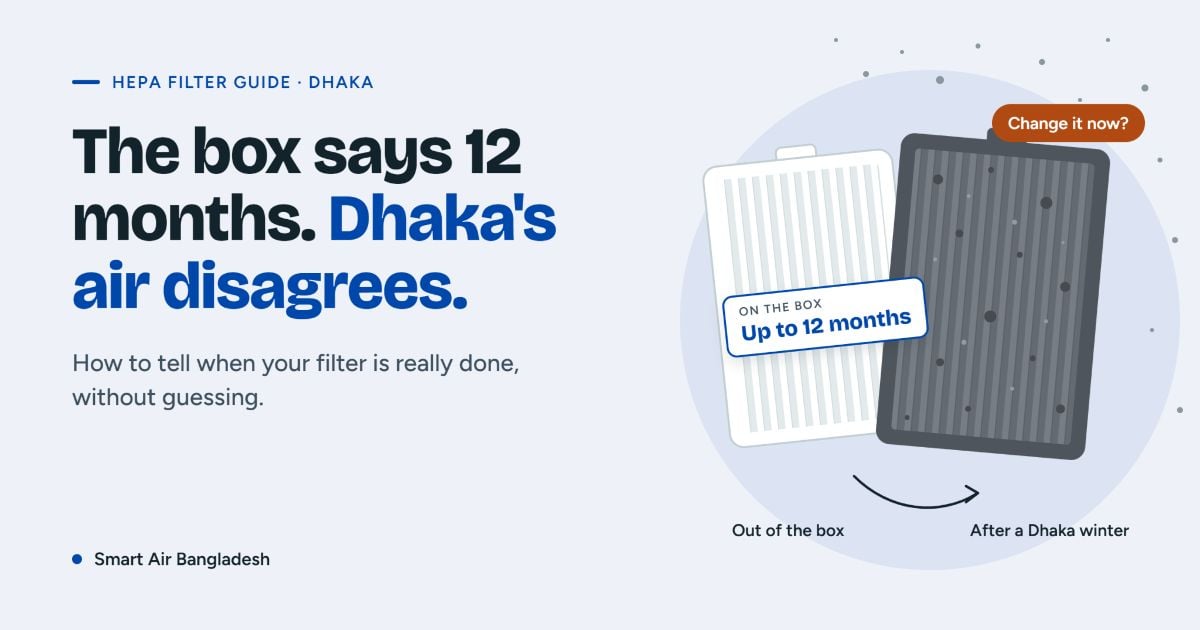
You open your air purifier, and the filter that was bright white when it came out of the box is now dull grey, or even pitch black. Should you buy a new one today, or does it still have life left? Nobody wants to spend money on a new filter too early. But nobody wants to breathe through a worn-out one either. Here’s what you need to know about changing HEPA filters in Dhaka.
The quick answer
- Brands like Blueair and Xiaomi say every 6 to 12 months. In Dhaka’s air, filters usually need changing sooner, especially in winter. For Smart Air purifiers in Bangladesh, it’s about every 3 months for the Sqair, 4 months for the SA600, and 12 months for the Blast, at 8 hours a day.
- The best way to know is a simple test with a PM2.5 monitor. We explain it step by step below.
- Don’t judge a filter by its colour, and don’t wash it.
How often should you change your HEPA filter?
Start with the filter life your purifier’s brand gives you. You’ll usually find it in the manual or on the brand’s website. Then think about how dirty the air is where you live, because that makes a big difference.
The US Environmental Protection Agency (EPA) keeps it simple: every filter needs replacing regularly, because a dirty, overloaded filter won’t trap particles well.
Here’s a real example of why your city matters. In Smart Air’s tests in Beijing, the Sqair’s HEPA filter lasted about 6 months when running on high for 8 hours a day. But for Bangladesh, Smart Air recommends changing the Sqair’s filter every 3 months. Why the difference? Smart Air explains that filter life depends on how many hours you run the purifier and how polluted the local air is.
And Dhaka’s air is very polluted. In 2025, the city’s average PM2.5 was 68.0 µg/m³, according to IQAir. That’s an AQI score of about 160: red, or “Unhealthy”, as an average for the whole year. A 2025 study by researchers at BUET, working with the University of Dhaka and two universities in the US, also found that the air inside Dhaka homes was almost as polluted as the air outside. Our guide to air quality in Dhaka (see our guide) explains both findings.
So here’s the simple rule for Dhaka: follow the filter life your brand gives for Bangladesh, don’t stretch it, and check your filter more often in winter, when the air is at its worst.
Why do HEPA filters wear out faster in Dhaka?
Because a filter wears out from the dirt it catches, not from the days on the calendar. Think of a HEPA filter like a sponge. It can only hold so much. The dirtier the air, the faster it fills up. Once it’s full, much less clean air comes out of your purifier. Smart Air’s own tests show what “full” looks like. In Beijing, Smart Air ran a Sqair at its highest fan speed and tracked how well the filter cleaned the air. After 1,400 hours, or about 6 months at 8 hours a day, the filter was doing only half the job it did when it was new. That’s the point where Smart Air says it’s time for a new one.
Real homes show the same thing. Researchers in China tracked air purifiers in real homes and found that the dirtier the outdoor air, the faster the filters filled up. Using their results, they worked out that where outdoor PM2.5 is between 75 and 250 µg/m³, a purifier running 12 hours a day would last only about 1 to 3 months before it could no longer keep the room’s air clean enough.
Dhaka’s winter air falls right in that range. In 2025, IQAir found that Dhaka spent at least two months with PM2.5 above 100 µg/m³. That’s an AQI of about 182, deep in the red.
How long your own filter lasts also depends on how many hours a day you run the purifier, the fan speed, the size of the room, and the filter itself. That’s why one number can’t fit every home.
Myths about HEPA filter life
Myth 1: “My filter will last as long as the box says.”
Manufacturers will mention things like “filter life up to 2 years”. In some cases, we’ve even seen “filter life up to 10 years”. These are pure marketing claims, and they don’t hold up in real-life situations. Heavy dust, pollution, or running the purifier all day in a polluted city like Dhaka will reduce the actual lifespan of a HEPA filter.
Look at a few examples. Blueair, a Swedish brand, recommends changing its filters every 6 months. It adds that you’ll need to change them more often in very polluted places, but doesn’t say how much more often. Xiaomi says its Mijia Air Purifier Max filter lasts up to 12 months, and notes that this is only an estimate. Sharp says its long-life True HEPA filter lasts up to 2 years, “depending on the environment”.
So ask yourself: is one number for the whole world really right for Dhaka’s air? When Smart Air asked one popular brand where its filter life numbers came from, the brand said it doesn’t share that data.
Smart Air is the only company that (so far) gives accurate information on filter life. It tests and publishes how its filters perform over time, and lists a separate, shorter filter life for Bangladesh, because filters don’t last as long in our air.
Myth 2: “A grey or black filter is finished.”
Not necessarily. Smart Air’s tests found that colour is a poor way to judge how well a filter works. A dark filter mostly means it’s doing its job: catching pollution. Colour alone can’t tell you whether it’s time to change it.
Myth 3: “You can wash a HEPA filter and use it again.”
No. When Smart Air’s engineers washed used HEPA filters with plain water, more air flowed through afterwards, but the filters caught far fewer particles. Vacuuming the HEPA filter barely helped either: across eight filters, it improved particle capture by less than 1%, and a few got slightly worse.
Myth 4: “The filter light tells me exactly when to change it.”
Not always. On many purifiers, the light is just a timer counting hours. It doesn’t measure how dirty your filter is. Honeywell, for example, says this about its own models. Blueair’s own support page says its filter light comes on after six months of continual use. Check your manual to see how yours works.
Myth 5: “Running the purifier on low saves the filter, so it saves money.”
It’s a false saving. The US Environmental Protection Agency (EPA) explains that higher fan speeds and longer running times clean more air. A filter that lasts longer because the purifier barely runs just means you breathe less clean air.
How can you tell if your HEPA filter needs replacing?
Measure your air. It’s the only sign that tells you directly whether the filter is still doing its job. Smart Air’s guide to testing filters explains a simple routine using an indoor PM2.5 monitor:
- Note your starting number. When the filter is new, close the windows and door, run the purifier at your usual speed, and write down the lowest reading the monitor reaches.
- Repeat the test every few weeks. Use the same room and the same speed, ideally on a day when the outdoor air is similar.
- Replace the filter when the room can no longer get close to that first number.
New to PM2.5 readings? Our PM2.5 guide explains what the numbers mean.
No monitor? Follow the filter life your purifier’s brand gives, and treat it as the latest time to change the filter, not something to stretch. If you use a Smart Air purifier, here’s the filter life Smart Air gives for Bangladesh, when used 8 hours a day:
| Purifier | Best for | Change the HEPA filter after |
|---|---|---|
| Sqair | Bedrooms | About 3 months (950 hours) |
| SA600 | Larger rooms, like living rooms | About 4 months (1,150 hours) |
| Blast | Classrooms, offices and big spaces | About 12 months (3000 hours) |
Between filter changes, check two things. Feel whether the air coming out of the purifier is weaker than before. And look at the HEPA filter itself for any tears, cracks, or gaps. Here’s how far you can trust each sign:
| What you notice | Can you trust it? |
|---|---|
| Your monitor shows the room no longer gets as clean as before | Yes. It measures what you actually care about: clean air. |
| Weaker airflow from the purifier | Partly. A filter that’s filling up does slow the air down. In lab tests by researchers in China, airflow dropped by about 18 to 21% after a fast-forward filter-life test, which loads the filter with cigarette smoke instead of counting hours of use. For a real-life time frame, researchers in Germany ran purifiers in school classrooms for a full year, about 1,520 hours at 8 hours a day. As the filters clogged, the cleaning power of the purifiers that couldn’t speed up their fans dropped by up to a third. But a change like that is hard to notice by hand, so a monitor is more reliable. |
| A tear, crack or gap in the filter | Yes. Even small tears can stop a filter from working properly, says Smarter HEPA’s filter guide. |
When it’s time, buy the replacement filter made for your purifier model. If you have a Smart Air purifier, you can find replacement Sqair, SA600, and Blast HEPA filters here in Bangladesh.
What happens if you don’t change your HEPA filter?
You won’t notice, and that’s the problem. The purifier keeps running, but less clean air comes out. Researchers in Germany tested this by loading eight home air purifiers with the same amount of cigarette smoke. The clean air they gave out dropped by about 10% in the best models, and by about 70% in the worst. Remember, Smart Air recommends a new filter once its cleaning power has dropped by about half.
There’s no alarm to warn you. That’s why checking with a monitor matters most in Dhaka’s winter, when you need your purifier the most.
How can you make a HEPA filter last longer?
You can’t clean a HEPA filter back to new. But you can stop it from filling up faster than it needs to.
- Keep outdoor pollution out. Most of what your filter catches comes from outside. The BUET researchers found that 80 to 85% of the PM2.5 inside the Dhaka homes they studied had come in from outdoors. So keep windows closed when the outdoor reading is high (Saha et al., 2025). Our guide to running an air purifier with windows open or closed explains when fresh air is worth letting in.
- Use a kitchen hood while you cook. The same BUET-led study recommends this to cut indoor PM2.5.
- Clean the pre-filter, if your purifier has one. This is the outer layer that catches hair and big dust. Smart Air recommends vacuuming it regularly, because a dirty pre-filter can lower your purifier’s performance.
Frequently asked questions
How long does a HEPA filter last in Dhaka?
It depends on your purifier, how long you run it each day and the time of year. For Smart Air purifiers used 8 hours a day in Bangladesh, it’s about 3 months for the Sqair, 5 months for the SA600 and 12 months for the Blast. If you run yours longer each day, it will need changing sooner.
Should I change my filter more often in winter?
Usually, yes. Dhaka’s air is far dirtier in winter, so filters fill up faster, especially if you run your purifier longer. Check with your monitor more often during these months.
Can I clean or wash my HEPA filter?
No. Washing damages it, and vacuuming barely helps. You can, and should, clean the pre-filter.
Does cooking at home affect my filter?
Yes. Smart Air lists indoor pollution, such as cooking, as one of the things that shortens filter life. Using a kitchen exhaust fan while you cook helps.
What if I rarely use my purifier?
Filter life is counted in hours of use. So a filter in a purifier you rarely run will last more months. But a purifier that’s switched off isn’t cleaning your air. In Dhaka, it’s better to run it and change the filter on time.
So, back to that grey filter. Its colour won’t tell you much, and neither will the calendar on its own. A few minutes with a monitor every few weeks will. That’s the most reliable way to know when to change your HEPA filter in Dhaka. And it means you only pay for a new filter when the old one has truly stopped doing its job.
Explore more air quality guides on the Smart Air Bangladesh blog.
References
- Blueair. (n.d.). How often should I change my filter? https://www.blueair.com/blogs/filters/how-often-should-i-change-my-filter
- Duill, F. F., Schulz, F., Jain, A., van Wachem, B., & Beyrau, F. (2023). Comparison of portable and large mobile air cleaners for use in classrooms and the effect of increasing filter loading on particle number concentration reduction efficiency. Atmosphere, 14(9), 1437. https://doi.org/10.3390/atmos14091437
- Honeywell Store. (n.d.). How to replace Honeywell air purifier filters and reset light. https://www.honeywellstore.com/store/product-support/replace-honeywell-air-purifier-filter.htm
- Khin, C. (2026, January 8). How to clean air purifier filters and are HEPA filters washable? Smart Air. https://smartairfilters.com/en/blog/how-to-clean-wash-hepa-filter/
- Nahr, M. S. S. (2026, March 25). Bangladesh’s air remains the second-worst globally in 2025. The Business Standard. https://www.tbsnews.net/bangladesh/environment/bangladesh-2nd-most-polluted-globally-only-14-cities-meet-who-air-quality
- Pei, J., Dai, W., Li, H., & Liu, J. (2020). Laboratory and field investigation of portable air cleaners’ long-term performance for particle removal. Building and Environment, 181, 107100. https://doi.org/10.1016/j.buildenv.2020.107100
- Saha, P. K., Habib, A., Prapti, D. R., Jubair, T., Zarrah, A. U., Hossain, C. A., Rahman, S. M., Salam, A., Bari, M. A., & Marshall, J. D. (2025). Characterizing indoor-outdoor PM2.5 concentrations using low-cost sensor measurements in residential homes in Dhaka, Bangladesh. Atmospheric Environment, 342, 120945. https://doi.org/10.1016/j.atmosenv.2024.120945
- Schumacher, S., Banda Sanchez, A., Caspari, A., Staack, K., & Asbach, C. (2022). Testing filter-based air cleaners with surrogate particles for viruses and exhaled droplets. Atmosphere, 13(10), 1538. https://doi.org/10.3390/atmos13101538
- Sharp. (n.d.). How long does your air purifier filter last? https://simplybetterliving.sharpusa.com/bite-size/how-long-does-your-air-purifier-filter-last
- Smart Air. (n.d.). Blast HEPA filter. https://smartairfilters.com/bd/en/product/blast-ffu-hepa-filter/
- Smart Air. (n.d.). SA600 HEPA filter (2-pack). https://smartairfilters.com/bd/en/product/sa600-hepa-filter-2-pack/
- Smart Air. (n.d.). Sqair HEPA filter. https://smartairfilters.com/bd/en/product/sqair-hepa-filter/
- Smart Air. (n.d.). The Sqair air purifier. https://smartairfilters.com/bd/en/product/air-purifier-sqair/
- Smarter HEPA. (2025, January 22). Signs it’s time to change your HEPA filter. https://www.smarterhepa.com/blogs/learn/signs-its-time-to-change-your-hepa-filter
- U.S. Environmental Protection Agency. (2026, October 1, last updated). Guide to air cleaners in the home. https://www.epa.gov/indoor-air-quality-iaq/guide-air-cleaners-home
- Vanzo, T. (2021, June 19). Using an air monitor to determine when to replace a HEPA filter. Smart Air. https://smartairfilters.com/en/blog/using-air-monitor-to-determine-when-to-replace-hepa-filter/
- Vanzo, T. (2024, January 15). How often should I change air purifier filters and how long do they last? Smart Air. https://smartairfilters.com/en/blog/when-to-change-your-air-purifiers-hepa-filter/
- Xiaomi. (n.d.). Mijia Smart Air Purifier Max filter. https://www.mi.com/global/product/mijia-air-purifier-max-filter/
Free Guide to Breathing Safe
Want to learn more about breathing clean air? Join thousands more and stay up to date on protecting your health.

