
It’s a weekday morning in Dhaka. The school bag is packed, your child’s shoes are on, and before you open the door, you check one last thing on your phone: the air quality in Dhaka. A coloured circle. A number. You’ve seen it so often that it hardly registers anymore.
So you head out anyway. After all, what else can you do?
Actually, more than you might think. That number is a reading for a single hour, and it fits into a much bigger pattern. Once you can see the pattern, you’ll know when Dhaka’s air is at its worst, why two apps can show completely different numbers for the same city, and which small changes at home actually help. Here’s what the data shows.
What does the AQI number on my phone actually mean?
AQI stands for Air Quality Index. It’s a scale that turns pollution measurements into one simple number: the higher the number, the dirtier the air and the bigger the risk to your health. Apps then colour-code that number so you can read it at a glance. Did you know each country has its own AQI scale? For example, China, India, and the USA all have different scores for what is “green” air.
Which AQI scale to trust? Most often, the USA scale is accepted as trustworthy.
The number comes from measuring PM2.5, the tiny particles in the air that are far too small to see. In Dhaka, PM2.5 is the one that matters most: the Department of Environment (DoE) calls it the main pollutant behind Bangladesh’s air problem. Our PM2.5 guide explains what these particles are (see our guide).
Here’s an easy way to keep the two apart. PM2.5 is like the temperature: the raw measurement. The AQI is like the weather forecast: it tells you what that measurement means for your day. For example, according to IQAir, Dhaka’s average PM2.5 in 2024 was 78 micrograms per cubic metre of air (µg/m³). That equals an AQI of about 167. On your phone, that’s red, or “Unhealthy”. Red means the air is bad enough that anyone can start to feel it, not just children, older people or people with asthma: think irritated eyes, coughing, and extra strain on the heart and lungs.
Here’s what each colour means, in the Department of Environment’s own words, lightly simplified:
| AQI | Colour | What it means for you |
|---|---|---|
| 0 to 50 | Green | Good. The air poses little or no risk. |
| 51 to 100 | Yellow | Moderate. Fine for most people; a very small number of unusually sensitive people may be affected. |
| 101 to 150 | Orange | Unhealthy for sensitive groups. Sensitive people may feel effects; most others won’t. |
| 151 to 200 | Red | Unhealthy. Everyone may start to feel effects, and sensitive people more so. |
| 201 to 300 | Purple | Very unhealthy. A health alert: everyone may feel more serious effects. |
| 301 and above | Maroon | Hazardous. Emergency conditions: everyone is more likely to be affected. |
Some apps show the raw PM2.5 reading in µg/m³ instead of an AQI number. If yours does, here’s a quick way to read it: anything from about 55 to 125 µg/m³ over a day counts as red, or “Unhealthy”. That range comes from the US Environmental Protection Agency’s (EPA) 2024 scale, which Bangladesh’s own AQI system is modelled on. One thing to keep straight: the colour scale is a warning system, not a safety line. The World Health Organization’s daily guideline is 15 µg/m³, a line it says the air should cross on no more than 3 to 4 days a year. So by the time your app turns red, the air is already more than three times over that line. Keep that in mind for the numbers below.
Is Dhaka the most polluted city in the world?
On some mornings, yes: Dhaka does hit number one in the live rankings. But averaged over a full year, it sits just behind the top spot. IQAir’s 2025 World Air Quality Report, as reported by The Business Standard, found Dhaka was the second most polluted capital city in the world, after New Delhi. Its average PM2.5 level for the year was 68.0 µg/m³, an AQI of about 160. That’s red, or “Unhealthy”. And remember, this isn’t the reading from one bad morning. It’s what the air averaged out to across all 365 days of the year.
To put that in context, the World Health Organization’s guidelines set limits on how much PM2.5 our bodies should be exposed to: no more than 5 µg/m³ as a yearly average, and a daily average above 15 µg/m³ on no more than 3 to 4 days a year. Bangladesh’s own legal limit, set in the Air Pollution (Control) Rules 2022, is far looser: 35 µg/m³ as a yearly average, seven times the WHO guideline. Dhaka’s 2025 average of 68.0 µg/m³ blew past both, nearly double our own legal limit, and more than 13 times what the WHO considers safe. And this isn’t just a Dhaka problem. Bangladesh as a whole averaged 66.1 µg/m³ in 2025 (an AQI of about 158), making it the second most polluted country in the world.
Is Dhaka’s air getting better?
Maybe a little. Dhaka’s 2025 average of 68.0 µg/m³ (an AQI of about 160) was lower than 2024’s 78 µg/m³ (an AQI of about 167). That’s good news. But the average AQI for both years still sat in the red, “Unhealthy” zone, and one better year doesn’t make a trend. When the Department of Environment (2025) looked at six years of its own data, from 2018 to 2023, pollution in and around Dhaka barely changed. It went up a little in some years and down a little in others. Part of that is about where the readings come from: the DoE measures the air with sensors at fixed spots around the city, so when big construction work starts near one of those stations, that station’s readings climb. The weather plays a part too. A year with more rain and wind clears more pollution out of the air, while a drier, stiller year lets it build up.
Why does Dhaka top the pollution rankings one day and not the next?
Because daily rankings are based on one reading at one moment. On 2 October 2026, for example, The Business Standard reported that Dhaka was the fifth most polluted city in the world, with an AQI of 163 at 9:25 am. A few hours later, the list can look completely different. A morning ranking tells you about that morning. The yearly average tells you what you actually breathe, month after month, and you can follow Dhaka’s live and historical readings on IQAir’s Dhaka page.
When is air quality in Dhaka at its worst?
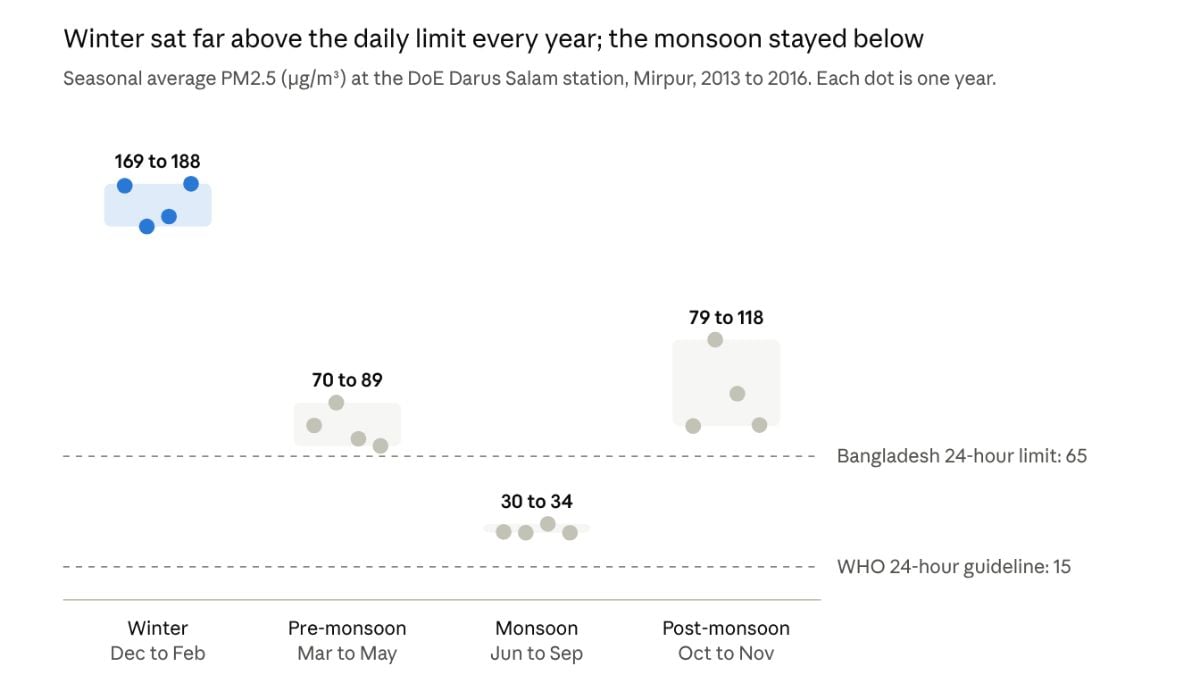
In winter, by a long way. At the DoE’s stations in and around Dhaka, December and January are the most polluted months, followed by February and March. Across the country, July is usually the cleanest.
How big is the gap? A 2021 study by Nafisa Islam and colleagues at BUET, working with the DoE, looked at four years of data (2013 to 2016) from the government’s monitoring station at Darus Salam in Mirpur. Winter PM2.5 levels were 5 to 6 times higher than in the monsoon. In winter, PM2.5 was over Bangladesh’s daily legal limit almost every single day (99.45% of days). In the monsoon, it went over on just 4.5% of days.
The pattern hasn’t gone away. In 2025, IQAir found Dhaka spent at least two months with PM2.5 above 100 µg/m³. That’s an AQI of about 182, deep in the red. To put that in human terms, researchers at Berkeley Earth estimate that breathing air with 22 µg/m³ of PM2.5 for a full day carries roughly the same health risk as smoking one cigarette. At 100 µg/m³, that’s like smoking four to five cigarettes a day. Over two months, it adds up to more than 270 cigarettes for every person in the city, including babies and children who have never been near one.
The shape repeats every single year: a big winter peak, a monsoon low, and the months in between somewhere in the middle.
Why is Dhaka’s air so much worse in winter?
It isn’t one cause. It’s several things lining up at the same time:
- Still, cold air. In winter, the air near the ground barely moves, so pollution stays close to where we breathe. Picture a lid over the city. On January nights, the DoE found that this lid can sit as low as 31 metres, about the height of a 10-storey building. All the smoke, dust and exhaust from a city of millions gets squeezed into that thin layer of air, right where we live and sleep.
- Almost no rain. In the monsoon, rain washes particles out of the air. In winter, that cleaning mostly stops.
- Brick kilns. The kilns around the city run mainly in the dry winter months.
- Wind from the northwest. From November to March, the wind blows in from the northwest and carries pollution from outside Bangladesh into the city. A 2025 study led by researchers at BUET, working with the University of Dhaka and two universities in the US, found the same cross-border pattern.
What time of day is Dhaka’s air cleanest?
Usually the afternoon. But in Dhaka, especially in winter, that means less dirty, not clean. That same BUET-led study also measured the air inside and outside 17 homes in Dhaka in 2021 and 2022. In winter, outdoor PM2.5 in the afternoon was 30 to 35% below the daily average. At night and early in the morning, it was 15 to 25% above it.
In winter, as the sun comes up, the air gets warmer. The pollution travels into the atmosphere. As the afternoon ends, the sun goes down, the temperature goes down, and air pollution is trapped in a blanket of cold air.
In everyday terms, the morning school run and the after-dinner walk tend to land in the dirtier hours. Mid-afternoon is usually your better window for outdoor play or exercise, but you have to be very careful, because during Dhaka’s winter season the air will still be heavily polluted.
Why do air quality apps show different numbers for Dhaka?
Mostly because of where the numbers come from. PM2.5 levels differ from one part of Dhaka to another, so sensors across the city pick up different readings. An app blends these into one average AQI for the whole city, and that city-wide number is usually similar from app to app. But the air at your exact spot can be a different story: next to a busy road, a construction site or a factory, pollution will almost certainly be higher than the city average. The apps also don’t all use the same sensors. The DoE pulls data only from its own handful of stations, while apps like IQAir and AirGradient pull from many independent sensors scattered across the city. Different sources, different numbers.
The DoE runs five monitoring stations in Dhaka city and publishes real-time AQI readings on its website. Apps like IQAir AirVisual also pull in readings from smaller sources. Smart Air Bangladesh, for example, has been installing outdoor sensors across Dhaka since 2022.
Location makes a real difference, even a few kilometres apart. The DoE found that its station in Agargaon, away from heavy traffic, picked up 10 to 15% less particle pollution than its stations beside busy roads in Farmgate and Darus Salam. So if one app shows a reading near a main road and another shows a quieter area, they won’t match. That’s normal.
One well-known source has also gone quiet. For years, the US Embassy in Dhaka shared readings from its own monitor. That stopped on 4 March 2025, when the US government halted its embassy monitoring programme, The Business Standard reported.
The simple fix: pick one app (we like AirGradient Map and IQAir AirVisual), check the same location each time, and watch whether the number is going up or down. The direction tells you more than any single reading.
How can I protect my family from Dhaka’s air pollution?
You can’t fix air quality in Dhaka on your own. But the data points to a few things that genuinely help.
Don’t assume indoors is safer. Most people in Bangladesh think of air pollution as an outdoor problem; the BUET-led team points out. Their measurements in those 17 homes say otherwise. In winter, PM2.5 inside averaged 146 µg/m³. Outside, it was 153. Almost the same. About 80 to 85% of the pollution indoors had come in from outside. Their advice: keep windows closed when the outdoor reading is high, and run an exhaust fan in your kitchen while you cook.
Know your own numbers. An indoor air quality monitor shows what your family is breathing at home, including the bedroom where your child sleeps. If you manage a school, office, or apartment building, an outdoor monitor does the same for the air around it.
Clean the air in the rooms you use most. The same BUET team points to many earlier studies showing that indoor air filters bring indoor pollution down. The trick is matching a HEPA purifier to the size of the room: the Sqair for a bedroom, the SA600 for a larger room like a living room, and the Blast for big spaces like classrooms, offices and open-plan floors.
Wear a mask outside on red and purple days. A well-fitted FFP2 air pollution mask filters out fine particles, so keep a few by the door for the school run and your commute. Fit matters as much as the mask itself: if air leaks in around the edges, so does the pollution.
So the next time you check that number before the school run, you’ll know what it’s really saying. Is it a winter morning or a monsoon one? Would the afternoon be better for the park? Is the air inside any cleaner than the air outside?
Cleaning up Dhaka’s air will take policy and time. Cleaner air in the room where your child sleeps can start this week.
Explore more air quality guides on the Smart Air Bangladesh blog.
References
- AQI.in. (n.d.). Dhaka air quality index (AQI). https://www.aqi.in/dashboard/bangladesh/dhaka-division/dhaka
- Berkeley Earth. (2015). Air pollution and cigarette equivalence. https://berkeleyearth.org/air-pollution-and-cigarette-equivalence/
- Department of Environment. (2025). Ambient air quality in Bangladesh (2018–2023). Ministry of Environment, Forest and Climate Change, Government of Bangladesh. https://objectstorage.ap-dcc-gazipur-1.oraclecloud15.com/n/axvjbnqprylg/b/V2Ministry/o/office-doe/2024/12/014a6e225cf849098389d835538afdc9.pdf
- IQAir. (2025, October 10). October 10, 2025: Dhaka among top 10 most polluted cities in the world. IQAir Newsroom. https://www.iqair.com/newsroom/dhaka-among-top-10-most-polluted-cities-in-the-world-10-10-2025
- Islam, N., Saroar, M. G., & Ahmed, T. (2021). Meteorological influences on urban air quality parameters in Dhaka City. Journal of Engineering Science, 12(1), 1–8. https://doi.org/10.3329/jes.v12i1.53095
- Nahr, M. S. S. (2026, March 25). Bangladesh’s air remains the second-worst globally in 2025. The Business Standard. https://www.tbsnews.net/bangladesh/environment/bangladesh-2nd-most-polluted-globally-only-14-cities-meet-who-air-quality
- Saha, P. K., Habib, A., Prapti, D. R., Jubair, T., Zarrah, A. U., Hossain, C. A., Rahman, S. M., Salam, A., Bari, M. A., & Marshall, J. D. (2025). Characterizing indoor-outdoor PM2.5 concentrations using low-cost sensor measurements in residential homes in Dhaka, Bangladesh. Atmospheric Environment, 342, 120945. https://doi.org/10.1016/j.atmosenv.2024.120945
- Smart Air Bangladesh. (n.d.). Air quality monitors. https://smartairfilters.com/bd/en/air-quality-monitors/
- The Business Standard. (2025). US embassy monitoring halt: Air quality monitoring crisis may deepen in Bangladesh. https://www.tbsnews.net/bangladesh/environment/us-embassy-monitoring-halt-air-quality-monitoring-crisis-may-deepen
- The Daily Star. (2023). Real-time air quality tracking launched across Bangladesh. https://www.thedailystar.net/tech-startup/news/real-time-air-quality-tracking-launched-across-bangladesh-3474436
- UNB. (2026, October 2). AQI: Dhaka ranks 5th among world’s most polluted cities. The Business Standard. https://www.tbsnews.net/bangladesh/aqi-dhaka-ranks-5th-among-worlds-most-polluted-cities-1560316
- U.S. Environmental Protection Agency. (2024). Final updates to the Air Quality Index (AQI) for particulate matter: Fact sheet and common questions. https://www.epa.gov/system/files/documents/2024-02/pm-naaqs-air-quality-index-fact-sheet.pdf
- World Health Organization. (2021). WHO global air quality guidelines: Particulate matter (PM2.5 and PM10), ozone, nitrogen dioxide, sulfur dioxide and carbon monoxide. https://iris.who.int/bitstream/handle/10665/345329/9789240034228-eng.pdf
Free Guide to Breathing Safe
Want to learn more about breathing clean air? Join thousands more and stay up to date on protecting your health.

