
You fried fish an hour ago, and the whole flat still smells of it. Or the painters finished the bedroom yesterday. Or the new sofa has a strong chemical smell, and the window faces a busy road where traffic fumes drift in all day. Your air purifier has been running the whole time. So why can you still smell it?
Maybe the shop told you it removes everything. No single filter does. Your purifier probably isn’t broken; it may just have the wrong filter for the job. That’s the heart of the HEPA vs carbon filter question: each one catches a different kind of pollution.
Does a HEPA filter remove smells?
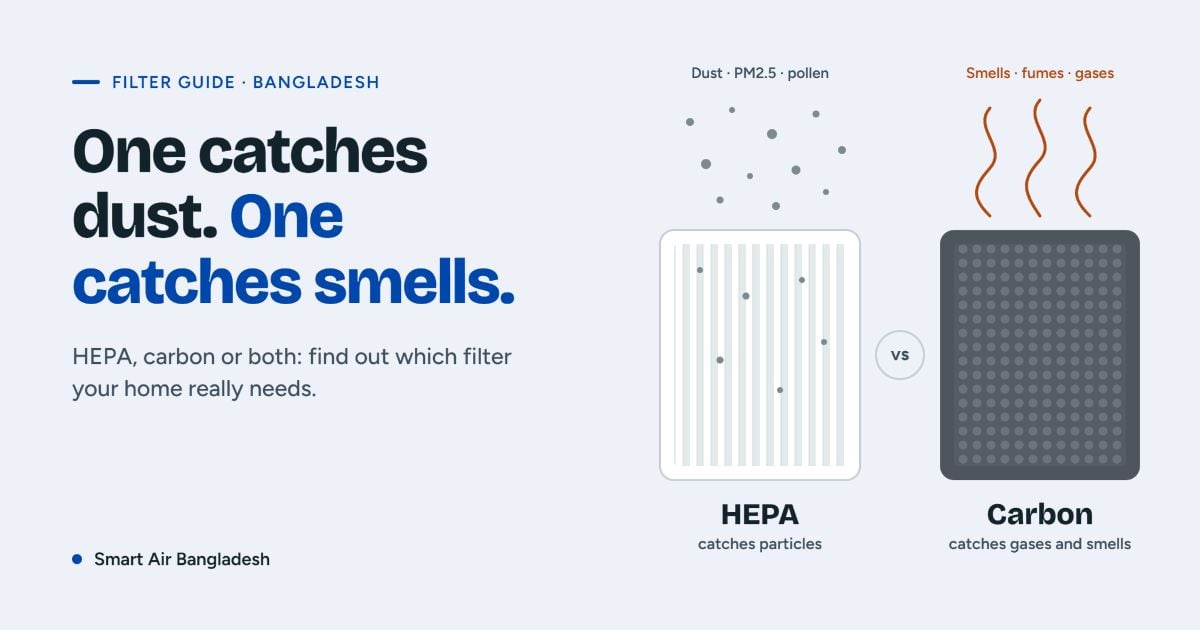
No. A HEPA filter traps particles such as dust, pollen, pet dander, mold and PM2.5. But smells and chemical gases are a different kind of pollution: their molecules are far too small for a HEPA to hold, so they pass straight through the filter, as Smart Air’s own lab tests show.
The opposite mistake is just as common. A carbon filter soaks up smells and gases, but it doesn’t capture particles, including dust and allergens. So a purifier with only carbon won’t clean the PM2.5 out of Dhaka’s air, and one with only HEPA won’t clear the smell of frying oil.
What is the difference between a HEPA and a carbon filter?
In the HEPA vs carbon filter comparison, the difference is simple: HEPA catches particles, and carbon catches gases. A HEPA filter is a thick layer of very fine fibres that traps particles as air passes through. Activated carbon is full of tiny holes, and gas molecules stick to its surface as air flows through.
| HEPA filter | Carbon filter | |
|---|---|---|
| What it catches | Particles: PM2.5, dust, pollen, mold, pet dander | Gases and smells: paint fumes, chemical gases, cigarette smoke and cooking odours |
| What it misses | Odours and gases | Particles |
| Who needs it | Every home in Dhaka | Homes with a specific problem with smells or chemical gases |
Do I need a HEPA filter in Dhaka?
For most homes, yes, because Dhaka’s main air problem is particle pollution. Bangladesh’s Department of Environment calls PM2.5 the main pollutant behind the country’s poor air. And when BUET-led researchers measured the air in 17 Dhaka homes, they found that 80 to 85% of the fine particles indoors had come in from outside. Catching those particles is exactly what a HEPA filter is built to do.
When do you need a carbon filter?
Only when chemical gases or smells are part of the problem. Activated carbon handles VOCs, the chemical gases that the US EPA says are given off by everyday things like paint, new furniture, building materials and cleaning products. Carbon helps most in homes like these:
- A room that was recently painted, renovated, or filled with new furniture
- Someone who smokes indoors
- A home near a busy road or a factory
- A kitchen with a gas stove, or a lot of frying in oil
So the question is simple: do any of these describe your home? If yes, keep a carbon filter working. If not, HEPA is doing the real work for you. In Bangladesh, Smart Air’s Sqair and SA600 both come with a carbon filter in the box, so you’re covered from day one. But carbon has a trade-off: it slows the air down. Smart Air’s own Sqair specs show it delivers less clean air with the carbon filter in. So if smells and chemical gases aren’t a problem in your home, you don’t have to replace the carbon once it’s used up. The Sqair then runs on HEPA alone, at full strength.
Do I need both a HEPA and a carbon filter?
Only if you have both kinds of pollution. Some sources create particles and gases at the same time. Cigarette smoke is one: a HEPA filter catches its fine particles while carbon deals with the smell. That’s exactly why Smart Air’s lab used cigarette smoke to test its carbon filters: it produces both kinds of pollution at once. Living beside a busy road with heavy traffic is another, since vehicle exhaust gives off fumes and gases, like nitrogen dioxide, on top of the PM2.5 already in Dhaka’s air.
Think back, frying smells in the kitchen, fresh paint in the bedroom, a new sofa, and a window on a busy road. That home has Dhaka’s particle pollution coming in all day, a job for HEPA. With smells and fumes layered on top, a job for carbon. That’s a both-filters home.
How do I know which filter I need?
Start with what you notice. Here’s a simple rule: if you can see it as dust or measure it as PM2.5, you’re dealing with particles. If you can smell it, a gas is usually involved.
| What you notice at home | What’s causing it | Filter that handles it |
|---|---|---|
| Dust on surfaces, haze, or a high AQI or PM2.5 reading | Particles | HEPA |
| Dust from a building site next door | Particles | HEPA |
| Sneezing around dust or pollen | Particles | HEPA |
| Pet hair and pet smell | Particles and odours | Both |
| Cooking smells that linger after frying | Odours | Carbon |
| Paint, renovation or new furniture smell | Chemical gases (VOCs) | Carbon |
| Cigarette smoke indoors | Particles and gases | Both |
| Fumes from a busy road outside | Gases, plus the city’s PM2.5 | Both |
In Dhaka, HEPA is the starting point for almost everyone. Add carbon only if one of the smell or chemical-gas situations in the table matches your home.
Which Smart Air purifiers come with a carbon filter?
It depends on the model, so it’s worth checking before you buy. If smells are your main concern and you’d rather not think about add-ons, the Sqair Chemical Warfare and the SA600 both come with a HEPA filter and a carbon filter in the box. The Blast Mini and Blast come with HEPA, and carbon is a separate add-on you can buy if your situation calls for it.
Two models work differently. The DIY purifier has a carbon filter available separately, but it runs one filter at a time, so you choose HEPA or carbon, not both together. The portable QT3 is HEPA only, with no carbon option.
Frequently asked questions
Does a carbon filter remove PM2.5?
No. Carbon targets gases and smells. For PM2.5 and dust, you need a HEPA filter.
Does a carbon filter last forever?
No. Carbon gets used up as it traps gases. HouseFresh notes that purifiers with only a small amount of carbon can fill up quickly in rooms with a lot of chemical gases.
Can an air purifier replace my kitchen exhaust?
No. Experts speaking to Expert Reviews describe a purifier as extra help alongside ventilation, not a replacement for it, and the BUET-led study above also recommends running a kitchen exhaust while you cook. Purifiers are also not designed to remove carbon monoxide, which needs a proper detector.
The bottom line
HEPA handles the dust and fine particles you can’t smell. Carbon handles the smells and gases you can. For most Dhaka homes, the HEPA vs carbon filter choice starts with HEPA, and carbon is worth adding when smells or chemical gases are a regular problem.
Explore more air quality guides on the Smart Air Bangladesh blog.
References
- Ashton, D. (2025, December 17). Smart Air Sqair review. HouseFresh. https://housefresh.com/smart-air-sqair-air-purifier-review/
- Ashton, D. (2026, September 18). The best air purifiers you can buy in 2026. HouseFresh. https://housefresh.com/best-air-purifiers-we-tested/
- Department of Environment. (2025). Ambient air quality in Bangladesh (2018–2023). Ministry of Environment, Forest and Climate Change, Government of Bangladesh. https://objectstorage.ap-dcc-gazipur-1.oraclecloud15.com/n/axvjbnqprylg/b/V2Ministry/o/office-doe/2024/12/014a6e225cf849098389d835538afdc9.pdf
- Expert Reviews. (n.d.). Does an air purifier help with smell? https://www.expertreviews.co.uk/beauty-wellness/air-treatment/does-an-air-purifier-help-with-smell
- Lee, A. (2024, November 15). HEPA vs. carbon filters: Which one enhances air quality better? HisoAir. https://hisoair.com/hepa-vs-carbon-filters/
- Saha, P. K., Habib, A., Prapti, D. R., Jubair, T., Zarrah, A. U., Hossain, C. A., Rahman, S. M., Salam, A., Bari, M. A., & Marshall, J. D. (2025). Characterizing indoor-outdoor PM2.5 concentrations using low-cost sensor measurements in residential homes in Dhaka, Bangladesh. Atmospheric Environment, 342, 120945. https://doi.org/10.1016/j.atmosenv.2024.120945
- Smart Air Bangladesh. (n.d.-a). Blast Mini Mk II air purifier. https://smartairfilters.com/bd/en/product/blast-mini-ffu/
- Smart Air Bangladesh. (n.d.-b). Blast Mk II air purifier. https://smartairfilters.com/bd/en/product/air-purifier-blast-2/
- Smart Air Bangladesh. (n.d.-c). Original DIY 1.0 air purifier. https://smartairfilters.com/bd/en/product/air-purifier-diy-1-0/
- Smart Air Bangladesh. (n.d.-d). QT3 portable air purifier. https://smartairfilters.com/bd/en/product/air-purifier-qt3-portable/
- Smart Air Bangladesh. (n.d.-e). SA600 air purifier. https://smartairfilters.com/bd/en/product/sa-600-large-room-air-purifier/
- Smart Air Bangladesh. (n.d.-f). The Sqair air purifier: Chemical Warfare. https://smartairfilters.com/bd/en/product/air-purifier-the-sqair-chemical-warfare/
- Smarter HEPA. (2023, July 17). Carbon vs. HEPA air filters: What are the differences? https://www.smarterhepa.com/blogs/learn/carbon-vs-hepa-air-filters-what-are-the-differences
Free Guide to Breathing Safe
Want to learn more about breathing clean air? Join thousands more and stay up to date on protecting your health.

