
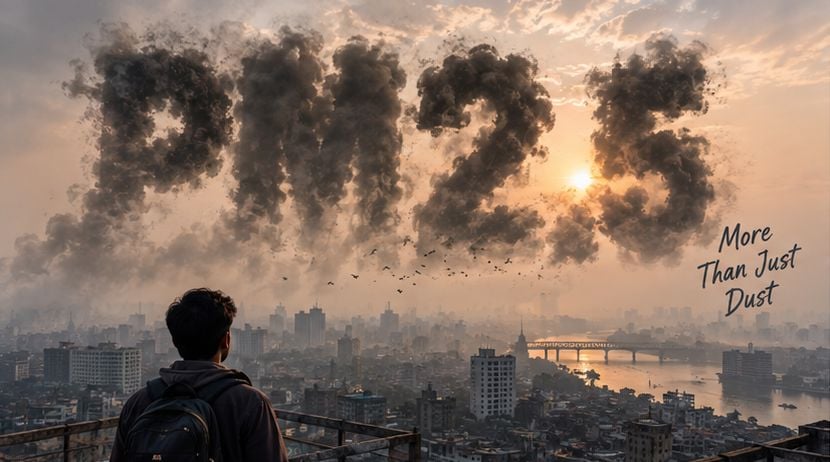
On a bad winter morning in Dhaka, you can taste the air before you see it. The sky sits low and grey, your eyes sting by the bus stop, and somewhere near Farmgate there’s a scratch in your throat that wasn’t there when you left home. Open an air quality app, and there’s a number for this, with a colour beside it: orange, red, or purple on many winter mornings. The letters PM2.5 sit somewhere near it.
In this guide, we will explain PM2.5 in simple words, what levels are considered safe, why it is a serious problem in Bangladesh, and how you can protect yourself and your family.
What Is PM2.5?
PM2.5 is a shorthand term used by experts to refer to the tiniest particles in the air. There are tiny soot, smoke, dust, and specks called “particulate matter” (PM). The “2.5” stands for their size: each particle measures under 2.5 micrometers wide, making them about 30 times thinner than a single human hair (EPA, n.d.).
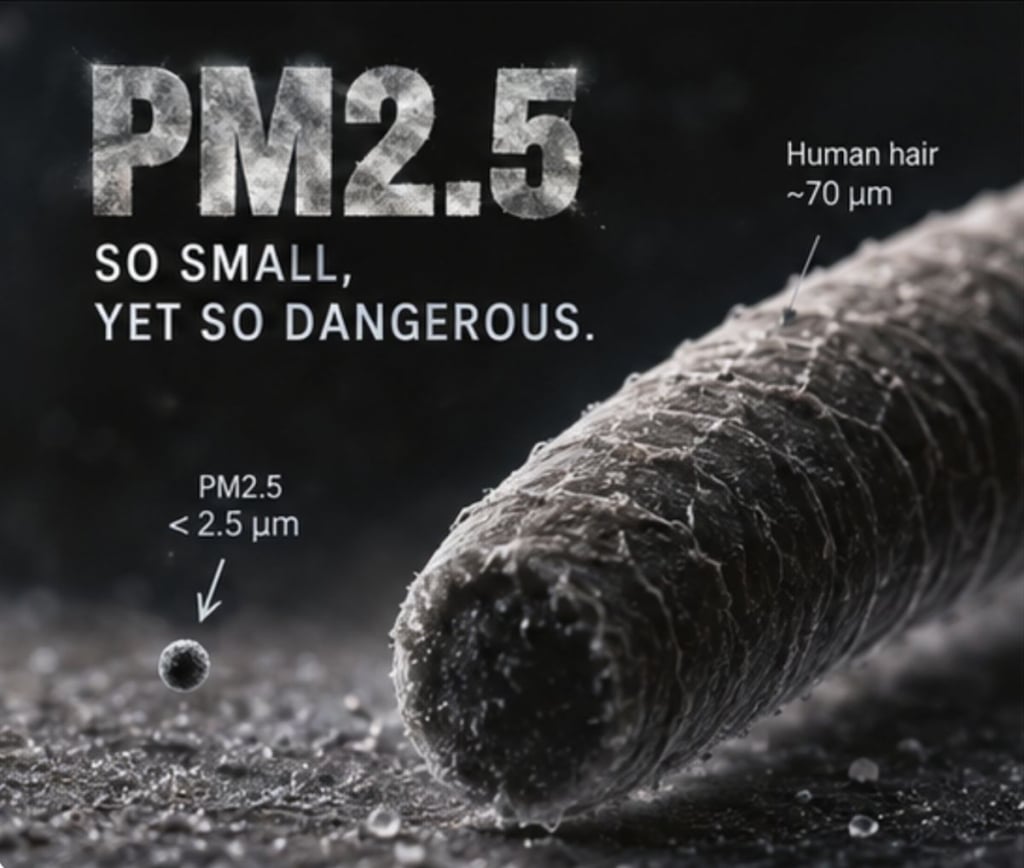
You cannot normally see a single PM2.5 particle. But when a huge amount of these particles fills the air, they can create the grey haze we often see in Dhaka.
PM2.5 can include:
- Smoke
- Soot
- Tiny chemical droplets
- Very fine dust
- Pollution from burning fuel
In Bangladesh, the main sources are traffic, especially old and unfit buses and trucks, brick kilns, factories, diesel generators, and power plants. Open waste burning and dust from roads and construction add to it (Mattsson, 2025).
PM2.5 is usually measured in micrograms per cubic metre, written as µg/m³.
This tells you how much PM2.5 is present in a certain amount of air.
The basic rule is simple:
Lower PM2.5 means cleaner air.
Higher PM2.5 means more particle pollution.
For example, a reading of 20 µg/m³ means the air contains much less fine particle pollution than a reading of 100 µg/m³.
PM2.5 vs AQI: What Is the Difference?
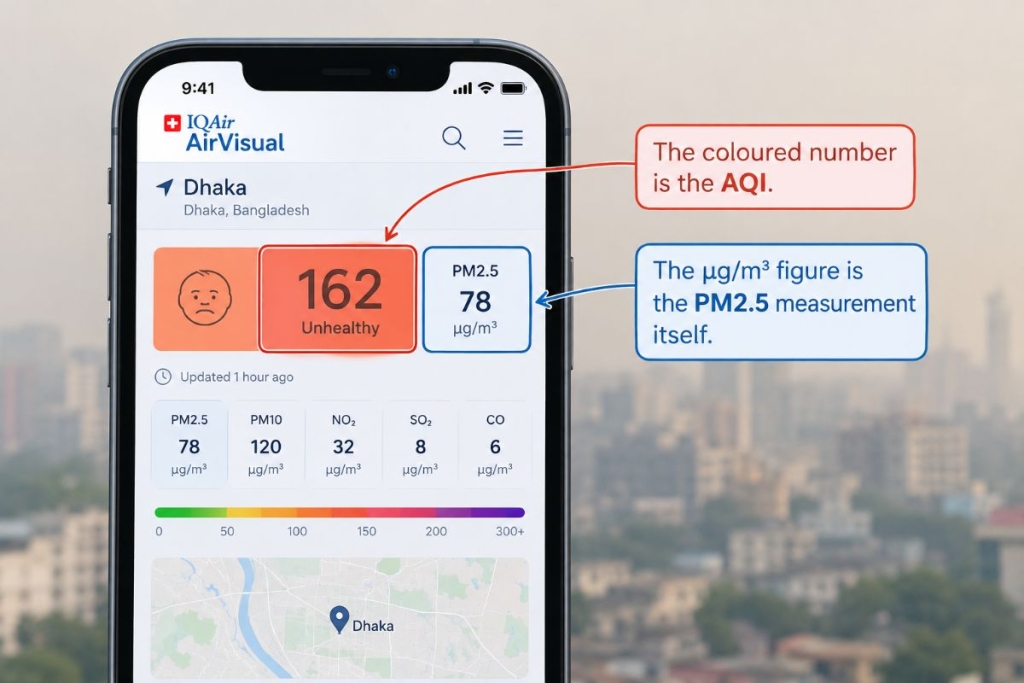
Air quality apps often show both a PM2.5 reading and a larger coloured number called the AQI.
AQI stands for Air Quality Index. The two numbers do different jobs. The PM2.5 reading tells you how much fine particle pollution is in the air. The AQI turns that pollution level into an easier health warning.
Common AQI colours include:
- Green: Good
- Yellow: Moderate
- Orange: Unhealthy for sensitive groups
- Red: Unhealthy
- Purple: Very unhealthy
- Maroon: Hazardous
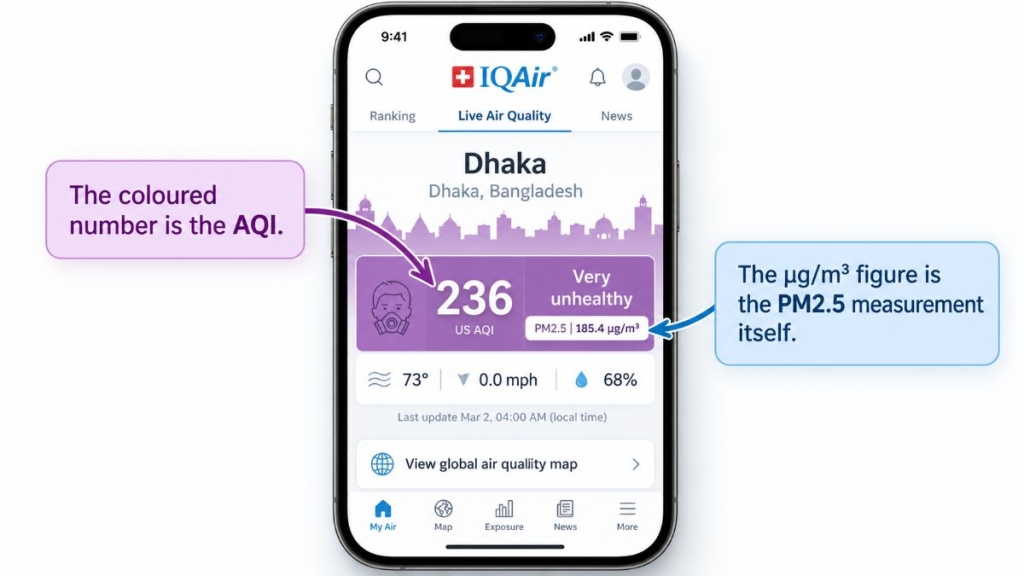
Bangladesh’s Department of Environment follows the US AQI system. Under this system, PM2.5 readings from 55.5 to 125.4 µg/m³ fall into the red or unhealthy range. Readings from 125.5 to 225.4 µg/m³ fall into the purple or very unhealthy range.
What Is the Difference Between PM2.5 and PM10?
PM10 is the bigger and heavier cousin. PM10 includes particles up to 10 micrometres wide, while PM2.5 includes much smaller particles.
Larger particles are more likely to get trapped in your nose and throat. Your body can often remove them through coughing or sneezing.
PM2.5 can travel much deeper into the lungs. Some of these very small particles may even enter the bloodstream.
This is one reason PM2.5 receives so much attention from health and environmental organisations.
What Is a Safe PM2.5 Level?
According to the World Health Organization (WHO), long-term annual exposure to PM2.5 should not exceed 5 µg/m³, while 24-hour average exposure should remain below 15 µg/m³ for health safety (World Health Organization , 2021). Bangladesh’s own standard, set under the Air Pollution (Control) Rules 2022, is less strict: 35 µg/m³ as a yearly average and 65 for a single day (DoE, 2025).
Here’s where we stand. In 2025, 130 of the 143 countries and territories IQAir monitored exceeded the WHO yearly guideline. Bangladesh had the second-worst air of them all, averaging 66.1 µg/m³: about 13 times the WHO level and nearly double our own standard (IQAir, 2026). Dhaka averaged 68.0 µg/m³, second among world capitals after Delhi. The report also singled Dhaka out as a capital that spent at least two months of the year above 100 µg/m³ (Nahr, 2026).
Is Dhaka’s Air Like Smoking Cigarettes?
Air pollution is sometimes compared with cigarette smoking to make the health risk easier to understand.
Researchers from Berkeley Earth estimated that breathing air with a PM2.5 concentration of about 22 µg/m³ for 24 hours carries a similar long-term health risk to smoking one cigarette.
Using that comparison, Bangladesh’s 2025 average of 66.1 µg/m³ is roughly equal to the long-term health risk of smoking around three cigarettes a day.
When winter PM2.5 readings in Dhaka rise above 100 µg/m³, the comparison becomes closer to four or five cigarettes per day.
This does not mean polluted air and cigarette smoke are the same. The comparison is simply a way to explain the possible health risk.
How Does PM2.5 Affect Your Health?
The biggest concern with PM2.5 is that the particles are small enough to reach deep inside the lungs.
Short-term exposure may cause problems such as:
- Burning or irritated eyes
- Coughing
- Sore throat
- Breathing discomfort
- Worsening asthma symptoms
For children, however, a cough that continues throughout the winter can be a sign worth paying attention to. Read more about a child’s cough that lasts all winter
Long-term exposure to PM2.5 is linked with a higher risk of heart disease, stroke, respiratory illness, asthma, and lung cancer.
The Air Quality Life Index estimates that air pollution may reduce the average life expectancy of a person in Bangladesh by 5.5 years compared with breathing air that meets the WHO guideline. For Dhaka district, the estimate is 6.9 years. (Energy Policy Institute at the University of Chicago [EPIC], 2025)
How Can You Protect Yourself From PM2.5?
You may not be able to control Dhaka’s outdoor air, but you can reduce how much polluted air you breathe.
Check the Air Quality
Use an air quality app such as AirGradient Map or IQAir AirVisual before spending a long time outdoors.
Do not rely only on how the sky looks. Pollution can be high even when the air does not look extremely dirty.
Reduce Outdoor Activity on Bad Days
When PM2.5 levels are high, consider moving exercise indoors and reducing long outdoor activities.
Children, older adults, and people with heart or breathing problems may need to be more careful.
Wear a Proper Mask
A well-fitting N95, KN95, orIQAIR FFP2 Air Pollution mask can help filter fine particles. Fit matters, as a gap at the nose or cheeks lets unfiltered air leak straight in, so look for one that seals closely and comes in a size made for your face. The IQAir FFP2 Face Mask(available in two sizes) is one option built around that kind of fit, filtering PM2.5, PM1, PM10, and other common particulates.
Check Your Indoor Air
Being indoors does not always mean the air is clean.
Outdoor PM2.5 can enter through windows, doors, gaps, and ventilation.
An indoor air quality monitor such as the Temtop S1+ can help you see how polluted your room is.
Use a HEPA Air Purifier
A HEPA air purifier such as the Sqair (Covers rooms up to 36 m²) can remove fine particles from indoor air.
Research found that a small HEPA purifier running at medium speed, with windows and doors closed, reduced indoor pollution by around 80%. (The Sqair Air Purifier)
Final Thoughts
PM2.5 may be invisible, but its effects are real.
These tiny particles can enter deep into the lungs, and Bangladesh regularly experiences levels far above international health guidelines.
Understanding your PM2.5 reading is the first step.
Check the air quality, reduce unnecessary exposure on heavily polluted days, wear the right mask, and pay attention to the air inside your home.
You may not be able to clean the whole city’s air, but you can take practical steps to create cleaner air for yourself and your family.
Want to know what you are breathing at home? Book a free air quality audit today.
Frequently Asked Questions
What does PM2.5 stand for?
PM stands for particulate matter. The 2.5 means the particles are 2.5 micrometres wide or smaller.
What PM2.5 level is considered safe?
The WHO recommends an average annual exposure of no more than 5 µg/m³ and a maximum 24-hour exposure level of 15 µg/m³.
Is PM2.5 more dangerous than PM10?
PM2.5 can travel deeper into the lungs than larger PM10 particles, and some particles may reach the bloodstream.
Can PM2.5 enter my home?
Yes. Outdoor PM2.5 can enter through doors, windows, gaps, and ventilation.
Does an air purifier remove PM2.5?
A proper HEPA air purifier can remove a large amount of fine particle pollution from indoor air.
What type of mask is best for PM2.5?
A well-fitting N95, KN95, or FFP2 mask provides much better protection from fine particles than a loose cloth mask.
References
- Department of Environment. (2025). Air quality monthly report: August 2025 (Table 1, National Ambient Air Quality Standards for Bangladesh). Ministry of Environment, Forest and Climate Change, Government of Bangladesh. https://doe.portal.gov.bd/sites/default/files/files/doe.portal.gov.bd/page/4e37d9e4_c6e5_4767_9905_f92f52cd557e/2025-10-08-08-11-0ca293c4c1464b0ec6515b83a6938332.pdf
- Energy Policy Institute at the University of Chicago. (2025). Air Quality Life Index: Bangladesh fact sheet 2025. https://aqli.epic.uchicago.edu/files/Bangladesh%20FactSheet_2025.pdf
- IQAir. (2025, December 30). PM2.5. IQAir Newsroom. https://www.iqair.com/as/newsroom/pm2-5
- IQAir. (2026, March 24). IQAir’s 2025 World Air Quality Report finds only 14% of cities meet WHO air pollution guideline [Press release]. https://www.iqair.com/newsroom/waqr-2025-pr
- Mattsson, M. (2025, December 26). Breathing death: What Bangladesh must do to tackle air pollution. The Daily Star. https://www.thedailystar.net/ds/big-picture/news/breathing-death-what-bangladesh-must-do-tackle-air-pollution-4066701
- Muller, R. A., & Muller, E. A. (2015). Air pollution and cigarette equivalence. Berkeley Earth. https://berkeleyearth.org/air-pollution-and-cigarette-equivalence/
- Nahr, M. S. S. (2026, March 25). Bangladesh’s air remains the second-worst globally in 2025. The Business Standard. https://www.tbsnews.net/bangladesh/environment/bangladesh-2nd-most-polluted-globally-only-14-cities-meet-who-air-quality
- Saladin, S. (2026, April 9). Beyond the numbers: The controversy in PM2.5 and health. AirGradient. https://www.airgradient.com/blog/the-controversy-in-pm25-and-health
- Smart Air Bangladesh. (n.d.-a). The Sqair air purifier [Product page]. https://smartairfilters.com/bd/en/product/sqair-air-purifier/
- Smart Air Bangladesh. (n.d.-b). Temtop S1+ 4-in-1 air quality monitor [Product page]. https://smartairfilters.com/bd/en/?p=14200
- Talhelm, T. (2019, April 29). What is PM2.5 AQI and how is it calculated? Smart Air. https://smartairfilters.com/en/blog/difference-pm2-5-aqi-measurements/
- Talhelm, T. (2024, October 23). Particle air pollution: PM10 vs PM2.5. Smart Air. https://smartairfilters.com/en/blog/pm10-pm2-5-difference-particle-air-pollution/
- U.S. Environmental Protection Agency. (n.d.). Particulate matter (PM) basics. https://www.epa.gov/pm-pollution/particulate-matter-pm-basics
- U.S. Environmental Protection Agency. (2024). Final updates to the Air Quality Index (AQI) for particulate matter: Fact sheet and common questions. https://www.epa.gov/system/files/documents/2024-02/pm-naaqs-air-quality-index-fact-sheet.pdf
- World Health Organization. (2021). WHO global air quality guidelines: Particulate matter (PM2.5 and PM10), ozone, nitrogen dioxide, sulfur dioxide and carbon monoxide. https://iris.who.int/bitstream/handle/10665/345329/9789240034228-eng.pdf
Free Guide to Breathing Safe
Want to learn more about breathing clean air? Join thousands more and stay up to date on protecting your health.

